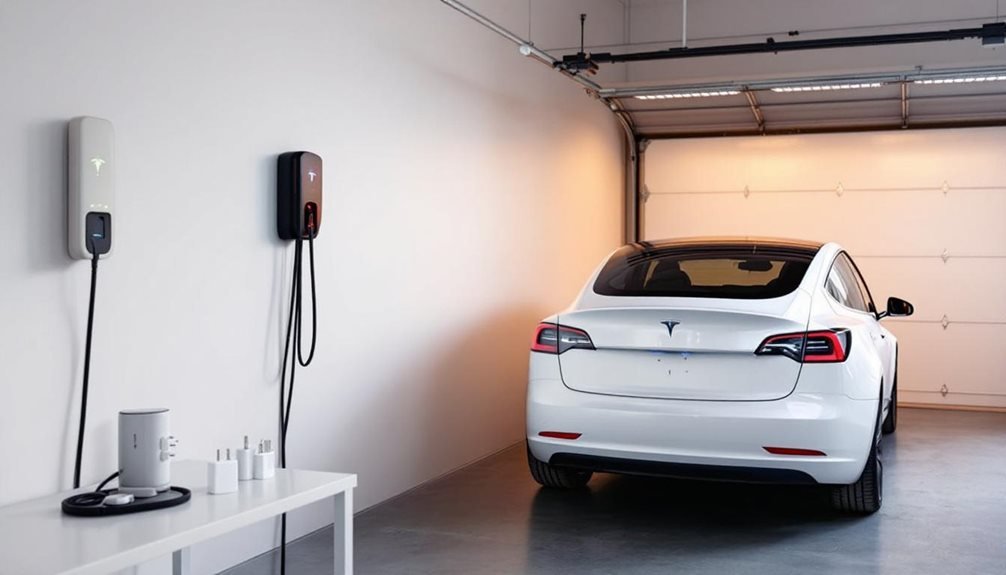
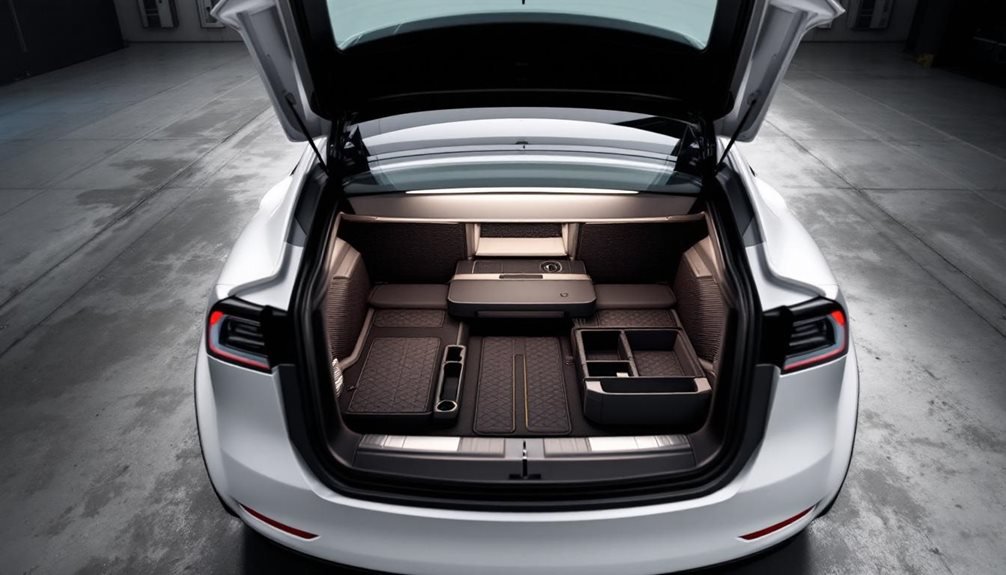
Tesla’s Mobile Connector ($250-$550) handles basic charging needs with 4-5 miles per hour on 110V or 30-40 miles per hour on 240V setups. Tesla’s Wall Connector offers faster speeds but requires installation costs. Third-party options like WiseCar’s systems deliver up to 22 kW with better features and value. Only Cybertrucks get vehicle-to-home backup power—other Tesla models are stuck with one-way charging. Federal tax credits can slash costs by 30%, making home setups more palatable for those willing to investigate deeper.
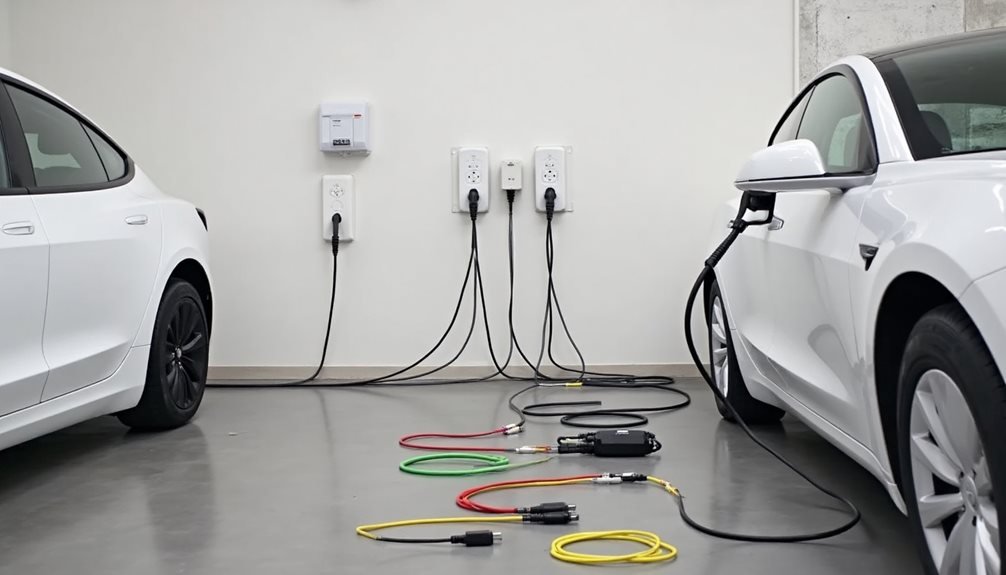
Tesla owners face a surprisingly messy terrain when it comes to home charging. The days of bundled charging cables are gone. Tesla now sells their Mobile Connector separately for $250–$550, leaving new owners scrambling to figure out what they actually need.
Tesla’s $250-550 Mobile Connector nickel-and-diming leaves new owners drowning in charging confusion where simplicity once reigned.
The Mobile Connector handles both 110V and 240V setups, making it the Swiss Army knife of Tesla charging. Level 1 charging crawls along at 4-5 miles per hour—fine if you’re not going anywhere fast. Level 2 bumps that up to 30-40 miles per hour with proper 240V systems. It’s portable, which matters if you’re renting or moving frequently.
Tesla’s Wall Connector represents their stationary solution, designed for 240V systems and faster charging speeds than the Mobile Connector. But here’s where things get weird. Vehicle-to-home backup only works with Cybertrucks and Tesla’s Magic Dock setup. Model S, X, 3, and Y owners are out of luck, despite paying premium prices for their vehicles.
Third-party options shake things up considerably. WiseCar’s WTP3 delivers 22 kW of portable power, compatible with Tesla vehicles through swappable charging tails. Their WT3 Smart offers 11 kW with app controls and scheduling features. The WTPS3 Premium pushes 22 kW for users wanting maximum speed and fancy features.
Amperage determines everything. Standard 16A systems limit efficiency, while 32A setups *enable* 7.7 kW charging speeds. Single-phase systems cap most Tesla vehicles below their potential, though three-phase options exist for power users. CCS Combo 2 ports in Tesla Model 3/Y vehicles handle both AC home charging and DC fast charging through the same connection point.
Model 3 and Y owners can fully charge in 4-7 hours with proper 240V/50A configurations. While charging at home, Tesla owners can also utilize the Tesla mobile app for other vehicle functions like remotely moving the car in and out of tight parking spaces.
The Cybertruck stands alone with legitimate V2H capability through Tesla’s Universal Wall Connector. Combined with Solar and Powerwall systems, it creates genuine grid independence. Other Tesla models might gain this feature post-2025, but current owners remain stuck with one-way charging.
Portable chargers eliminate installation headaches and costs. They’re perfect for temporary solutions or renters who can’t modify electrical systems. Tesla’s third-party adapter support allows optimization through different amperage tails—10A, 15A, and 32A options exist for various situations. Federal tax incentives can reduce the total cost of charging equipment and installation by 30 percent, making dedicated charging setups more affordable for homeowners.
Frequently Asked Questions
How Much Does It Cost to Install a Tesla Home Charger?
Installing a Tesla home charger typically costs $1,000 to $2,500 total.
The Wall Connector hardware runs $400-$600, while installation labor adds another $750-$1,500.
But here’s the kicker – complex scenarios can hit $7,000 if your home needs electrical upgrades or trenching.
Distance matters too. Longer wiring runs mean higher labor costs.
Don’t forget permits, which tack on $100-$300 more.
Can I Claim Tax Credits for Tesla Home Charger Installation?
Tesla owners can claim a 30% federal tax credit on home charger installations, capped at $1,000 per household. The credit covers hardware and installation costs through December 2032.
They’ll need IRS Form 8911 and all receipts. No income restrictions apply for residential installations.
Even bidirectional chargers qualify. State rebates might stack on top, making the deal sweeter.
What Electrical Requirements Are Needed for Tesla Home Charging?
Tesla charging needs vary dramatically by setup. Level 1 uses standard 120V outlets but crawls at 2-3 miles per hour—painfully slow.
Level 2 demands 240V outlets with 50A or 60A breakers for decent 10-30 mph speeds.
Wall Connectors require dedicated circuits and 60A wiring.
Professional installation runs $750-$1,500 for new outlets.
Don’t mess around—electricians handle permits and code compliance.
How Long Does Tesla Home Charger Installation Typically Take?
Tesla home charger installation typically takes several hours, depending on complexity.
Simple setups near electrical panels with existing wiring? Maybe 2-3 hours.
Complex scenarios involving trenching, panel upgrades, or multiple chargers? You’re looking at a full day.
Most standard installations fall somewhere in between.
Wire run length, electrical infrastructure age, and site preparation all affect timing.
Don’t attempt DIY installations.
Will a Tesla Home Charger Work With Other Electric Vehicles?
Tesla home chargers have a complicated relationship with other EVs. Generation 1 units work with non-Tesla vehicles if someone fiddles with physical switches.
Generation 2? Nope, Tesla-only club.
Generation 3 chargers can be configured during installation to play nice with all EVs. Otherwise, owners need adapters like Lectron NACS-to-J1772 or TeslaTap.
It’s feasible, just not always straightforward.