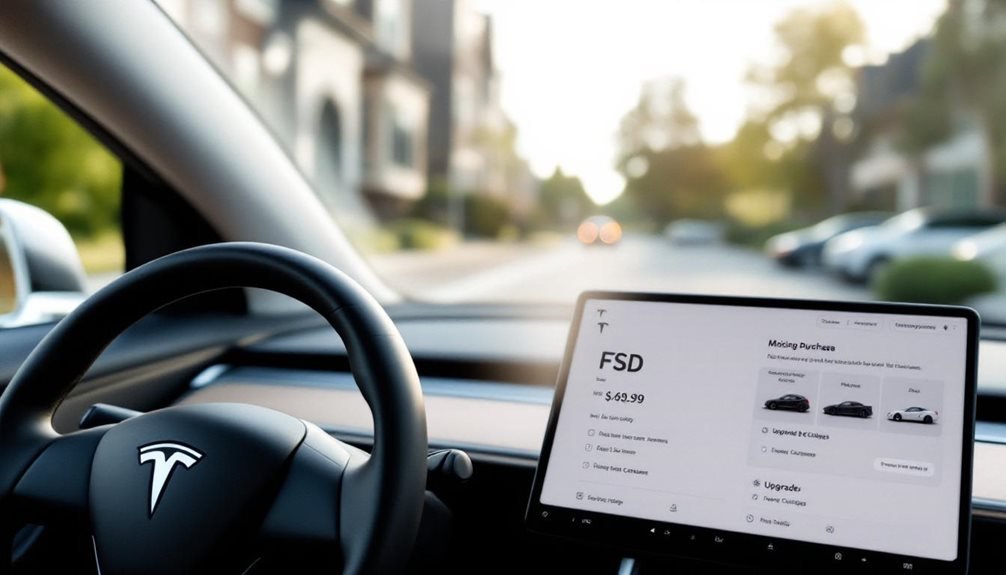
Yes, Tesla owners can buy Full Self-Driving later through the Tesla app, though it’ll cost anywhere from $2,000 to $22,000 depending on their current package. There’s also a $199 monthly subscription for those who prefer not to commit. The catch? Vehicles need Autopilot Hardware 3 or newer, and older cars are simply out of luck. The process involves some complexity and bureaucratic obstacles that reveal just how intricate Tesla’s FSD ecosystem really gets.
How exactly does Tesla’s Full Self-Driving transfer program work, and why are so many owners scratching their heads over the fine print? The answer isn’t pretty. Tesla’s FSD transfer system reads like legal gibberish designed to confuse even seasoned owners. Many owners are left frustrated, wondering how to set up tesla fsd while navigating through convoluted terms and conditions. This lack of clarity makes it challenging for users to understand their rights and options regarding the transfer of software licenses. As a result, potential confusion often leads to mixed feelings about the value of the feature itself.
Here’s the brutal reality: you can absolutely buy FSD later, but Tesla makes it deliberately complicated. Want to add FSD to your existing Tesla? No problem. Pull out your phone, open the Tesla app, and prepare to fork over anywhere from $2,000 to $22,000 depending on what Autopilot package you already have. The monthly subscription route costs $199 per month if you’re not ready to commit to that eye-watering lump sum. It’s worth noting that while the pricing may seem steep, understanding the options available can make the process more manageable. For those considering a purchase, “negotiating tesla prices explained” can provide valuable insights into securing the best deal possible. Additionally, exploring community forums and Tesla’s official resources can help demystify the decision-making process. Moreover, potential buyers should consider how their decision will impact long-term costs, including how Tesla affects electric bills for daily charging. It’s essential to factor in these additional expenses when budgeting for ownership, as the savings from fuel can offset the initial investment. Overall, a comprehensive understanding of both FSD pricing and ongoing costs can lead to a more informed and satisfying ownership experience.
But wait, there’s more fine print. Your car needs Autopilot Hardware 3 or newer. Older vehicles? Tough luck. Tesla won’t magically upgrade your ancient hardware just because you’re waving cash around. Additionally, even if your vehicle meets the hardware requirements, you’ll need to weigh the pros and cons of Tesla ownership. While many appreciate the seamless updates and cutting-edge technology, others find the limitations frustrating. So, before diving into that cash offer, consider what you’re truly getting—and what you might be leaving behind. Moreover, if you’re eyeing enhancements like the Tesla Acceleration Boost, it’s essential to ensure that your model supports such upgrades. For those unfamiliar, ‘tesla acceleration boost explained‘ provides insight into how this feature can significantly enhance your driving experience, but it’s not universally available to all models. Before making any commitments, it’s wise to research these features thoroughly to ensure they align with your expectations. Furthermore, Tesla vehicles come with unique features such as the tesla bioweapon defense mode features, which provide unparalleled protection against environmental hazards. This may be a game-changer for those who prioritize safety and health in polluted urban environments. However, it’s essential to evaluate if these advanced functionalities align with your lifestyle and driving needs. Moreover, there’s the everyday upkeep to think about, such as replacing your Tesla key fob battery when it runs low. Neglecting these small details can lead to unexpected inconveniences, even in a luxury vehicle. So, ensure you’re prepared for both the exhilarating and mundane aspects of Tesla ownership.
The transfer program sounds generous until you read the requirements. Only vehicles delivered between October 10 and December 31, 2024, qualify for transfers to newer models. Miss that window? You’re buying FSD all over again. The kicker? You must own your current vehicle outright—no leases, no commercial vehicles, no exceptions. Once the transfer completes, it becomes permanently irreversible, making this a one-way decision with lasting consequences.
Transferring FSD strips your original car of all advanced features. It reverts to basic Autopilot, making your old Tesla feel like a technological relic overnight. Want FSD on both vehicles? Pay twice. Tesla isn’t running a charity here.
The subscription model offers an escape hatch for commitment-phobic buyers. Monthly billing, no long-term contracts, and you can cancel whenever reality hits your bank account. Trial periods occasionally pop up, usually after Tesla events when the marketing machine needs feeding. After completing your FSD purchase, expect an automated reboot to activate the full self-driving features.
Despite all the hype, FSD still requires constant driver supervision. Hands must remain ready to take control, making “Full Self-Driving” feel like false advertising. FSD includes features like Actually Smart Summon which allows the car to navigate around obstacles to come to you within 279 feet using the mobile app. The software improves through over-the-air updates, but full autonomy remains a distant promise dependent on regulatory approval and reliability benchmarks that don’t exist yet.
Planning to buy FSD later requires precise timing, deep pockets, and patience for Tesla’s bureaucratic maze.
Frequently Asked Questions
Does FSD Transfer to a New Tesla if I Trade in My Current Vehicle?
FSD can transfer to a new Tesla when trading in, but only during specific windows Tesla decides to offer.
Both vehicles must be under the same Tesla account, and the new car needs delivery within Tesla’s designated timeframe.
Here’s the kicker: the traded vehicle permanently loses FSD features, reverting to basic Autopilot.
Tesla doesn’t guarantee these transfer programs will continue.
Can I Get a Refund if FSD Doesn’t Meet My Expectations?
Tesla rarely offers FSD refunds voluntarily. The company typically sends standardized denial messages when customers request their money back.
A 48-hour refund window exists for Enhanced Autopilot through the app, but FSD doesn’t receive the same treatment.
Disappointed buyers often turn to arbitration, small claims court, or legal action.
International customers might have better luck due to stronger consumer protection laws in their regions.
Will FSD Prices Continue to Increase Over Time?
FSD prices have been all over the map. Started at $7,000, hit $15,000 by 2023, then dropped to $6,000 for new cars and $4,500 for demos in 2024.
Musk keeps threatening massive price hikes to $100,000+ once “true autonomy” arrives. But his credibility is shot after missing deadline after deadline.
Future increases depend entirely on actually providing Level 5 autonomy, which remains uncertain.
Does Purchasing FSD Affect My Car Insurance Rates?
Purchasing FSD creates a mixed bag for insurance rates. Tesla’s own insurance offers up to 10% discounts for heavy FSD users, but only in Arizona and Texas.
Most third-party insurers? They don’t care about FSD discounts. Actually, some charge more for Teslas due to expensive repairs and parts.
The $8,000 FSD cost likely outweighs any insurance savings anyway.
Can I Share FSD With Family Members Who Drive My Tesla?
Yeah, family members can use FSD if they’re driving the same Tesla. It’s tied to the vehicle, not the driver. So everyone gets access without paying extra fees. Pretty straightforward, actually.
But here’s the catch – they can’t take FSD features to another car, even if it’s also in the family. Each vehicle needs its own FSD purchase or subscription.