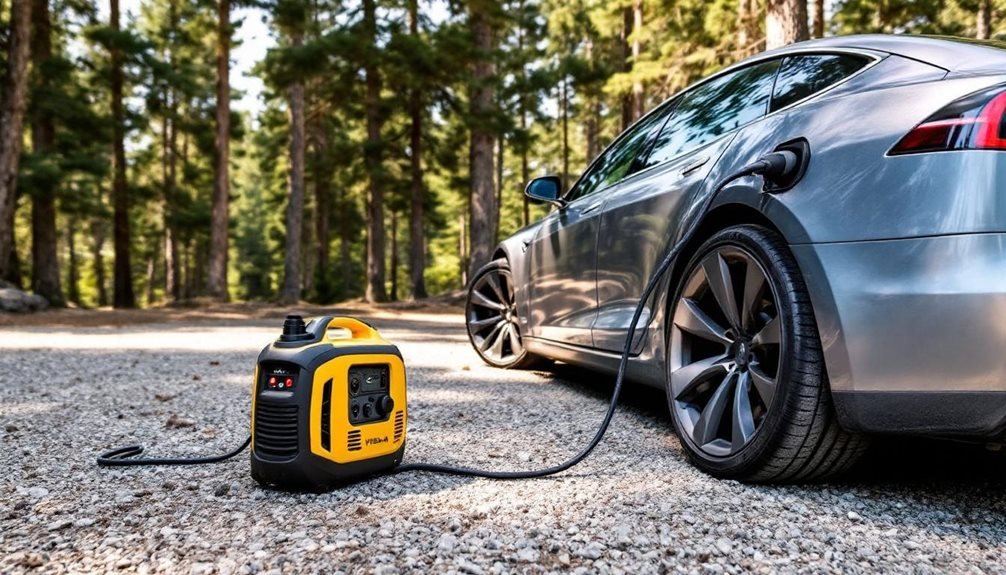
Yes, you can charge a Tesla with a generator, though it’s hardly the stuff of electric vehicle dreams. Generators producing 110-240V AC work with Tesla’s mobile adapter, but expect glacial charging speeds of 3-30 miles per hour depending on voltage. You’ll need at least 2,500 watts of continuous power, proper safety equipment, and realistic expectations. It’s fundamentally using fossil fuels to charge your eco-friendly car. Think emergency backup, not road trip solution. The details reveal why this method has serious limitations.
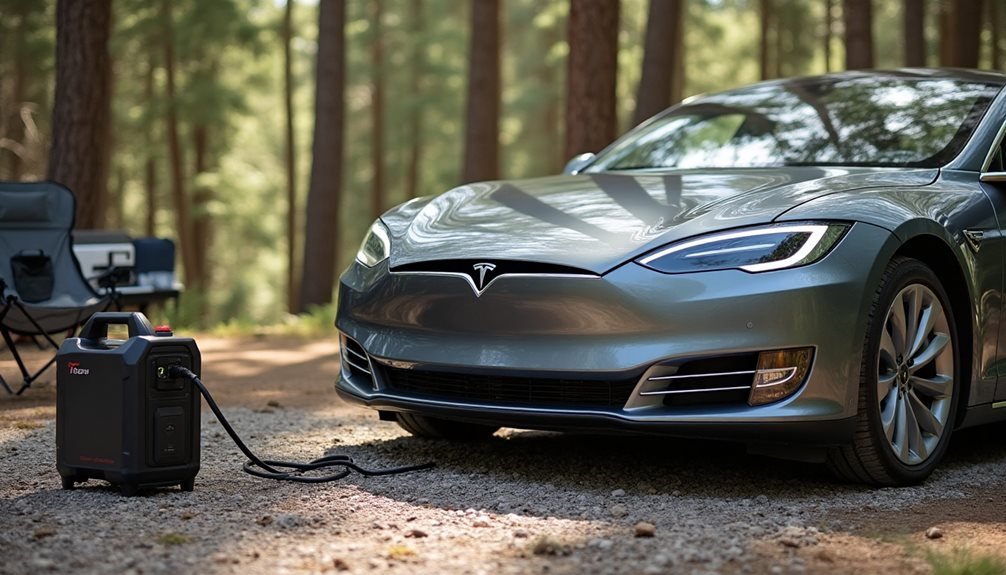
Why would anyone want to charge a Tesla with a generator? Power outages happen. Remote camping trips beckon. Sometimes the grid fails, and Tesla owners need backup plans that don’t involve hitchhiking.
Charging a Tesla with a generator is absolutely possible, though it’s not exactly rocket science. Any generator producing 110-240V AC can juice up these electric vehicles through Level 1 or Level 2 charging. The catch? The generator needs serious muscle—at least 2,500 to 4,000 watts to make charging worthwhile.
Most generators top out around 7,000 watts, which limits charging speeds even with ideal setups. Tesla’s onboard charger handles the AC-to-DC conversion since generators can’t supply DC power directly. It’s like using a translator between two languages that don’t quite mesh.
Speed varies dramatically depending on voltage. Hook up to 120V through a standard NEMA 5-15 outlet, and expect a crawling 3 miles of range per hour. Bump up to 240V with a NEMA 14-50 outlet, and charging jumps to around 30 miles per hour. Still nowhere near Tesla Supercharger speeds, but respectable for emergency situations.
The equipment list is straightforward. Tesla’s mobile adapter is essential for connecting to generator outlets. Surge protectors and GFCI outlets help prevent electrical disasters. Heavy-duty cables rated for high current flows keep things safe. Load testing ensures the generator can actually deliver promised wattage continuously. Inverter generators provide the cleanest power output for safer Tesla charging compatibility.
Safety matters more than convenience here. Generators belong outdoors—carbon monoxide kills. Proper grounding prevents shocks. Fire extinguishers should be nearby because fuel and electricity make volatile companions. Never exceed the generator’s continuous power rating unless thermal shutdowns sound appealing. Tesla vehicles feature comprehensive protection systems including multiple airbags and intelligent sensors that activate during impacts to unlock doors and disable high voltage systems.
The efficiency numbers are brutal. Generators convert roughly 20% of fuel energy into usable charging power. It’s environmentally contradictory—burning fossil fuels to power an electric vehicle defeats much of the sustainability purpose. While some have attempted generator-powered road trips, these experiments prove that energy consumption typically exceeds generator output.
Practical applications include power outages, off-grid living, camping escapades, disaster preparedness, and remote worksites. Generator charging works best for emergency top-ups rather than full battery replenishment. Think 20-50% charges, not zero-to-full sessions. It’s a backup plan, not a primary charging strategy.
Frequently Asked Questions
How Long Does It Take to Fully Charge a Tesla Using a Generator?
Charging a Tesla with a generator takes anywhere from 7 to 19 hours for a full charge, depending on the setup.
A basic 110V connection? You’re looking at nearly a full day.
Step up to 240V/50A and it drops to around 7-8 hours.
Most people find 240V/30A hits the sweet spot at 11-12 hours overnight.
The math is pretty straightforward once you factor in battery capacity.
What Size Generator Is Needed to Charge a Tesla Model 3?
A Tesla Model 3 needs at least a 3,500-4,000W generator for basic charging. But here’s the thing—30A capacity at 240V is where it gets interesting.
That setup delivers roughly 7 kW of charging power.
Smaller generators? Sure, they’ll work with 120V outlets, but expect glacial speeds.
Most experts recommend 8,000-10,000W generators for decent performance.
The car’s 11 kW onboard charger caps everything anyway.
Can Using a Generator Damage My Tesla’s Battery or Charging System?
Using a generator can absolutely damage Tesla’s battery or charging system. Dirty power from non-inverter generators stresses charging electronics with unstable voltage. Even inverter generators lack grid-level stability, triggering error corrections and unexpected shutdowns.
Improper grounding causes ground-fault errors, while voltage fluctuations strain power electronics. Lower charging speeds create inefficient energy conversion, risking thermal overload in Mobile Connectors.
Tesla’s systems weren’t designed for generator quirks.
Is It Legal to Charge a Tesla With a Generator in Public?
No U.S. laws explicitly ban generator-powered Tesla charging in public spaces. However, local ordinances often restrict generator use in parks and parking lots.
Public charging stations aren’t designed for generator hookups anyway. Safety regulations require proper ventilation to prevent carbon monoxide poisoning, and most public areas lack designated generator zones.
Plus, permits may be required for operating generators in public parking areas.
How Much Does It Cost to Charge a Tesla With Gasoline Generator?
Charging a Tesla with a gasoline generator costs roughly $0.35 per mile, about seven times more expensive than grid charging at $0.03-$0.05 per mile.
One gallon of gas produces approximately 10 miles of Tesla range after efficiency losses. So adding 100 miles costs around $35 in fuel.
It’s basically paying gas prices to drive an electric car—defeating the whole point economically.