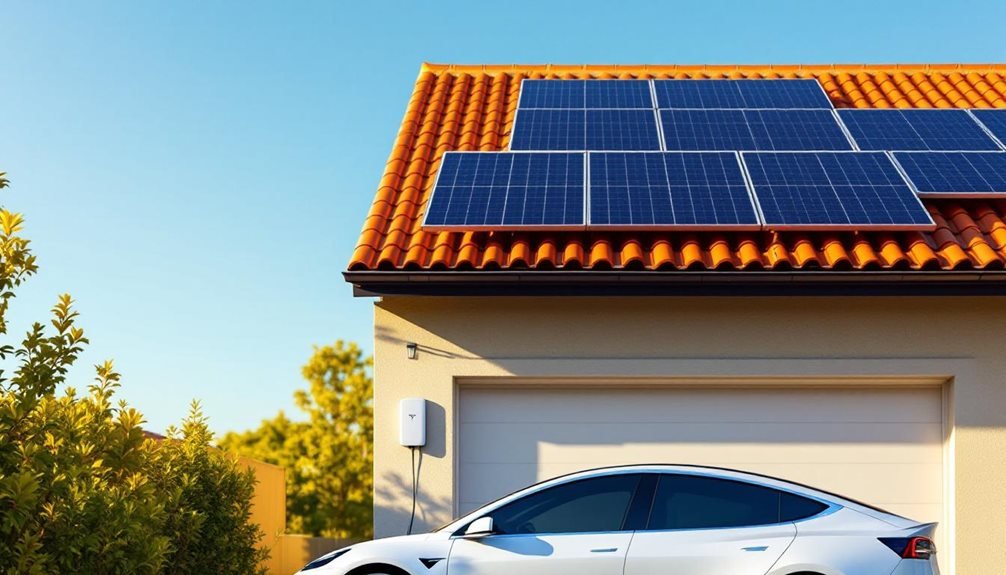
Tesla owners can efficiently charge their vehicles with solar power by installing a home solar system with at least 56-75 panels for Model Y/X and using Tesla’s app to set charging preferences. The system requires 1.2kW of stable excess solar generation to activate solar-only mode, operates at 85-90% efficiency, and automatically switches to grid power when solar output drops. South-facing panels maximize sunlight capture, though weather and shading impact performance. Grasping the complete setup process reveals additional optimization strategies.
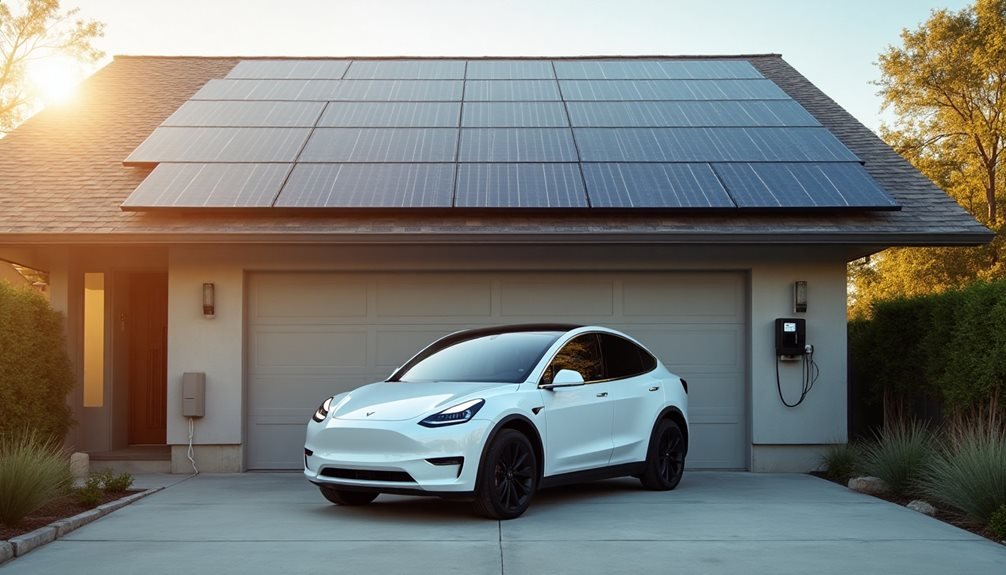
Why settle for charging a Tesla with dirty grid power when the sun offers a cleaner alternative? Solar charging metamorphoses sunlight into miles, though it’s not as simple as slapping panels on the roof and calling it a day.
Tesla’s solar charging feature uses a sun slider in the app to prioritize solar energy. Set a base charge limit, and the vehicle automatically switches to solar-only mode once it exceeds that threshold. Pretty clever, actually.
Tesla’s app sun slider lets you set solar-only charging above your base limit—elegantly simple tech that actually works.
The system allows grid charging to resume if solar output drops below required levels, preventing drivers from getting stranded with a dead battery.
The math gets interesting when calculating panel requirements. A Tesla Model Y or X needs roughly 56 to 75 panels at 300 watts each, assuming five hours of daily sunlight. That’s a lot of real estate.
Under ideal conditions, smaller systems might get away with just 10 panels, but “ideal” rarely happens in the real world.
Essential components include inverters that convert DC solar energy to AC for Tesla compatibility, battery storage systems like Powerwall for energy stabilization, and dedicated 240V charging stations.
South-facing panel orientation maximizes sunlight absorption because physics doesn’t negotiate.
Smart charging strategies prioritize daytime charging to align with peak solar generation. Use excess solar energy first, with grid backup for consistency. The feature requires at least 1.2kW of stable excess solar generation before charging begins.
Weather-dependent generation limits reliability in cloudy climates, which explains why Seattle residents need larger systems than Phoenix dwellers.
Efficiency hovers around 85 to 90 percent due to AC/DC conversions and system losses. That’s the price of playing with electrons.
Charging speeds lag behind Superchargers since Level 2 charging can’t match DC fast charging, but patience pays environmental dividends. Fully charging a Tesla takes less than eight days at the longest, though most drivers rarely deplete their entire battery capacity.
Location matters enormously. Regional weather patterns determine system sizing requirements, while local regulations govern grid interconnections and permits.
Minimize shading or watch efficiency plummet faster than a lead balloon.
Maintenance involves regular panel cleaning and battery system upkeep. Tesla’s app and inverter tools track performance, because data nerds need their numbers.
The upfront investment stings, but solar charging offers long-term benefits for drivers committed to reducing their carbon footprint. Unlike jump-starting other vehicles, which Tesla discourages due to potential damage to the 12-volt battery and electrical system, solar charging actually protects your Tesla’s components.
Frequently Asked Questions
Can I Charge My Tesla With Solar Panels During Cloudy Weather?
Yes, Tesla owners can charge their electric vehicles with solar panels during cloudy weather, though the experience isn’t exactly thrilling.
Solar panels generate only 10-25% of their normal output under cloud cover. That means charging times stretch from the usual 8 hours to several days.
Heavy rain can drop generation to zero entirely. It’s technically possible, just painfully slow and frustrating for impatient drivers.
How Much Does a Solar Panel System for Tesla Charging Cost?
A conventional Tesla solar panel system runs about $20,304 before incentives.
This drops to roughly $14,212 after the 30% federal tax credit.
That’s around $2.82 per watt.
For dedicated Tesla charging, expect to need 8-10 extra panels beyond typical home usage—figure a 6-8 kW system.
Want battery storage? Add another $15,400 for a Powerwall.
The fancy Solar Roof? That’s $106,000 total.
Will Charging My Tesla Drain My Home’s Solar Power Supply?
Charging a Tesla will absolutely drain a home’s solar power supply if the system wasn’t sized for both household and vehicle needs.
A Tesla Model 3 demands roughly 11.3 kWh daily for 40 miles of driving.
Most existing residential solar arrays weren’t designed with EVs in mind, so they’ll come up short.
Without battery storage or additional panels, homeowners will pull from the grid during charging periods.
Can I Use Portable Solar Panels to Charge My Tesla While Traveling?
Yes, but don’t expect miracles. Portable solar panels generate 600-1,000 watts, providing maybe 6-8 miles per hour in perfect sunlight. That drops to a pathetic 1-2 mph when cloudy.
You’ll need a micro-inverter for Tesla compatibility. Aerodynamic drag from mounted panels actually hurts efficiency while driving.
Better to use removable panels during stops. It’s supplemental charging at best—think 20-40 miles daily in ideal desert conditions.
How Long Does It Take to Charge Tesla Using Only Solar Power?
Charging a Tesla with solar alone takes anywhere from 8 to 48+ hours for a full charge, depending on the model. A Model S with its 100 kWh battery needs more juice than a Model Y’s 75 kWh.
Weather matters too—winter conditions can double charging times compared to summer.
Most people don’t sit around waiting for full solar charges anyway; they top off partially discharged batteries instead.