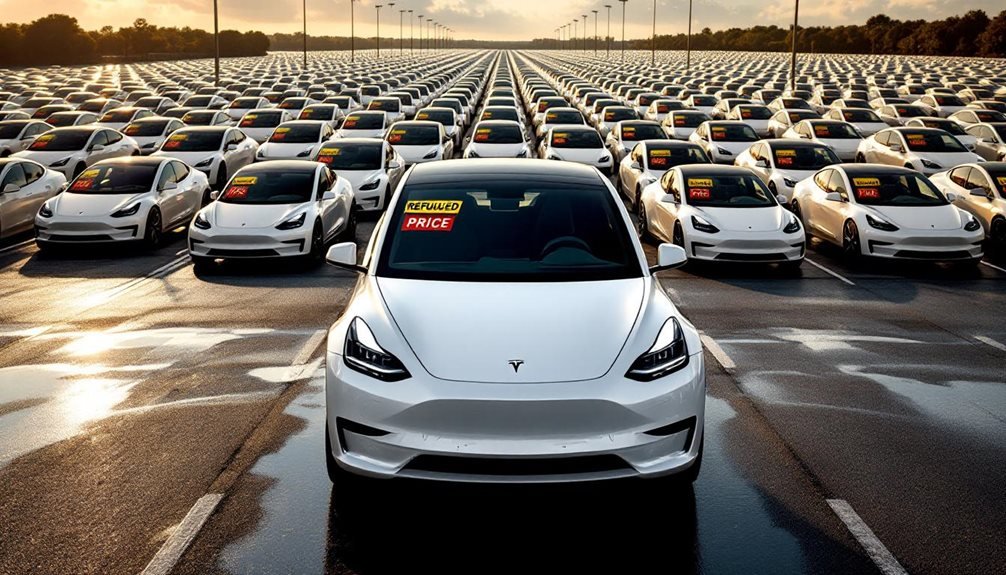
Tesla vehicles are experiencing a brutal resale value collapse that makes traditional gas cars look like financial geniuses. Resale values plummeted 27% year-over-year in 2025, with the Cybertruck losing 35% of its value since release. Tesla models now depreciate twice as fast as Ford Mustangs and a staggering 70 times faster than Chevrolet vehicles. The Model S hemorrhages $52,165 over five years. Several factors fuel this depreciation nightmare, which we’ll investigate further.
The Tesla value retention story has taken a brutal turn. Used Tesla resale values plummeted 27% year-over-year in 2025, making previous claims about Tesla’s superior value retention look laughable.
Tesla’s supposedly rock-solid resale values have completely collapsed, exposing the myth of electric vehicle investment protection.
The Cybertruck, Elon’s angular fever dream, lost 35% of its value since release. So much for revolutionary design.
Model Y prices dropped 25.5% in 2024 alone. That’s worse than most gas-guzzling ICE vehicles, which is saying something.
Tesla inventory surged 31% year-over-year, creating a glut that hammers resale values. Trade-ins for Cybertrucks were literally halted because nobody wants them.
The comparison with traditional vehicles is stark. Tesla depreciation hit 28.9% year-over-year while Chevy actually gained 0.4%. Tesla models lose twice the value of Ford Mustangs or Nissan Maximas.
The math is brutal: Tesla depreciates 70 times faster than Chevy. A Model S lost $52,165 over five years, far exceeding typical ICE losses.
Even in the EV space, Tesla struggles. The Porsche Taycan retained 60.1% of its value over 10 years, making it look like a bargain compared to Tesla’s steep declines.
Used EV prices fell 2.8% in April 2025, but Tesla’s drops were more pronounced.
Long-term patterns reveal the damage. Model Y owners watched $36,825 evaporate over five years, representing 60.4% of the original price.
Model 3 and Y had the steepest depreciation among all vehicles analyzed in 2024. Tesla vehicles typically depreciate about 60% of MSRP over the first five years, with trade-in values varying significantly by condition, mileage, and location.
Battery degradation concerns and Tesla’s rapid tech cycles create uncertainty about future values.
Several factors drive this decline. Oversupply floods the market, especially for Model Y SUVs.
Rapid technological advancements make older models obsolete quickly.
Battery health worries spook buyers, and Tesla’s limited service network compared to traditional automakers hurts confidence.
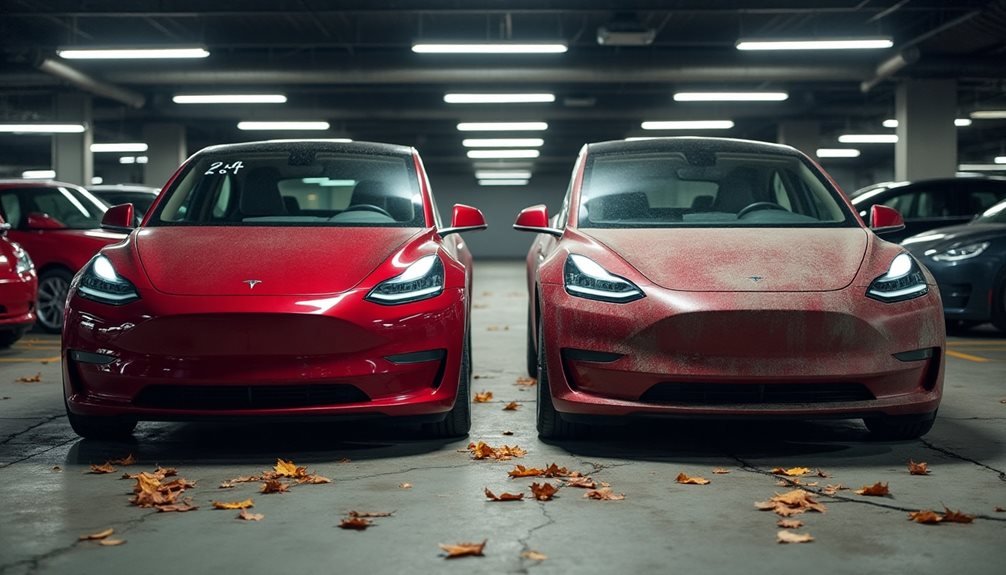
Software-dependent features create market volatility as updates alter capabilities. Nearly 50% of Tesla owners report intentional vandalism linked to anti-Elon Musk sentiment, further complicating resale prospects.
Interestingly, some studies still claim Tesla holds value better than average due to brand loyalty. Recent data suggests otherwise. Tesla’s minimal maintenance requirements compared to ICE vehicles create some offsetting benefits for long-term owners.
The contrast between long-term studies and current trends shows divergent outcomes.
Tesla’s value course faces challenges from EV market saturation, contradicting earlier optimistic projections about electric vehicle value retention.
Frequently Asked Questions
How Does Tesla’s Resale Value Compare to Luxury Gas Vehicles?
Tesla’s resale value gets crushed by luxury gas vehicles. The Model 3 manages only 37.3% retention while Toyota Tacoma leads at 64.1%.
Even the Mercedes G-Class at 56.6% demolishes Tesla’s performance.
Model S and X fare slightly better initially but still trail markedly.
By year 10, both lose nearly 80% of their value.
Which Tesla Model Retains the Highest Percentage of Its Value?
Among Tesla’s lineup, the Model 3 surprisingly retains the highest percentage of its value at 37.3% after five years. That’s not exactly impressive, but it beats the Model Y’s dismal 30.7% retention and the Model S’s catastrophic 34.8% retention (losing 65.2% of value).
The Cybertruck? It’s already down 35% since launch.
Tesla’s value retention across all models is frankly underwhelming compared to luxury competitors.
Do Tesla Software Updates Affect the Car’s Resale Price?
Tesla software updates absolutely elevate resale prices. Cars with full OTA update histories command higher prices because buyers know they’re getting the latest features.
Updates add serious value—Steam gaming and Apple Music appeared on older Model S/X vehicles through software alone.
FSD capabilities can add $10K-$20K premiums.
Smart buyers verify update records before purchasing.
It’s free money, basically.
How Does Battery Degradation Impact Tesla’s Long-Term Value Retention?
Battery degradation hits Tesla values, but not as brutally as expected. Model S and X lose just 12% capacity after 200,000 miles, while newer Model 3/Y suffer 15% degradation.
Ironically, older Teslas often outperform newer ones. The 8-year warranty cushions resale fears, and transparent battery data helps buyers sleep better.
Tesla’s battery management systems prevent catastrophic drops that would tank values completely.
Are Used Teslas Under Warranty More Valuable Than Those Without?
Used Teslas with remaining warranty coverage command markedly higher resale values than those without protection. Buyers pay premiums for warranty security, especially given battery replacement costs ranging from $10,000 to $25,000.
The 4-year/50,000-mile basic warranty transfers to new owners. But here’s the kicker – battery warranties don’t transfer under Extended Service Plans.
CPO vehicles maintain full manufacturer coverage, making them considerably more precious than regular used models.