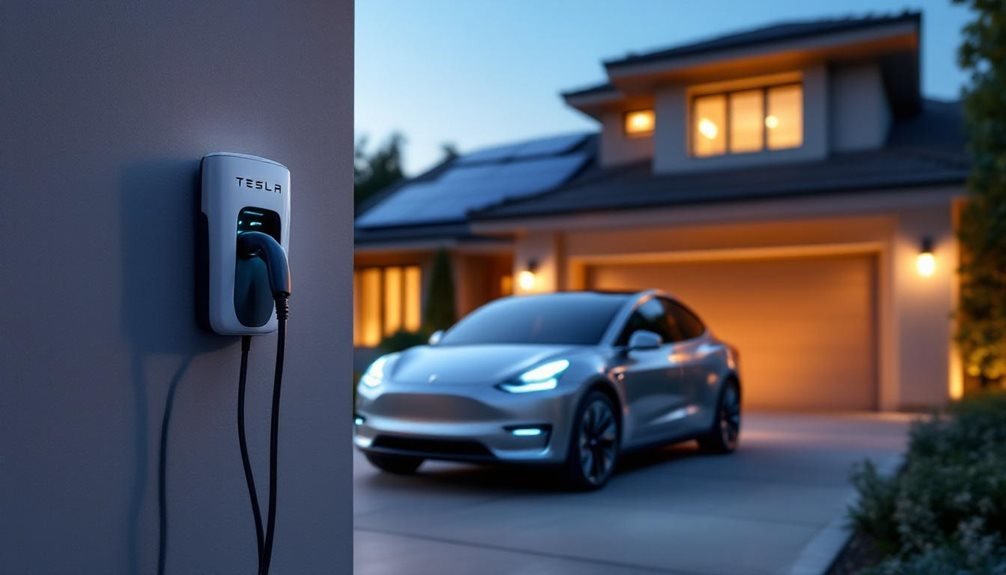
Yes, Tesla owners pay to charge their cars. Home charging costs between $10.98 and $18.00 per full battery, depending on the model. Public Superchargers are pricier, ranging from $13 to over $70 per charge. There’s no free lunch here. Even with solar panels, Tesla owners still pay upfront installation costs. The good news? Charging averages $0.04 per mile compared to gas cars at $0.13 per mile. The savings add up noticeably once you grasp the full image.
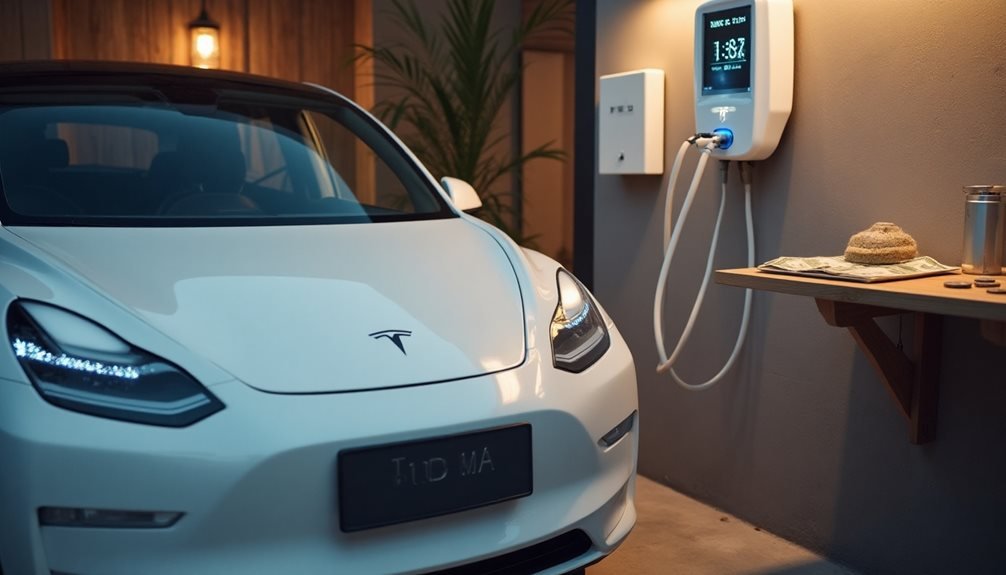
How much does it actually cost to charge a Tesla? The answer isn’t as simple as plugging in and hoping for the best. Home charging typically runs between $10.98 and $18.00 for a full battery, depending on which Tesla model is sitting in the driveway.
Tesla charging costs aren’t straightforward—home charging ranges from $10.98 to $18.00 per full battery depending on your model.
A Model Y with its 75 kWh battery costs about $13.20 to juice up at home, while the hulking Model X demands $17.55 with its 100 kWh appetite.
Here’s the kicker: charging isn’t perfectly efficient. Tesla owners need 15-20% more electricity than the battery’s actual capacity due to energy losses during the charging process. Physics, apparently, still applies to electric vehicles.
Public charging tells a different story entirely. Superchargers and other DC fast charging stations can cost anywhere from $13 to over $70 for a full charge. The pricing schemes vary wildly—some charge per minute at $0.28 to $0.60, others go by kilowatt-hour at $0.38 to $0.88.
Network fees and taxes tack on another $1 to $5 because, naturally, convenience costs extra.
The comparison to gas vehicles reveals where Tesla owners actually win. Charging costs about $0.04 per mile versus $0.13 per mile for gas cars—a 64% reduction that translates to $1,800+ in annual savings for heavy drivers. Monthly expenses typically run between $39 and $57 for most Tesla models, representing a fraction of traditional gasoline costs.
Per 100 miles, Tesla EVs cost $3.98 to $5.30 while gas vehicles demand $20 to $30.
Solar panels change the game completely. With solar charging dropping costs to $0.06 per kWh, monthly expenses can shrink by $150 or more. Tesla’s Powerwall integration makes this even smoother for those willing to invest upfront. A 6 kW solar system pays for itself over time by generating 6,130-10,500 kWh annually.
Location and timing matter notably. Urban electricity rates typically exceed rural ones, and time-of-use plans reward overnight charging during off-peak hours between 10 PM and 5 AM.
Cold weather reduces efficiency slightly but doesn’t kill the cost advantage.
The average U.S. electricity rate sits at $0.15 per kWh, though regional differences between states like California and Texas create substantial variations. These operational savings become especially important given that Tesla vehicles typically experience 60% depreciation over their first five years.
Tesla’s routing system adjusts routes to prioritize Superchargers, though that convenience comes with premium pricing.
Frequently Asked Questions
How Long Does It Take to Fully Charge a Tesla?
Tesla charging time depends entirely on the method used. Superchargers blast to 80% in about 15 minutes at 250 kW.
Home wall connectors take 5-8 hours for a full charge.
Standard 120V outlets? Forget it. That’s a painful 48-hour ordeal for a full charge.
Most owners stick with overnight home charging or quick Supercharger stops during road trips.
Can You Charge a Tesla With a Regular Household Outlet?
Yes, Teslas can charge from regular household outlets, but it’s painfully slow. The Mobile Connector plugs into standard 120V outlets, crawling along at roughly 2-3 miles per hour. That’s about 40 miles overnight if you’re lucky.
Tesla’s proprietary hardware is mandatory—no fancy adapters, no shortcuts.
For anything beyond light supplemental charging, that regular outlet becomes more frustrating than helpful. It works, barely.
What Happens if a Tesla Runs Out of Battery While Driving?
When a Tesla’s battery dies while driving, the car doesn’t just suddenly stop. It gives plenty of warnings first – dashboard alerts, reduced performance, suggestions for nearby charging stations.
Eventually though, it’ll enter “tow mode” and shut down. The driver needs to contact Tesla Roadside Assistance and sit tight.
Pretty inconvenient, but the car tries hard to prevent this scenario from happening.
Do Tesla Charging Stations Work for Other Electric Vehicle Brands?
Tesla Superchargers now work with other EVs, but there’s a catch. Only select stations are open to non-Tesla vehicles, and drivers need the Tesla app plus compatible CCS or NACS ports. Sorry, Nissan Leaf owners—you’re out of luck with CHAdeMO connectors.
Ford, GM, Hyundai, and Rivian vehicles can access these stations. Many brands are transitioning to NACS ports by 2025, making adapters unnecessary.
Is It Cheaper to Charge a Tesla at Home or Public Stations?
Home charging absolutely destroys public stations on cost. Tesla owners pay $10.98-$18.00 to fill up at home, while Superchargers can hit $70 with peak pricing. That’s brutal.
Home charging cuts fuel costs in half compared to gas cars, potentially saving $1,800 annually.
Public charging? It basically kills long-term savings.
Solar drops costs to six cents per kWh. Home wins, period.