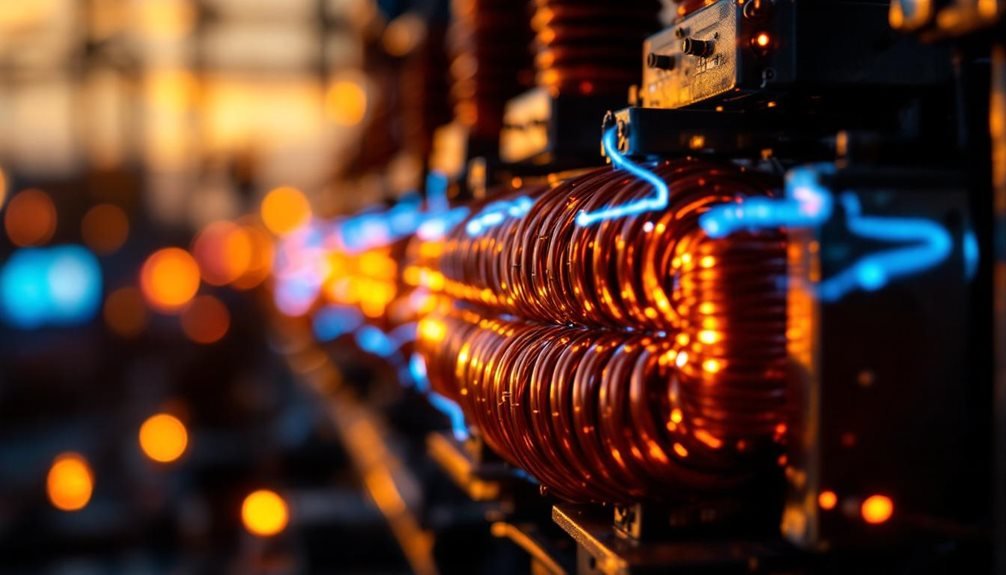

Tesla’s AC system works by making electrical current flip direction 50-60 times per second, which sounds insane but is actually genius. This rapid reversing allows transformers to easily bump voltage up to 100,000+ volts for long-distance transmission, then step it back down to safe 120 volts for your toaster. Unlike Edison’s DC current that flows one way like a lazy river, AC’s constant oscillation creates the magnetic flux changes transformers need to function efficiently, enabling global power grids that would make Tesla smirk at his former boss.
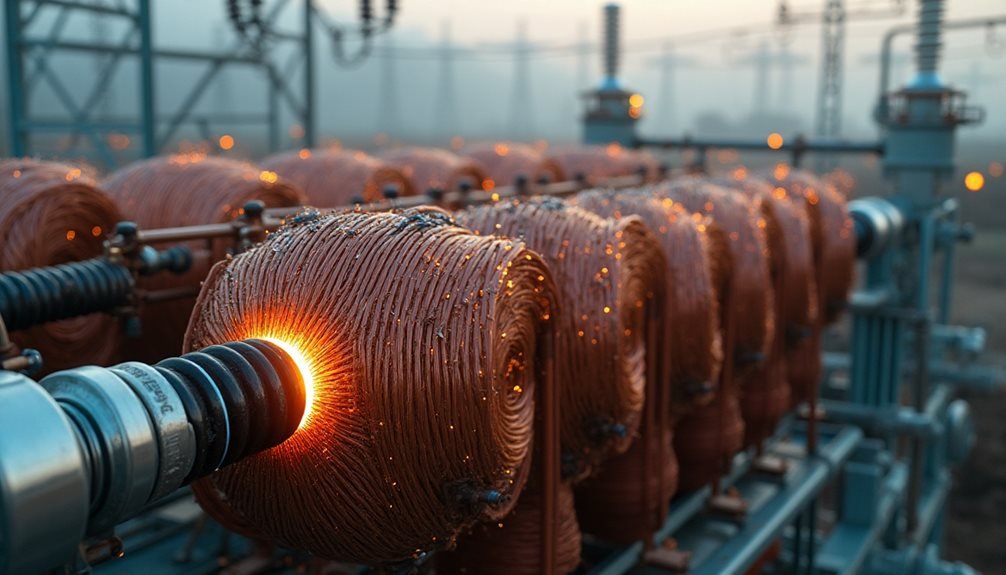
While Edison was busy promoting his direct current system like a carnival barker, Nikola Tesla was quietly reforming how electricity would power the world. Tesla’s alternating current system wasn’t just different—it was superior in every way that mattered.
Tesla’s quiet genius revolutionized electricity while Edison played carnival barker—proving superior innovation speaks louder than flashy promotion.
The magic happens because AC reverses direction rapidly, cycling back and forth 50 to 60 times per second. This constant flip-flopping might seem chaotic, but it’s precisely what makes transformers possible. DC flows in one direction like a stubborn river. AC dances, and that dance changes everything.
Transformers are the unsung heroes of Tesla’s system. They use multiple coils wrapped around iron cores, leveraging time-varying magnetic flux to step voltage up or down. These transformers play a crucial role in managing power distribution, ensuring that energy is efficiently converted to meet the varying demands of Tesla’s electric vehicles. In addition to this, understanding the Tesla mobile connector overview helps users to comprehend how these systems integrate with charging solutions, providing optimal performance in everyday use. The seamless operation of transformers ultimately contributes to the overall efficiency and reliability of Tesla’s innovative technology.
Power plants crank up the voltage for long-distance transmission, dramatically reducing energy loss. Then substations step it back down for safe home delivery. Simple. Brilliant.
Edison’s DC system had a fatal flaw—voltage drop over distance made it impractical for anything beyond city blocks. Tesla’s AC could travel continents without breaking a sweat. Higher voltages meant less energy wasted as heat, and polyphase systems provided balanced current flow that made engineers weep with joy.
The “War of Currents” wasn’t really a fair fight. Westinghouse smartly acquired Tesla’s patents while Edison threw public electrocution demonstrations like some macabre science fair. Tesla’s innovations included the Tesla Coil for high-frequency generation, brushless polyphase motors, and alternators that integrated beautifully with hydroelectric plants.
Tesla’s system didn’t just win—it obliterated the competition. AC powers everything from industrial machinery to neon signs blazing across city skylines. It enabled wireless communication technology and advanced X-ray generators that revolutionized medical imaging. Tesla’s early designs for electric motors became foundational to the entire power industry. Tesla also pioneered concepts for fluorescent lights that would later illuminate the modern world.
Today’s electrical grids spanning entire continents exist because Tesla understood something Edison missed. Electricity isn’t just about making light bulbs glow—it’s about efficient transmission across vast distances. Tesla’s AC system became the foundation for global electrification, proving that sometimes the quiet genius in the corner beats the loudest voice in the room. Modern home chargers for electric vehicles continue to rely on this same AC technology for efficient power delivery. As the world transitions to more sustainable energy solutions, understanding the evolution of electricity transmission remains crucial. The Tesla destination charging overview highlights the importance of strategically placed charging stations that utilize this AC technology, ensuring electric vehicles can access reliable and efficient power wherever they travel. This framework not only supports the growing demand for electric vehicles but also honors the visionary contributions of Tesla in shaping our modern electrical landscape. Tesla’s vision extended beyond mere lighting solutions; it paved the way for innovations like how Tesla Superchargers operate. These fast-charging stations harness the power of AC technology to deliver electricity swiftly and efficiently to electric vehicles. As a result, they exemplify the lasting impact of Tesla’s revolutionary ideas on today’s sustainable transportation systems.
The world runs on Tesla’s vision. Every time you flip a switch, you’re witnessing his reform in action.
Frequently Asked Questions
How Does AC Electricity Differ From DC Electricity in Practical Applications?
AC and DC electricity serve completely different purposes in real life.
AC dominates power grids because transformers make long-distance transmission efficient—something DC can’t do without expensive converters.
Your house runs on AC, but your phone needs DC, so it converts the power internally.
Solar panels generate DC but need inverters to connect with AC grids.
Basically, AC rules infrastructure while DC powers electronics.
What Are the Main Advantages of AC Power Over DC Power Systems?
AC power dominates because it’s simply better at moving electricity around. Convert easily step voltage up or down, making long-distance transmission incredibly efficient. Power companies love this – it costs less than DC alternatives.
Safety’s another win; AC current naturally hits zero during cycles, so circuit breakers work smoothly. Plus, existing grid infrastructure runs on AC. DC had its moment, but AC won the war for good reasons.
Why Did Edison Oppose Tesla’s AC System During the War of Currents?
Edison opposed Tesla’s AC system for brutally simple reasons: money and ego. His empire was built on DC patents and infrastructure that AC would make worthless overnight.
So he launched a vicious campaign, literally electrocuting animals to “prove” AC was deadly.
He even pushed for AC-powered electric chairs.
Classic move – when you can’t compete technically, scare the hell out of everyone instead.
How Do Transformers Work to Change AC Voltage Levels Safely?
Transformers change AC voltage through electromagnetic induction – pretty clever, actually. The primary coil creates an oscillating magnetic field when AC flows through it. This magnetic field induces current in the secondary coil without any direct connection.
The voltage change depends on the turn ratio between coils. More turns in the secondary means higher voltage output.
Air cores prevent energy losses at high frequencies, unlike iron cores which waste energy through eddy currents.
What Modern Devices Still Use DC Power Instead of AC Power?
Modern devices overwhelmingly favor DC power. Smartphones, laptops, and LED lights all run on DC for efficiency.
Electric vehicles store DC energy in batteries, though they need conversion when charging.
Solar panels generate DC directly—no alteration needed.
Data centers waste massive energy converting AC to DC constantly.
Even TVs use DC internally for displays.
Basically, most electronics prefer DC but get forced into AC conversions.