
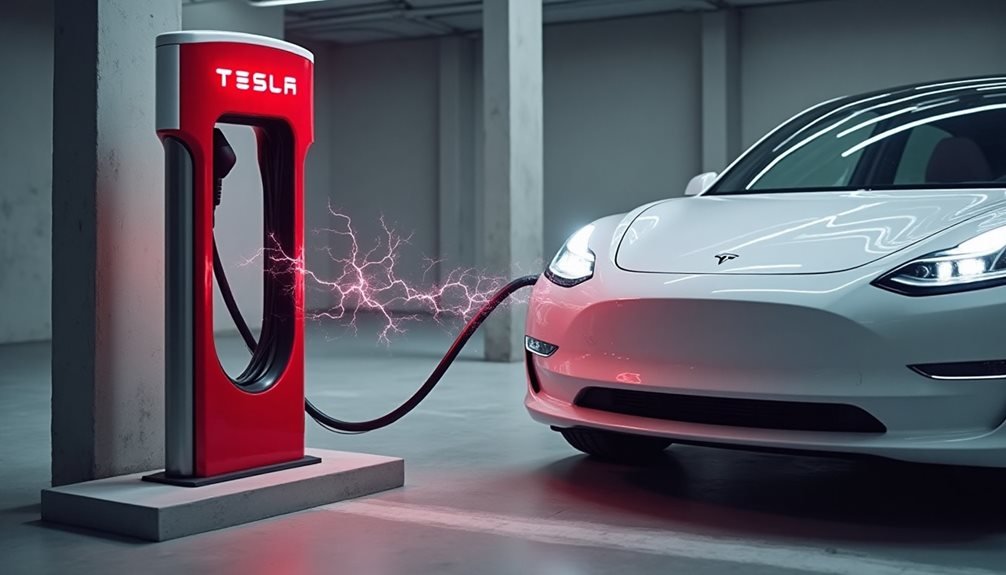
Tesla Superchargers convert AC grid power into high-voltage DC current that flows directly into the battery, bypassing the car’s slower onboard charger entirely. These stations pump out 72kW to 300kW through liquid-cooled cables that won’t melt in your hands. Just plug in—no apps, no payment cards, no nonsense. The car talks to the charger, handles payment automatically, and adds roughly 200 miles of range in 15 minutes. There’s more to this charging revolution than meets the eye. Additionally, Tesla’s network allows users to schedule charging during offpeak hours, taking advantage of lower electricity rates. This not only saves money but also helps to balance the grid by reducing demand during peak times. As the number of Supercharger stations continues to grow, the infrastructure supports a more sustainable future for electric vehicle owners. As electric vehicles become increasingly popular, many owners are also considering how to install a wall charger at home for added convenience. This allows for faster charging overnight and ensures your vehicle is always ready for the road. Embracing this technology not only enhances personal accessibility but also contributes to a growing network of renewable energy usage. Additionally, understanding some tesla charging tips and tricks can help you maximize your charging efficiency and maintain your battery’s health. For instance, charging during off-peak hours can often result in lower costs, while utilizing features like scheduled departure can ensure your car is preconditioned and ready to go when you need it. Embracing these practices not only enhances the convenience of your Tesla experience but also contributes to a more sustainable approach to energy consumption. In addition to Superchargers, Tesla also offers a comprehensive network of destination chargers, providing convenient charging options at hotels, restaurants, and shopping centers. A complete tesla destination charging overview highlights how these installations enable Tesla owners to charge their vehicles while they enjoy their time at various locations. This seamless integration into everyday life further emphasizes Tesla’s commitment to making electric vehicle ownership more accessible and practical.
How did Tesla manage to solve the electric vehicle’s biggest nightmare? Range anxiety. They built a network of DC fast chargers that fundamentally turned road trips from impossible to inevitable.
Tesla Superchargers convert AC power to DC, bypassing the car’s onboard inverter entirely. This isn’t rocket science, but it’s clever. The result? Direct, high-voltage charging straight to the battery. No middleman, no delays.
Smart engineering: skip the onboard conversion, pump DC power straight to the battery. Simple concept, game-changing results.
The network itself is ruthlessly strategic. Highway rest stops, urban hubs, places people actually want to be while waiting. Unlike other charging networks that seem designed by someone who’s never taken a road trip, Tesla’s placement makes sense. With over 23,000 Supercharging points available globally, the dense coverage eliminates range anxiety for most drivers.
Power output varies by generation. V1 stations deliver 72kW, V2 pushes 150kW, and the newest V3 stations hit 250kW to 300kW. That translates to roughly 200 miles of range in 15 minutes at peak performance. Not bad for grabbing a coffee.
Here’s where it gets interesting: the system automatically preconditions batteries to ideal charging temperatures. Hot batteries charge slowly. Cold batteries charge even slower. Tesla’s software handles this background choreography.
The user experience is strikingly simple. Tesla owners just plug in. No apps to fumble with, no payment cards to wave around. The car talks to the charger, the charger talks to Tesla’s servers, money moves electronically. Tesla’s EVSE manages safety communication through its relay system and onboard computer interface. Done.
Of course, there are limits. Charging speed tapers as batteries fill up, stopping automatically at 90% to preserve battery life. Newer stations share power flexibly between vehicles, though this can slow things down during busy periods.
Pricing follows a pay-per-kilowatt-hour model, typically ranging from $0.20 to $0.50 per kWh depending on location. Some legacy Model S and X owners still get free charging, a reminder of Tesla’s early promotional strategies.
The stations themselves feature liquid-cooled cables to prevent overheating and work in extreme weather conditions. They’re designed for 350-500V and 250-300A, using Tesla’s proprietary connector, though CCS1 adapters are becoming available. While charging, Tesla vehicles also maintain other security features like Sentry Mode, which uses cameras and sensors to monitor the surroundings and protect against theft or vandalism. Additionally, the stations are equipped with advanced software that provides real-time charging data and diagnostics, ensuring optimal performance. For those using home charging solutions, a comprehensive ‘tesla mobile connector overview‘ offers insights on how to make the most of a Tesla’s charging capabilities on the go. This flexibility enhances the overall charging experience, making it convenient for Tesla owners to find and utilize charging stations effectively.
Tesla’s Supercharger network essentially solved the infrastructure chicken-and-egg problem that plagued early EVs. Build the cars, build the charging network, make road trips possible. Simple strategy, effective execution.
Frequently Asked Questions
Can Non-Tesla Vehicles Use Tesla Superchargers?
Yes, non-Tesla vehicles can use Tesla Superchargers, but there’s a catch. They need either a CCS connector or built-in NACS port.
Major brands like Ford, Hyundai, Kia, and Rivian are compatible. Users access charging through Tesla’s app and pay per use.
Currently, about 500 stalls across 50+ UK sites accommodate non-Tesla EVs. More manufacturers are adding native NACS ports.
How Much Does It Cost to Charge at a Tesla Supercharger?
Tesla Supercharger costs range from $6 to $50 per session, depending on battery size and location. The national average sits around $0.25 per kWh, though rates vary wildly by state.
A 100kWh Model S costs more than a 75kWh Model 3.
Home solar charging runs about $0.06 per kWh—four times cheaper than Superchargers. Regional electricity rates and station-specific pricing create significant cost variations.
How Long Does It Take to Fully Charge Using a Supercharger?
A full 0% to 100% charge takes 30-45 minutes at Tesla’s fastest 250kW Superchargers.
Most drivers don’t actually need this though. The sweet spot is 20% to 80%, which only takes 15-30 minutes.
After 80%, charging crawls to protect the battery.
Older V2 chargers at 150kW will drag that time out longer.
Temperature and battery age mess with these times too.
Do I Need a Membership or Account to Use Superchargers?
Tesla owners get the easy route – no membership needed, just their Tesla account.
Non-Tesla drivers? Different story. They need a payment account minimum, though membership isn’t mandatory.
The $12.99 monthly membership cuts charging costs, but only makes sense if someone’s burning through 100+ kWh monthly. Otherwise, pay-as-you-go works fine.
Either way, the Tesla app runs the show for session control.
What Happens if a Supercharger Station Is Full or Broken?
When Supercharger stations fill up, Tesla’s guidance system automatically reroutes drivers to less crowded locations. The app shows real-time occupancy levels, which helps with planning.
If chargers break down, the vehicle prompts users to report issues immediately and directs them to working units nearby. Tesla prioritizes repairs based on severity.
Multiple cars sharing adjacent stalls means slower charging speeds for everyone.