
Tesla windshield replacement takes 1-2 hours for actual installation, but that’s where things get complicated. Parts sourcing stretches the timeline from several days to two weeks because windshields are rarely stocked locally. Tesla’s supply chain makes simple replacements feel like hunting rare artifacts. Add mandatory ADAS calibration for Autopilot functionality, adhesive curing time, and potential weather delays, and owners face markedly longer waits than the installation itself suggests.
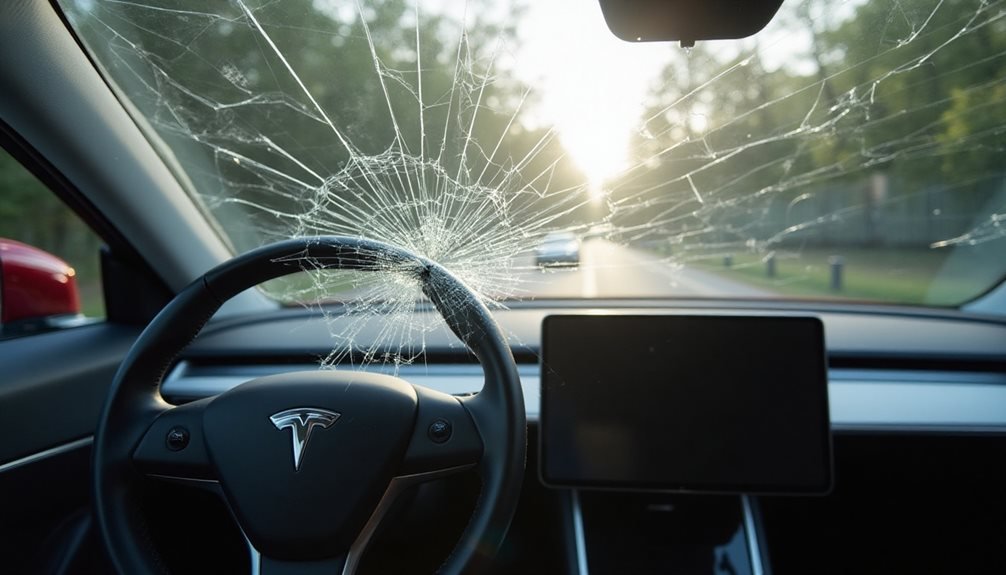
When a Tesla windshield cracks, owners quickly find they’re not dealing with a typical car repair. The actual installation takes one to two hours, which sounds reasonable. But that’s where things get complicated.
Tesla windshields aren’t sitting on every corner shop’s shelf. Parts availability can stretch the process to one or two days. Sometimes Tesla centers need two weeks just to source the windshield. Two weeks. For a piece of glass.
Two weeks for a windshield. Tesla’s supply chain makes simple glass replacement feel like ordering rare diamonds.
The replacement process itself follows predictable steps. Service centers verify part availability before scheduling, which should be standard practice but apparently isn’t always. Owners book appointments, sign digital paperwork via email, and get pickup notifications through the Tesla app. Tesla owners can also access Tesla’s Electronic Parts Catalog to locate windshield part numbers and check availability for their specific model. The tech integration works better than the parts supply chain.
Model type matters notably. Model S windshields are heavier than Model 3 versions, requiring more installation time. Model Y falls somewhere in between, with costs ranging from $400 to $1,100. The Model 3 is cheapest at $350 to $950, while the Model S tops out around $1,000. Safe Light’s quote of approximately $1,666.66 contrasts with Tesla’s direct replacement cost of around $999.99 for the same OEM windshield.
Here’s where Tesla repairs get uniquely annoying: ADAS calibration. Every windshield replacement requires camera recalibration for Autopilot functionality. Tesla typically handles this, adding 30 to 60 minutes.
Third-party shops often punt calibration back to Tesla, extending the timeline further.
Adhesive cure time adds another layer. Dow Betaseal Express requires at least one hour before driving, assuming temperatures stay above zero degrees Fahrenheit. Colder weather extends curing time beyond manufacturer guidelines. Nobody wants their windshield falling out on the highway.
Location choice impacts everything. Tesla service centers prioritize parts availability and understand ADAS requirements. Third-party shops may lack Tesla-specific training, affecting calibration quality. Rural areas face longer parts delivery times compared to urban centers. Professional work ensures each windshield replacement meets Tesla’s specific quality standards and maintains the vehicle’s structural integrity.
Climate affects adhesive curing speed, with warmer temperatures helping the process. Geography determines parts distribution efficiency. High-volume centers reduce lead times compared to smaller locations.
Total service time depends on parts availability, model complexity, calibration requirements, and location capabilities. The installation itself is straightforward. Everything else surrounding it creates the real delays.
Frequently Asked Questions
Does Tesla Windshield Replacement Affect Autopilot Camera Calibration?
Yes, Tesla windshield replacement absolutely affects autopilot camera calibration. The cameras and sensors get knocked out of alignment during installation, which means autopilot features shut down until recalibration happens.
Tesla service centers handle this automatically with their fancy tools. Third-party shops? Hit or miss. Some skip it entirely or charge extra.
Owners can trigger self-calibration through the touchscreen, but it requires driving 100+ miles on marked roads.
Will Insurance Cover My Tesla Windshield Replacement Costs?
Most thorough insurance policies cover Tesla windshield replacement, but the devil’s in the details. Coverage varies wildly by provider and region.
Some insurers demand you use their approved shops, which might not include Tesla Service Centers.
You’ll likely pay a deductible first, then get reimbursed.
Tesla Insurance covers it in eligible areas, but that’s limited geographically.
Third-party shops exist, but good luck with those cameras.
Can I Drive My Tesla Immediately After Windshield Replacement?
Tesla owners can’t just hop in and drive off immediately after windshield replacement. The adhesive needs at least 60 minutes to cure properly—that’s the absolute minimum.
Most service centers actually recommend waiting a full day for safety reasons.
Weather affects curing time too. Hot, humid conditions speed things up, while cold temps slow the process down.
Some insurance companies even require the 24-hour wait.
Do Tesla Windshields Require Special Tools for Installation?
Tesla windshields definitely need specialized tools. Suction cup handles help align those massive glass panels without dropping them. Glazing spacers, triangular adhesive applicators, and protective materials prevent scratches during installation.
The real kicker? ADAS sensor recalibration systems and laser alignment tools for cameras and radar. Plus diagnostic software to test everything works properly. Regular windshield tools just won’t cut it for these high-tech vehicles.
How Much Does a Tesla Windshield Replacement Typically Cost?
Tesla windshield replacement costs hit hard. Model 3 runs $1,600-$1,750, though some unlucky owners paid $2,443.
Model Y ranges $1,565-$2,532, while Model S/X spans $1,200-$3,418.
Third-party shops cut costs 20-30%, but good luck with ADAS functionality.
Add $200-$400 for mandatory calibration because Tesla.
Recent quotes surge past $2,500 for complex windshields.
Inflation pushed prices up 10-15% in 2024. Ouch.