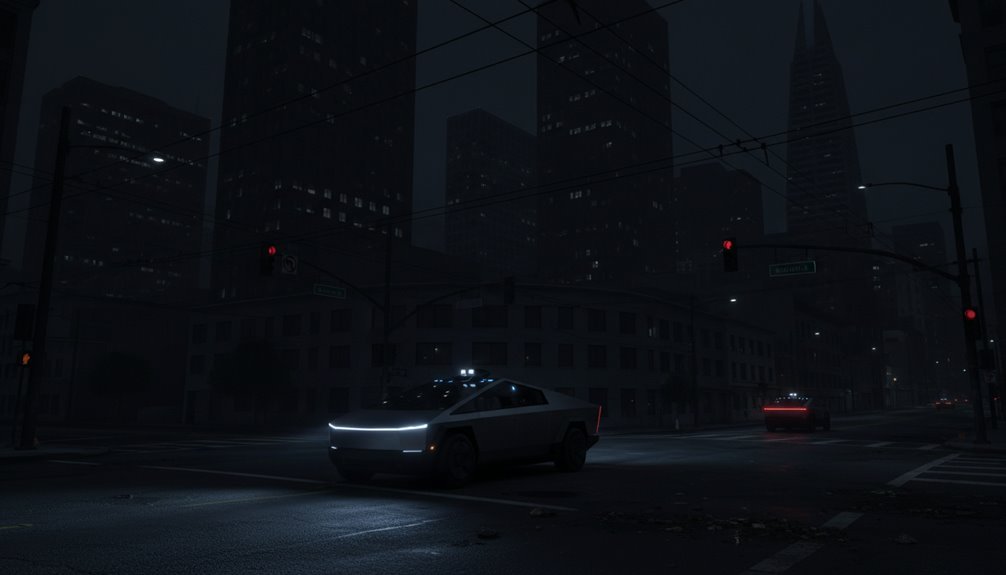
While a major blackout swept through San Francisco on December 20, 2025, Tesla’s self-driving vehicles kept moving smoothly through dark intersections. The same outage that left the city without power created a real-world test for autonomous vehicles.
Tesla’s robotaxis handled the challenging conditions well, but Waymo’s vehicles didn’t fare as well. During the blackout, Waymo’s autonomous taxis froze and stalled at dark intersections where traffic lights weren’t working. The company responded by suspending service across the entire city.
Waymo’s autonomous taxis froze at dark intersections during the blackout, forcing the company to suspend citywide service operations.
Tesla’s Full Self-Driving technology, however, continued operating without major problems. The incident highlighted significant differences between the two competing autonomous systems.
Tesla’s robotaxi fleet has grown remarkably fast. The company registered just 28 vehicles in August 2025 but expanded to 1,655 registered robotaxis in California by December. This rapid four-month growth shows Tesla’s aggressive push into the ride-hailing market in the demanding Bay Area.
The blackout demonstrated why real-world data matters so much for autonomous vehicles. Tesla’s fleet has now driven nearly 7 billion FSD miles. That massive amount of data helps the company’s artificial intelligence system learn and improve. Every mile driven teaches the system how to handle different situations better.
Tesla’s robotaxi operations are currently supervised, meaning human operators monitor the vehicles. This supervised approach is Tesla’s strategy for moving toward unsupervised autonomous driving. The company needs to collect plenty of safety data and prove reliability to regulators before it can operate completely without human oversight.
California regulators require companies to demonstrate that their systems work safely before granting approval for fully autonomous operations.
The Bay Area serves as an important testing ground for autonomous vehicle companies. Multiple competitors operate in the region, making it a competitive validation of the business model. Tesla’s ability to keep vehicles running during a major power outage suggests the company’s system design is more resilient than competitors’ systems.
Tesla’s robotaxi expansion represents new potential revenue streams for the company. Vehicle owners could eventually monetize their cars through autonomous ride-hailing networks. The blackout incident provided real evidence that Tesla’s autonomous technology works reliably in challenging real-world conditions.