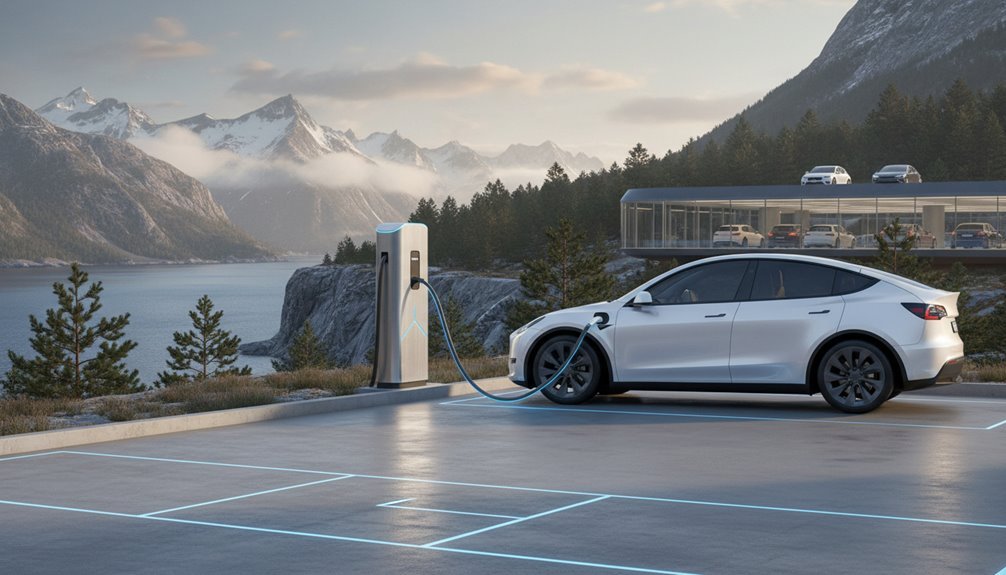

While most countries worldwide still rely heavily on gas-powered cars, Norway’s achieved something extraordinary: electric vehicles now make up nearly all new car sales. In September 2025, battery-electric vehicles reached a record 98.3% market share. This milestone shows how quickly one nation can change its automotive scenery.
Norway’s EV dominance didn’t happen by accident. The country implemented strong taxes on conventional cars rather than offering generous subsidies for electric ones. Zero-emission vehicles are wholly exempt from registration tax, annual ownership tax, fuel tax, and value added tax. These policies made gas-powered cars increasingly expensive while making EVs more competitive. The strategy’s worked remarkably well. The electric van market has also experienced significant growth, with 45.9% of new vans being battery electric in October, reflecting the comprehensive nature of Norway’s electrification across vehicle categories.
Norway implemented strong taxes on conventional cars while exempting zero-emission vehicles from registration, ownership, fuel, and value-added taxes.
The contrast with the rest of the world is striking. The European Union’s average EV market share sits at just 16.4% through October 2025, demonstrating Norway’s substantial lead in electrification compared to broader European trends. Even major EU markets like Germany and France haven’t surpassed 39% electric vehicle adoption. Norway’s 97.6 percentage point advantage over internal combustion engines shows how different its market’s become. Year-to-date, BEV sales increased 32.9% across the nation, demonstrating sustained momentum in the transition away from traditional powertrains. Additional incentives including road toll exemptions for zero-emission vehicles have further accelerated Norway’s automotive transformation.
Tesla dominates Norway’s EV market. The brand captured 33.7% of the overall market in September 2025, with the Model Y alone claiming 28.8%. Tesla‘s strong position is partly due to its delivery patterns. The company delivers to Norway every third month, which causes sales statistics to spike unpredictably. Tesla owners benefit from charging costs that are three to five times lower than gasoline, making the transition economically attractive. Other manufacturers are gaining ground though.
Volvo surged with 27.6% growth, reaching 8.7% market share, while Volkswagen captured 7.9% with 17.2% growth. Even Chinese manufacturer BYD recently entered the Norwegian market.
Total vehicle sales in Norway are climbing. New car sales increased 10.5% year-on-year to 14,329 units in September. Year-to-date sales through September reached 113,325 units, up 23.5%. BEV sales specifically jumped 12.7% to 14,084 units monthly and 32.9% year-to-date.
Norway’s alteration raises important questions about the future of automotive markets globally. Can other nations replicate this success through similar tax policies? Will Europe and North America eventually match Norway’s numbers? For now, Norway stands alone as proof that near-complete EV adoption isn’t just possible—it’s happening today.