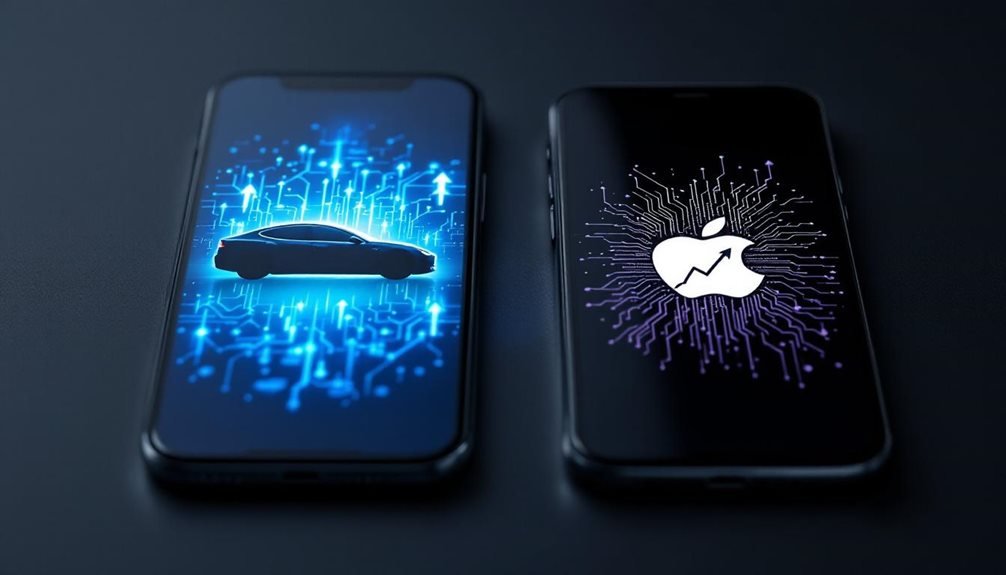
Two of America’s biggest tech companies are heading in opposite directions with their artificial intelligence bets. While Apple struggles to find its footing in AI, Tesla’s pushing forward with bold predictions that have caught Wall Street’s attention.
ARK Invest’s Cathie Wood has set a $2,600 price target for Tesla by 2029. That’s a massive jump from today’s price around $322. Her team believes Tesla isn’t just a car company anymore. They see it as an AI and robotaxi company that happens to make electric vehicles. The price target comes from a Monte Carlo simulation analyzing 45 different variables that could impact Tesla’s future. Additionally, Wood’s analysis suggests that Tesla’s innovations in autonomous driving technology will set it apart from traditional automotive competitors. As consumers compare options like the Tesla Model Y vs Genesis GV70, the focus on cutting-edge features and AI integration could influence their purchasing decisions. This shift in perception emphasizes the evolving landscape of the automotive industry, where electric and autonomous capabilities are becoming paramount. As Tesla continues to innovate in the fields of AI and autonomous driving, investor sentiment is likely to grow, driving demand for the stock. Analysts predict that as new technologies are unveiled, tesla shares rise before earnings, further fueling optimism among shareholders. This potential momentum could help bridge the gap between the current price and Cathie Wood’s ambitious target.
Tesla’s planning to launch robotaxi services within two years. The company expects these self-driving cars to earn about $0.25 per mile and generate over $100,000 annually per vehicle. ARK’s bull-case scenario shows robotaxis could bring in $951 billion in yearly revenue. That’s more than many countries’ entire economies.
The key to Tesla’s advantage is data. The company’s logged 300 million miles of Full Self-Driving information, with 1.3 billion total miles tracked. This massive dataset helps train Tesla’s neural networks to drive like humans. No other company has this much real-world driving data. Tesla’s latest FSD version 12 uses end-to-end neural networks that learn by imitating human driving behavior.
Tesla’s also changing its business model. Instead of just selling cars, they’re moving toward software subscriptions. FSD software could have 80% profit margins, compared to just 15-20% for selling electric vehicles. The company’s even planning to make one million humanoid robots per year by 2029.
But there are risks. Tesla’s electric vehicle profit margins dropped to 17.2% recently. Regulatory delays could slow down robotaxi approvals. The CyberCab’s been delayed, and battery costs aren’t falling as fast as expected. Political distractions might also cause problems. Tesla battery degradation occurs gradually, with real-world data showing vehicles maintaining strong performance over hundreds of thousands of miles. Despite these challenges, Tesla remains committed to innovation and expansion in the electric vehicle market. Recently, the company celebrated its Tesla Model 3 sales milestone, demonstrating strong consumer demand even amid broader economic uncertainties. Continued investment in technology and infrastructure could help mitigate some of the risks associated with regulatory hurdles and cost fluctuations.
Tesla controls its entire supply chain, from batteries to self-driving software. This vertical integration helps them cut costs and move faster than competitors. They’re expanding beyond cars into energy products like solar panels and home batteries.
Meanwhile, Apple’s AI efforts have disappointed investors. The contrast between Tesla’s aggressive AI push and Apple’s cautious approach shows how different tech giants are handling the AI revolution. Despite the contrasting strategies, both companies are under pressure to innovate and keep pace with rapidly advancing technology. Investors are closely watching the outcomes of Tesla’s 2025.26 update analysis, which is expected to reveal insights into the effectiveness of its bold AI initiatives. Meanwhile, Apple may need to reconsider its strategy to reassure stakeholders that it can remain competitive in this fast-evolving landscape. While Tesla continues to integrate AI into its vehicles with groundbreaking features, Apple’s hesitance raises questions about its future in the automotive space. This divide is evident in the ongoing discussions about why Apple CarPlay isn’t in Teslas, highlighting the distinct philosophies each company adopts regarding user experience and technological integration. As the race for AI dominance grows, Apple may need to rethink its strategy to keep pace with competitors like Tesla.