Tesla pulled the plug on its ambitious Dojo supercomputer project in August 2025, according to Bloomberg News. The company didn’t make an official announcement about ending the project. Instead, the news came from third-party reports about two years after Dojo entered production use.
The Dojo supercomputer was first announced at Tesla‘s Autonomy Day in April 2019. Tesla designed it to train artificial intelligence for self-driving cars by processing millions of terabytes of driving video data. The company powered on Dojo for production in August 2023, but it also built a separate cluster with 10,000 Nvidia H100 GPUs at the same time.
Tesla designed Dojo to train self-driving AI by processing millions of terabytes of driving video data.
Early signs showed the project faced serious challenges. During 2022 testing, Dojo drew 2.3 megawatts of power and tripped a local power substation in San Jose. By September 2022, Tesla was only making one Training Tile per day, showing slow production progress. Even Elon Musk called Dojo “a long shot worth taking” but “not a high probability” in January 2024.
Tesla had invested heavily in the project. The company built special facilities at Gigafactory Texas with massive power capacity. The computing cluster was designed to start at 130 megawatts and potentially exceed 500 megawatts of thermal design power. Tesla assembled a multidisciplinary team and created several System Trays and one complete Cabinet for the system. The company had planned to invest over $1 billion in Dojo through 2024, demonstrating its significant financial commitment to the project. The ExaPod system featured 120 tiles with 1,062,000 usable cores, capable of achieving 1 exaflop at BF16 and CFloat8 formats.
By June 2024, Tesla’s strategy had shifted. Musk revealed plans for an even mix of “Tesla AI” and Nvidia or other hardware at Gigafactory Texas. This change suggested Tesla was moving away from relying only on its custom Dojo chips.
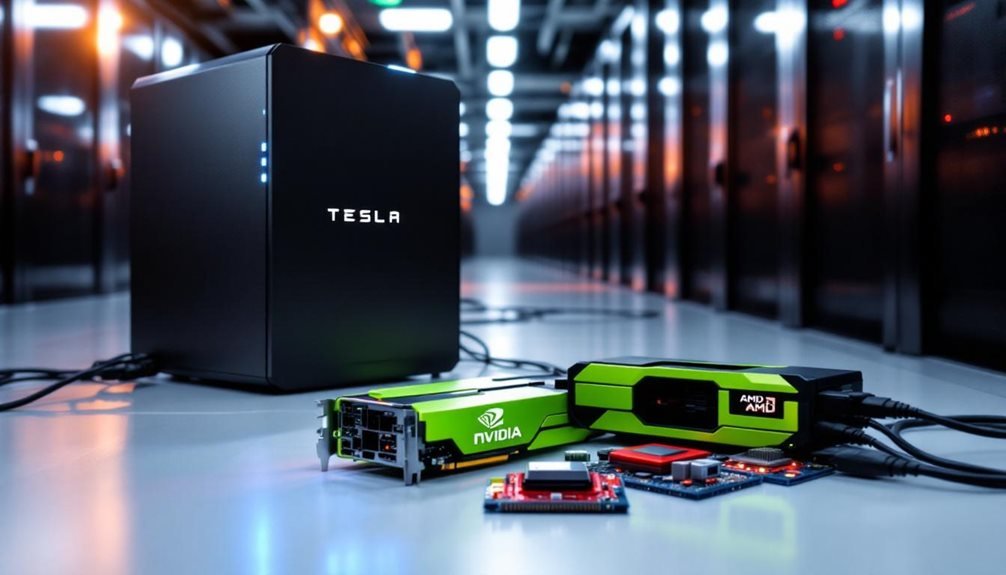
The end of Dojo could benefit chip makers like Nvidia and AMD. Tesla will likely need to buy more of their products to train its self-driving AI. These companies already dominate the AI chip market, and Tesla’s retreat from making its own chips removes a potential competitor.
With Dojo gone, Tesla joins other companies that depend on established chip makers for their AI computing needs.