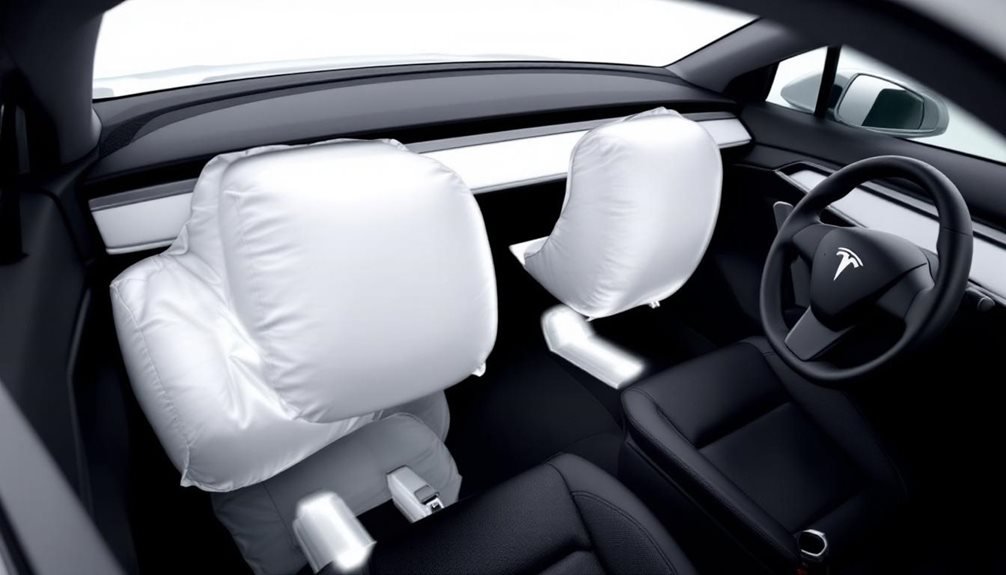
Tesla builds every airbag component in-house, eliminating third-party supplier headaches that plague other manufacturers. The system runs pre-drive diagnostics and customizes deployment based on occupant weight, position, and crash severity. Front airbags work with knee units for stability, while seat-mounted side bags protect against T-bone impacts. Curtain airbags activate during rollovers and severe collisions. Post-crash protocols automatically unlock doors and shut down high-voltage systems. There’s much more happening behind these split-second deployments.
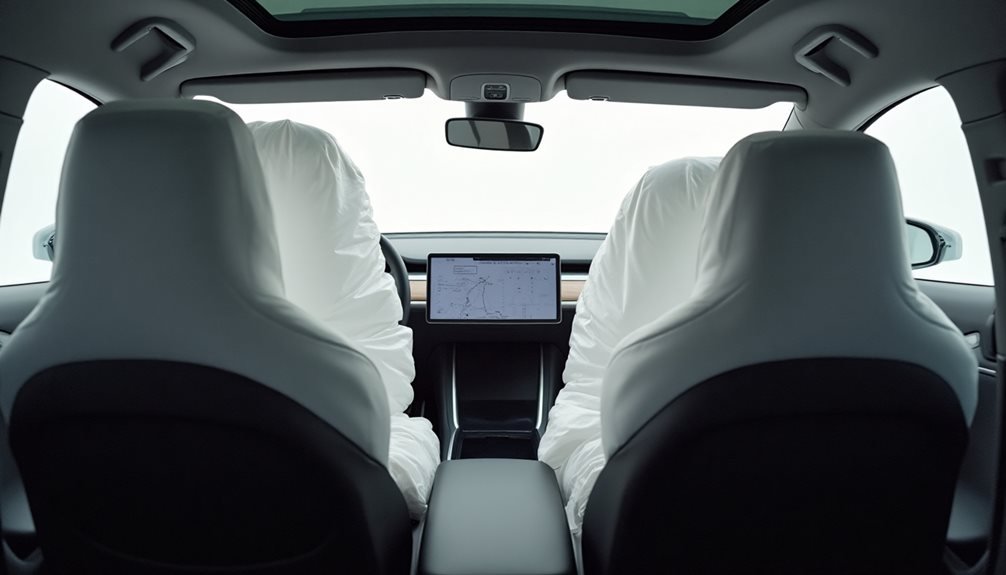
Tesla’s airbag system doesn’t mess around. The company ditched third-party components and built everything in-house, apparently having trust issues with suppliers who’ve caused recalls in other vehicles. Smart move, honestly.
Tesla’s trust issues with suppliers led to building airbags in-house, ditching third-party components after other manufacturers faced recalls.
Front airbags deploy for bigger passengers in front seats, working alongside knee airbags that keep legs from flailing around during crashes. The passenger front airbag stays permanently active in Model Y, which means kids absolutely cannot sit up front. No exceptions, no matter how much they whine about wanting the better view.
Side impacts get their own protection squad. Seat-mounted side airbags guard the pelvis, chest, and head during T-bone crashes. Curtain airbags kick in during severe side hits, rollovers, or offset frontal collisions.
Here’s where it gets interesting: both sides inflate during crashes, even the non-impacted side. Because physics is complicated.
Tesla’s system reads occupants like a creepy mind reader. Weight sensors, seating position monitors, and restraint detectors feed data to customize inflation pressure. Heavier passenger gets more cushion. Closer to the steering wheel means adjusted deployment force. It’s tailored violence prevention.
The airbag status indicator runs diagnostics before every drive, checking seat belts, accelerometers, and wiring. If something’s broken, warning lights persist until fixed. No ignoring this one.
When crashes happen, deployment takes milliseconds. Front airbags focus on protecting heads and chests while knee airbags stabilize thighbones. Side airbags handle torso protection, curtain airbags manage head injuries and rollover scenarios. The system deploys with significant force and noise, requiring occupants to avoid hot components until they cool down completely. Airbags function as an essential safety feature that works together with seatbelts to provide optimal protection during impacts.
Post-crash protocols activate automatically. Doors unlock, hazard lights flash, high voltage systems shut down, and brakes engage to stabilize the vehicle. The goal is keeping occupants alive and helping them escape quickly.
Tesla exceeds minimum safety regulations in markets requiring driver and passenger airbags. The system integrates with active safety features like collision avoidance and Lane Assist, creating multiple protection layers.
After deployment, airbags deflate gradually to prevent occupant entrapment while maintaining visibility. Post-collision service checks are mandatory for rearmament and component replacement. Because once these things pop, they’re done. Tesla’s comprehensive safety approach extends beyond airbags to include roadside assistance through their mobile app for various emergency situations.
The entire system works with structural design for maximum energy absorption, proving that sometimes controlling every component matters more than cost savings.
Frequently Asked Questions
How Much Does It Cost to Replace Tesla Airbags After Deployment?
Tesla airbag replacement costs start around $1,500 for a single deployed unit. Multiple deployments? That bill climbs fast when steering wheel, knee, and curtain airbags get involved.
Here’s the kicker – drivers can sometimes dodge full replacement costs through module reset services ranging from $70-$119.
Geographic location matters too, since rural Tesla owners might need to travel for repairs. Insurance typically covers these expenses, thankfully.
Can Tesla Airbags Be Repaired or Must They Always Be Replaced?
Tesla airbags can’t be repaired—they must always be replaced after activation. Period. The manufacturer’s policy is crystal clear: activated airbags, pretensioners, and related components get tossed in the trash. No exceptions, no repairs, no shortcuts.
It’s not just the airbag cushion either. The steering wheel assembly, seat assemblies, and even the Restraint Control Module often need replacing. Safety isn’t negotiable here.
Do Tesla Airbags Work Differently in Autopilot Mode Versus Manual Driving?
Tesla airbags don’t change their deployment protocols whether you’re sleeping at the wheel or white-knuckling through traffic. The actual crash response stays identical.
What’s different? Autopilot’s sensors spot trouble faster than humans can blink, often preventing crashes entirely. That’s why Tesla reports 1.21% fewer airbag activations since Autopilot integration.
The bags themselves work the same—it’s just that fewer situations require their dramatic entrance.
Are Tesla Airbag Sensors More Sensitive Than Traditional Car Airbag Systems?
Tesla’s airbag sensors aren’t necessarily more sensitive—they’re smarter. Traditional systems often trigger from minor bumps or seat covers, but Tesla’s sensors use flexible thresholds to avoid false alarms.
The real difference? Tesla’s sensors continuously analyze occupant size, position, and weight in real-time. Most cars just detect presence.
Tesla’s system actually thinks before implement, unlike basic crash-and-bang sensors in older vehicles.
Will Aftermarket Modifications Affect Tesla’s Airbag Deployment and Vehicle Warranty?
Aftermarket modifications absolutely mess with Tesla’s airbag systems. Swapping covers changes deployment paths, non-OEM parts disrupt force distribution, and tampering near sensors throws off calibration.
Tesla’s warranty? Gone. The company doesn’t mess around with unauthorized repairs or part substitutions.
Worse yet, modified systems might fail FMVSS safety standards.
Third-party airbag resets aren’t Tesla-approved either, leaving owners stuck with potentially unreliable safety systems.