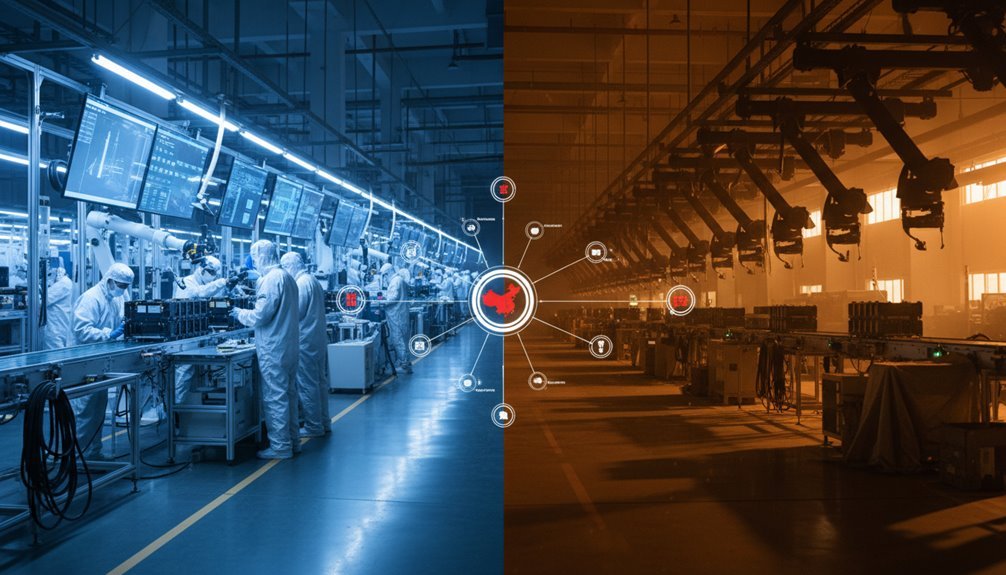

While Tesla’s leadership publicly supports Chinese suppliers, the company’s actions tell a different story for vehicles made in the United States. Tesla vice-president Grace Tao stated the company applies “unified and rigorous standards” in supplier selection regardless of geographic origin. Yet behind these public statements, Tesla’s directed suppliers to remove China-made components from parts sold for US-assembled vehicles.
Tesla’s public commitment to unified supplier standards contrasts sharply with its directive to remove China-made components from US-assembled vehicles.
The gap between Tesla’s words and actions reflects a broader strategy. The company continues sourcing from over 400 Chinese component manufacturers for its Shanghai Gigafactory. These suppliers provide critical components including batteries and heat-control systems. However, for US production, Tesla’s requirements are different.
According to Wall Street Journal reporting, suppliers have already begun replacing some China-made components in their products destined for American factories. This shift focuses on eliminating Chinese-made parts rather than completely severing relationships with Chinese companies. Tesla targets completing this changeover from China-made parts to non-China alternatives within one to two years. General Motors has similarly instructed its thousands of suppliers to remove China-made components as the auto industry collectively reassesses its reliance on Chinese sourcing. This industry-wide trend reflects shared concerns about supply-chain risk mitigation across major automakers.
Several factors drive this supply chain restructuring. Tariff uncertainty between the US and China stands out as a significant concern. The pandemic exposed vulnerabilities in relying too heavily on global manufacturing. Geopolitical tensions also increase supply chain risks for US operations. Moreover, past chip supply disruptions highlighted the dangers of depending on single sources. Tesla’s stated policy emphasizes that geographic location is not a criterion in vendor selection, yet the company’s actions contradict this principle for American production. Recent export restrictions by China on rare earths and magnets have intensified these concerns about dependence on Chinese materials.
Tesla’s approach seeks to create a more resilient and diversified supply chain for American production. Nevada battery production is planned to replace Chinese-made lithium-iron-phosphate batteries for US vehicles. This represents a strategic move toward independence. Tesla’s pricing fluctuations often reflect changing production costs and market conditions as the company adapts its supply chain strategies.
Meanwhile, Tesla’s encouraged Chinese suppliers to establish manufacturing facilities in Mexico and other locations. This strategy allows the company to maintain relationships with proven manufacturers while shifting production away from China for US markets.
Tesla’s position reveals how global manufacturing works today. Companies often make different decisions for different markets. Tesla backs Chinese suppliers for vehicles destined for China and Europe. But for US cars, the company’s implementing a different approach. These decisions reflect real business challenges companies face when balancing global relationships with national interests and supply chain security.