
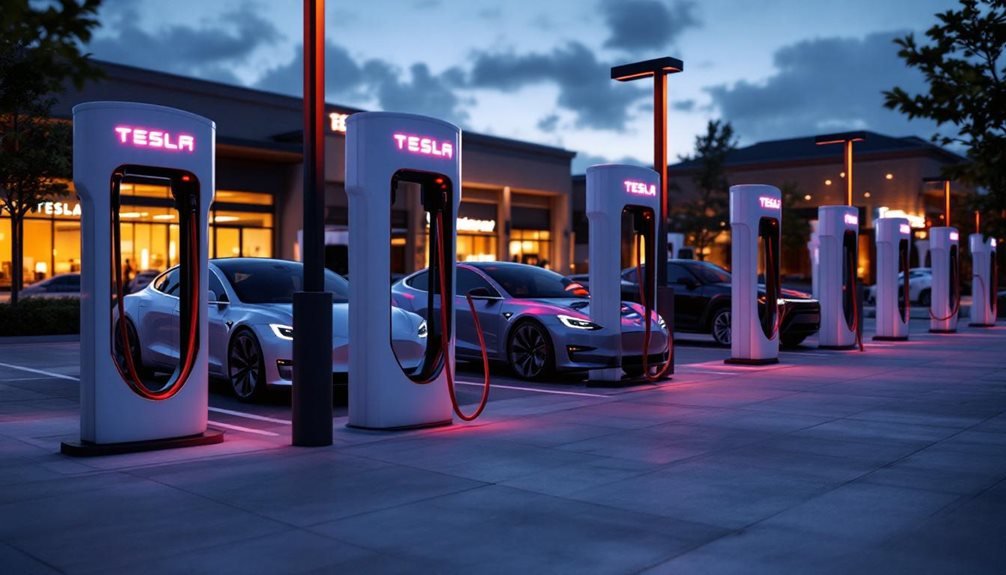
As Tesla’s stock price soared 80% after the recent presidential election, the electric car company has set its sights on dominating the self-driving market with an ambitious plan to initiate fully autonomous vehicles by mid-2025. The company’s value has reached $1.5 trillion, making it worth more than half of all other car companies combined.
Tesla’s already utilized over 4 million vehicles with Autopilot and Full Self-Driving features worldwide. The company’s worth 6.5 times more than Toyota and 14 times more than BYD, even though both sell more cars. Tesla’s advantage comes from having the world’s largest collection of real-world driving data, which helps improve its artificial intelligence systems.
Tesla’s 4 million connected vehicles create an unmatched real-world data advantage over traditional automakers.
The company expects regulatory rules to loosen under the Trump administration, making it easier to get approval for cars that don’t need human drivers. Tesla released its latest FSD V13 software in December 2024, though drivers still need to pay attention while using it. The company wants to get approval for completely driverless cars by the second quarter of 2025.
In October 2024, Tesla showed off its Robotaxi prototype. Elon Musk believes this technology could make Tesla worth $10 trillion. Unlike competitors Waymo and Cruise, which build special fleets, Tesla plans to convert its existing cars into self-driving taxis. This approach could save money and scale up faster. Tesla’s current Autopilot system demonstrates significantly improved safety metrics, with crashes occurring every 7.44 million miles compared to human drivers who crash approximately every 702,000 miles. Despite the excitement surrounding the potential of the Tesla Robotaxi, there are concerns about tesla robotaxi launch secrecy issues, as the company has been tight-lipped about specific timelines and operational details. Investors and consumers alike are eager for more transparency, especially considering the competition is advancing rapidly in the autonomous driving space. As Tesla continues to refine its technology, the anticipation builds for a full-scale rollout that could revolutionize urban transport. As Tesla forges ahead, other automakers like Volkswagen are exploring their own paths in autonomous driving, evidenced by their volkswagen robotaxi innovation strategy. This competitive landscape is pushing all companies to enhance safety features and efficiency in urban transport. With the potential for widespread adoption, these innovations may reshape the future of mobility and redefine transportation norms.
The numbers support Tesla’s ambitions. The global self-driving market‘s worth $1.7 trillion in 2024 and growing at 8.6% yearly. Experts predict 15 million self-driving cars will be on roads by 2030, with 70% reaching advanced autonomy by 2025. North America leads adoption with 25% market share. The robotaxi segment alone is projected to reach $174 billion by 2045, growing at 37% annually starting in 2025. The push toward autonomous vehicles gains momentum as human error causes 94% of road accidents, making safety improvements a primary driver for the technology’s adoption.
Tesla’s strategy extends beyond personal cars. The company’s targeting ride-hailing, delivery services, and logistics, where growth rates hit 14% annually. With its 45% share of the electric vehicle market and massive data advantage, Tesla’s positioned to reshape transportation. As Tesla ventures into these new areas, its innovations are likely to enhance operational efficiencies and reduce costs across various transportation sectors. Additionally, as the company continues to develop autonomous vehicle technology, it will further solidify its role as a leader in the industry. This evolution will also play a crucial part in shaping tesla’s impact on public perception, as more consumers embrace electric mobility solutions.
Market analysts project the self-driving industry will grow 30.8% annually through 2033. While Germany, China, and Mexico prepare for rapid adoption, Tesla’s betting its combination of technology, scale, and political support will cement its leadership in humanity’s shift toward autonomous vehicles. As competition intensifies, Tesla’s vision for autonomous vehicles emphasizes not only technological advancement but also a commitment to safety and sustainability. By investing heavily in artificial intelligence and machine learning, Tesla aims to stay ahead of regulatory hurdles and public skepticism. This strategic approach positions the company to dominate the market as consumer acceptance of self-driving technology continues to grow.