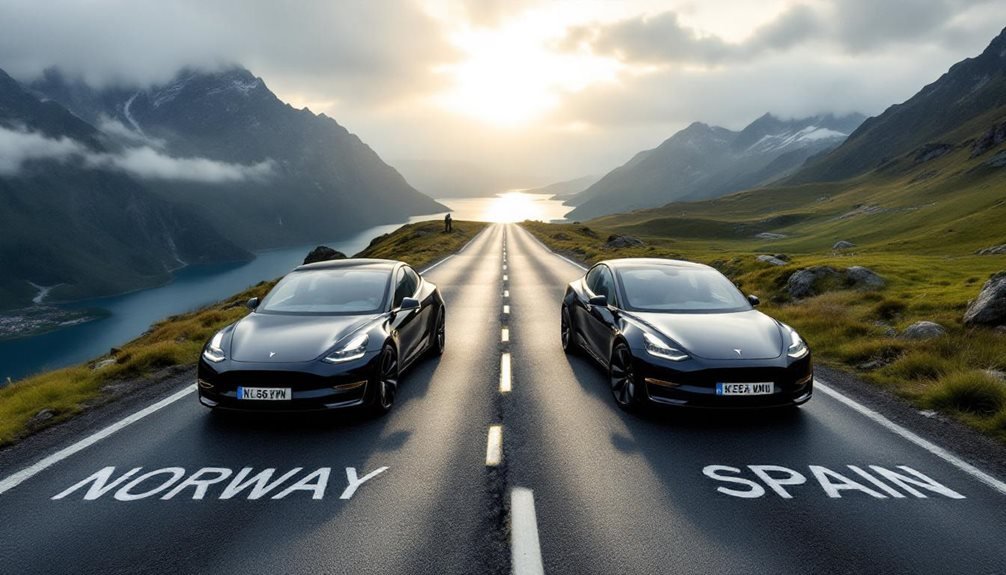

While many European countries struggle with slowing electric vehicle sales, Tesla’s finding surprising success in Norway and Spain. Norway’s May sales jumped 39.1% compared to last year, reaching 14,260 units. That’s the country’s strongest May since 1986.
Tesla’s Model Y dominated Norway’s market in June. The car captured 28.7% of Norway’s electric vehicle sales with 5,004 units sold. This performance helped Tesla grab 18.2% of Norway’s total car market, beating Volkswagen for the top spot. The Model Y’s 240% increase year-on-year drove much of Tesla’s success in the Norwegian market.
Norway’s electric vehicle adoption continues breaking records. Battery electric vehicles claimed 93.9% of new car sales in May. The country’s year-to-date electric vehicle share hit 92.6%, up from 87.3% in 2024. Traditional gas and hybrid cars nearly disappeared, holding just 0.3% to 1.2% of the market. June’s results pushed even higher with electric cars achieving 96.9% market share of all new registrations.
Norway’s battery electric vehicles captured 93.9% of new car sales in May, nearly eliminating traditional gas and hybrid options.
Spain also showed strong results for Tesla after early-year dips. The company’s second-quarter sales bounced back, helped by government subsidies and expanded charging stations. Spain’s growing electric vehicle market supports the European Union’s environmental goals.
Not all European countries shared this success. France, Denmark, and Sweden saw Tesla sales decline. These regional differences show how electric vehicle markets vary across Europe. Some Nordic countries face market saturation while southern European nations still have room to grow.
Competition’s heating up across Europe. Chinese automaker BYD grew 240.1% year-over-year and entered Norway’s top ten brands. Volkswagen and BMW launched competitive electric models. Citroën sales jumped 576% while Xpeng rose 338%.
Government policies played a major role in these results. Norway maintains tax exemptions and low sales taxes for electric vehicles. These incentives keep electric cars price-competitive with gas vehicles. Spain introduced its own subsidies and credits to encourage electric vehicle purchases. Tesla owners benefit from significantly lower charging costs compared to gas vehicles, with annual savings potentially exceeding $1,800 for heavy drivers.
Norway’s success shows what’s possible with strong government support. Average carbon dioxide emissions dropped to just 3.5 grams per kilometer in June. The country’s infrastructure and consistent policies created ideal conditions for electric vehicle adoption.
Meanwhile, Tesla’s varying performance across Europe highlights how local factors shape electric vehicle markets.