
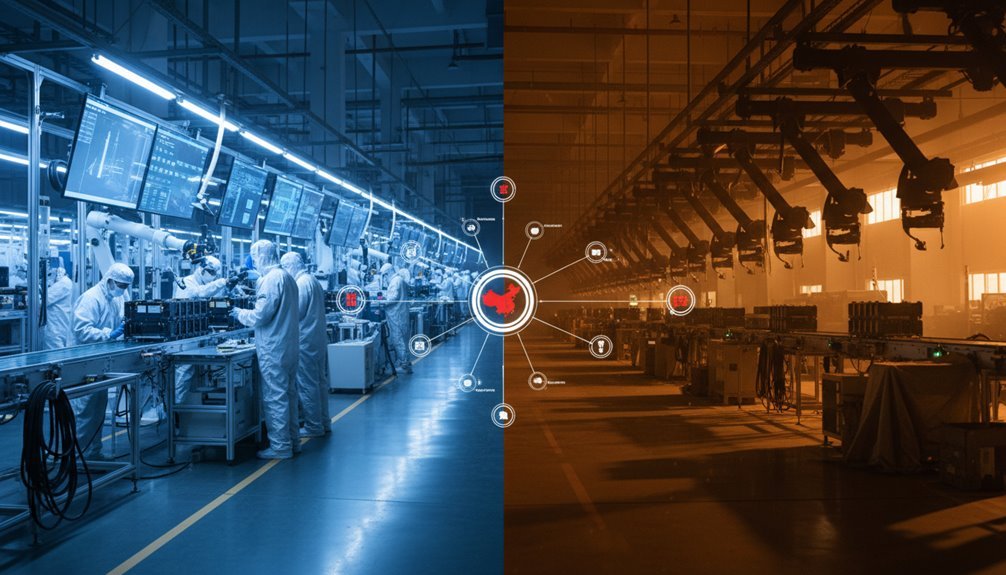
Tesla’s push to remove Chinese-made parts from its vehicles is reshaping global supply chains and threatening production stability worldwide. The company issued a directive in early 2024 requiring suppliers to eliminate all China-sourced components within one to two years. This mandate seeks to help Tesla avoid tariffs exceeding 25% on U.S.-bound vehicles. The focus targets critical parts like battery systems and motor assemblies used in Fremont-built vehicles.
Tesla’s 2024 directive mandates suppliers eliminate China-sourced components within one to two years, targeting tariffs exceeding 25% on U.S.-bound vehicles.
The U.S. government’s threat of 100% tariffs on Chinese electric vehicles has accelerated this decoupling effort. Tesla’s suppliers must relocate production to Mexico, the U.S., or Southeast Asia by 2025-2026 to comply. Meanwhile, the company’s Shanghai facility has faced production challenges. The plant halted facelifted Model Y production lines from January 22 through February 14, 2025, for equipment optimization. Model 3 production also paused briefly during Chinese New Year. These temporary shutdowns affect only Chinese-sourced component integration points in assembly lines.
Tesla’s strategy extends beyond U.S. production concerns. The company’s explicit supplier directive mandates manufacturing shifts away from China and Taiwan by 2025. This diversification includes Vietnam, India, and North American facilities to reduce Taiwan Strait disruption risks. CEO Elon Musk has previously expressed concerns about Chinese competitors like BYD and Li Auto during earnings calls. Electronics supplier executives have noted that moving supply chains would be more challenging and expensive than anticipated. The nearshoring strategy could add 20% U.S. jobs in the EV sector if fully implemented.
China’s market tells another story. Tesla stopped importing Model S and X vehicles there in April 2024 due to tariff retaliation. Instead of accepting orders, the company now shows customers “View Available Cars” from existing inventory. Tariff-inflated pricing creates 15-20% premiums compared to non-tariff markets for identical models. The company’s fixed pricing policy means customers cannot negotiate these tariff-adjusted costs, leaving buyers to accept elevated prices or seek alternatives.
Tesla’s China shipments declined markedly. The company delivered 61,497 vehicles in October 2024, representing a 9.7% year-over-year drop. Eight shipment declines occurred in ten consecutive months. Extended delivery timelines to November-December 2024 indicate inventory depletion and constrained output.
Production pauses in Shanghai coincide with these shipping challenges. Meanwhile, Germany’s Grünheide facility began producing facelifted Model Y vehicles, offsetting some global supply constraints. However, competing manufacturers like GM and Ford are developing their own contingency plans, though less formally than Tesla’s mandate. The restructuring reflects broader geopolitical tensions reshaping automotive manufacturing globally.