
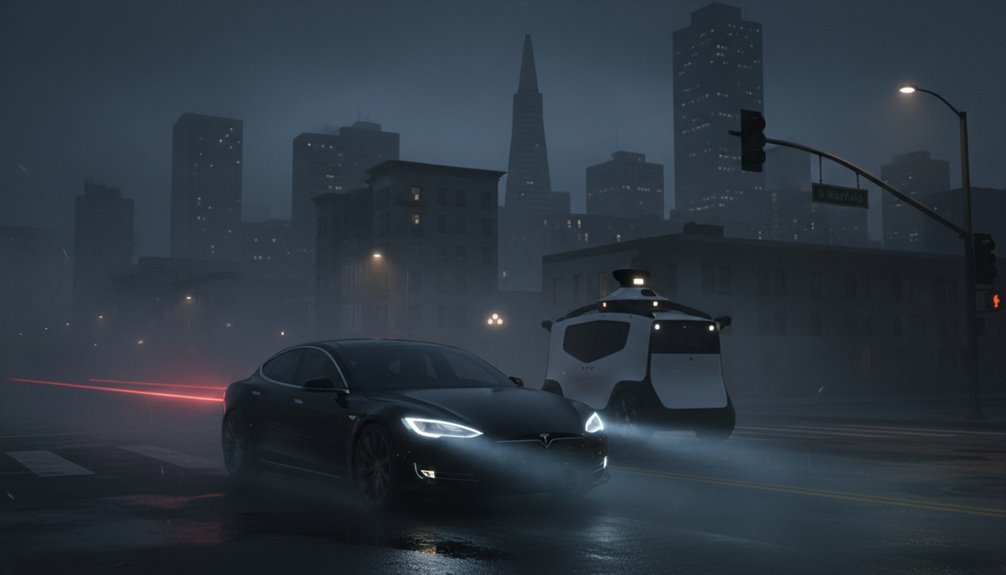
Tesla’s new Cybercab is a two-passenger vehicle that drives itself without a steering wheel or pedals. The electric car was recently spotted driving autonomously through downtown Austin on public roads. This marks the first time Tesla’s tested a prototype without traditional driving controls in a real city environment.
The Cybercab features a futuristic design with butterfly doors that open automatically. There’s no door handle to pull. The car also lacks a rear window and side view mirrors, relying instead on cameras and sensors to see everything around it. A hatchback in the back provides cargo space for passengers’ belongings.
The Cybercab’s futuristic design features automatic butterfly doors and relies on cameras and sensors instead of traditional mirrors and windows.
Tesla’s self-driving technology uses what the company calls Hardware 5, or AI5. This system includes cameras, radar, and ultrasonic sensors working together to maneuver roads safely. Significantly, the Cybercab doesn’t use LiDAR, a technology many other self-driving cars depend on. Instead, it relies on a vision-only artificial intelligence system trained on billions of miles of driving data. The vehicle represents Tesla’s evolution from earlier concepts, as Musk accepted a dual platform for both a small car and robotaxi without steering wheel capabilities. Approval processes for robotaxi operations are expected to take several years even as the technology advances. Continuous over-the-air updates enhance the vehicle’s autonomous capabilities and safety performance.
The vehicle can drive itself at Level 4 autonomy, meaning it doesn’t need human control in designated areas. The car reroutes around traffic and learns individual user preferences. Tesla claims its Full Self-Driving technology is ten to thirty times safer than human drivers. Unlike current FSD systems that require driver supervision, the Cybercab operates as a fully autonomous vehicle.
Performance-wise, the Cybercab offers impressive specs. The battery holds between 35 and 60 kilowatt-hours of energy. It can travel 200 to 300 miles on a single charge and accelerates from zero to 60 miles per hour in under seven seconds. Top speed reaches 100 miles per hour. The vehicle weighs between 2,500 and 3,000 pounds, making it lightweight for efficient city driving.
Charging the Cybercab doesn’t require traditional cables. The car uses wireless inductive charging pads, with efficiency above 90 percent. The vehicle can park itself over charging stations automatically. Robotic cleaning systems prepare the car for new passengers.
Tesla presented the Cybercab in October 2024 at its “We, Robot” event. The company plans to begin production before 2027, with prices under $30,000. Tesla intends to integrate the Cybercab into its robotaxi service by 2026, operating at costs as low as 20 cents per mile.