
Tesla’s latest Full Self-Driving update, version 14.2.1, brings considerable enhancements to how its vehicles see and steer the road. The upgraded neural network vision encoder now processes higher-resolution camera imagery, allowing the system to recognize objects with greater detail and accuracy. Emergency vehicles are now detected more reliably, and roadway obstacles stand out more clearly in the vehicle’s visual analysis. The camera visibility enhancement increases attention monitoring sensitivity to better track driver engagement.
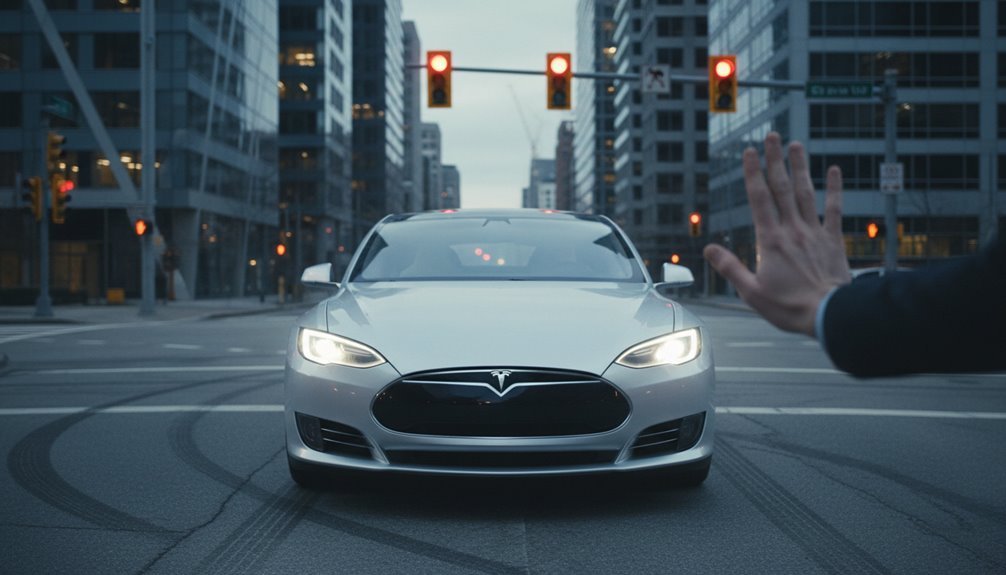
One standout feature in this update is the system’s new ability to recognize and respond to human hand gestures. This capability marks a notable step forward in how autonomous vehicles interact with their surroundings. Drivers and pedestrians can now communicate with the vehicle through hand signals, adding another layer of interaction beyond traditional traffic signals and road markings.
The update also introduces a dedicated Self-Driving Stats menu within Autopilot settings. This feature tracks total self-driving miles with precision, breaking down usage between city and highway driving. The system shows that roughly one-third of miles occur in city environments while two-thirds happen on highways. These statistics exclude standard Autopilot miles, focusing only on Full Self-Driving data.
A dedicated Self-Driving Stats menu now tracks autonomous miles, revealing two-thirds occur on highways versus one-third in cities.
Weather performance has improved substantially with this version. Tesla’s engineers have documented testing in snow conditions, where the system now handles road boundary recognition more effectively. The integration of improved traction control with FSD helps the vehicle adjust speeds appropriately on slippery surfaces and maintain stability in reduced visibility. The transition to end-to-end neural networks enables more adaptable responses in challenging weather scenarios.
The update rolls out to AI4 vehicle platforms, including newer Cybertruck models, Model 3, and Model Y vehicles. Each platform receives optimizations customized to its specific hardware and driving characteristics. Tesla vehicles achieve the lowest injury probability in standardized crash tests, demonstrating the company’s commitment to safety across all driving modes.
Driving behavior feels smoother overall. Acceleration and braking patterns now mimic human driving more closely, reducing jerky motions during lane changes and intersections. The system better predicts surrounding vehicles’ movements on highways and maneuvers through complex scenarios with improved safety considerations.
Attention monitoring systems have also been improved. The update features revised driver engagement thresholds that adjust to road conditions. Situationally-aware attention requirements mean the system doesn’t apply identical monitoring standards everywhere. If drivers text while the vehicle’s in autonomous mode, the system triggers safe pull-over protocols.
These improvements represent Tesla’s continued evolution in autonomous driving technology across its vehicle lineup.