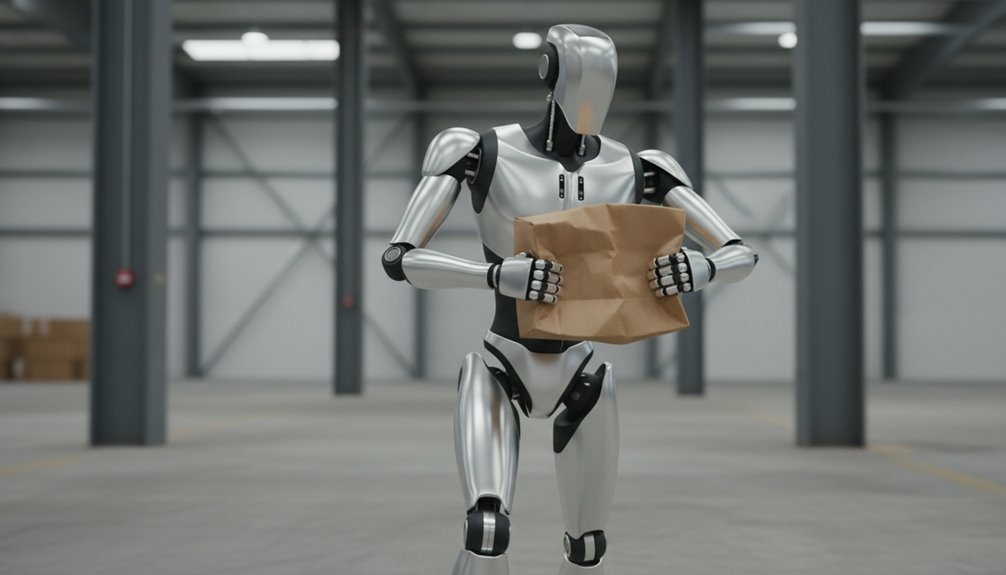
Tesla’s humanoid robot, known as Optimus, is shaping up to be one of the most advanced machines the company’s ever built. Standing 5 feet 8 inches tall and measuring around 125 pounds, Optimus can walk at speeds up to 5 mph and carry 20 pounds. The robot’s latest generation features 22 degrees of freedom in its hands, allowing it to perform delicate tasks like picking up eggs without breaking them.
Optimus isn’t just a prototype anymore. The robot can now pick up trash, run, and even deal cards—skills that demonstrate how quickly its abilities are expanding. It walks on two legs autonomously, balances on one leg, and recovers from slips on uneven ground without human help. With its advanced locomotion technologies and motion planning algorithms, Optimus moves fluidly and naturally across varying surfaces.
Optimus autonomously walks, balances on one leg, and recovers from slips without human intervention, showcasing rapidly expanding capabilities.
Gen 2, revealed in December 2023, showed a 30% speed improvement over earlier models and includes articulated toes for better balance. The robot uses the same AI technology that powers Tesla’s Full Self-Driving system. Eight autopilot cameras and multiple force sensors help Optimus comprehend its surroundings. The robot is built to be human-safe while operating in shared environments. Optimus is powered by 28 structural actuators that enable precise movement and manipulation. In June 2025, leadership changes occurred as Milan Kovac departed and Ashok Elluswamy replaced him, signaling shifts in the program’s strategic direction.
Its onboard computer processes visual information instantly, allowing it to recognize objects and adjust to new situations in real-time. Engineers trained Optimus by showing it human demonstrations, having it practice in virtual worlds, and testing it in physical spaces.
Tesla’s most recent generation, announced in May 2024, demonstrated these capabilities publicly in November 2024. The company plans low-volume production of 5,000 units in 2025 for use in Tesla factories. Mass production goals target 50,000 units by 2026.
Gen 3 is scheduled to debut in Q1 2026, with emphasis on making manufacturing easier and scaling up production. Eventually, Optimus could reach consumers. Tesla projects a price tag of around $30,000 for future consumer models. The company plans to utilize its automotive manufacturing experience and scale to reduce costs over time.
Right now, though, Optimus remains focused on factory work. Tesla’s clear path from prototype to production shows the robot’s ready for real-world implementation. Within a few years, humanoid robots might become common in industrial settings across the country.