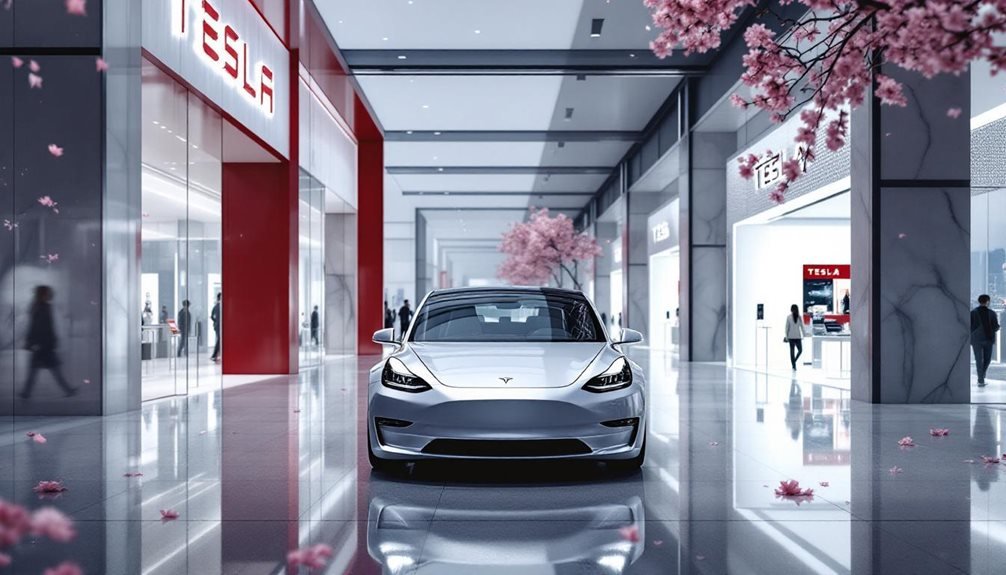

Tesla’s pushing to triple its store count in Japan over the next two years. The electric car maker plans to increase from 23 stores today to 30 by the end of 2025, then jump to 50 stores by the end of 2026. The company’s long-term goal is 100 stores nationwide.
The expansion marks a major shift in Tesla’s Japan strategy. Instead of relying on online sales and pop-up locations, Tesla’s opening permanent stores in shopping centers and busy commercial areas. The company now manages these outlets directly, giving customers a chance to see and test drive vehicles in person.
Tesla’s growth in Japan comes as sales surge. The company sold about 4,600 vehicles in the first half of 2025, up 70% from last year. That’s already close to the 5,600 vehicles sold in all of 2024. March 2025 set a monthly record with 1,249 units sold, an 89% jump from the previous year.
Tesla sold 4,600 vehicles in Japan’s first half of 2025, surging 70% year-over-year
The Model Y drives much of this success. Its compact size fits well on Japan’s narrow roads, and recent upgrades improved its range and performance. Tesla’s also offering five years of free Supercharging to attract buyers in a market where electric vehicles remain uncommon. However, Tesla recently halted custom orders for Model S and Model X in Japan as of April 1, 2025, limiting buyers to inventory and used models only.
Tesla’s building more charging stations too. The company operates 130 fast-charging sites across Japan and recently introduced an adapter that works with CHAdeMO chargers, giving drivers more charging options.
Competition’s heating up. Chinese automaker BYD plans to open 100 stores in Japan by the end of 2025. Meanwhile, Toyota sold just 1,021 electric vehicles in May 2025, showing how traditional carmakers struggle in the EV market. Short selling data shows BYD faces significant market pressure with a 49.937% short ratio and $1.59 billion in short positions.
Japan’s been slow to embrace electric vehicles compared to other countries. Most car buyers still prefer gas-powered vehicles from established Japanese brands. Tesla faces obstacles breaking into a market dominated by dealer networks and traditional automakers.
Despite these challenges, Tesla’s direct sales model and expanding store network position it as the leading import brand in Japan’s growing electric vehicle market. The company’s innovative approach not only showcases its commitment to sustainability but also enhances the overall customer experience. Additionally, the recent introduction of the tesla ultramodern diner menu at its charging stations has attracted even more attention, making the brand synonymous with a lifestyle choice. As Tesla continues to refine its offerings, it remains well-positioned to capture the interests of both eco-conscious consumers and automotive enthusiasts alike.