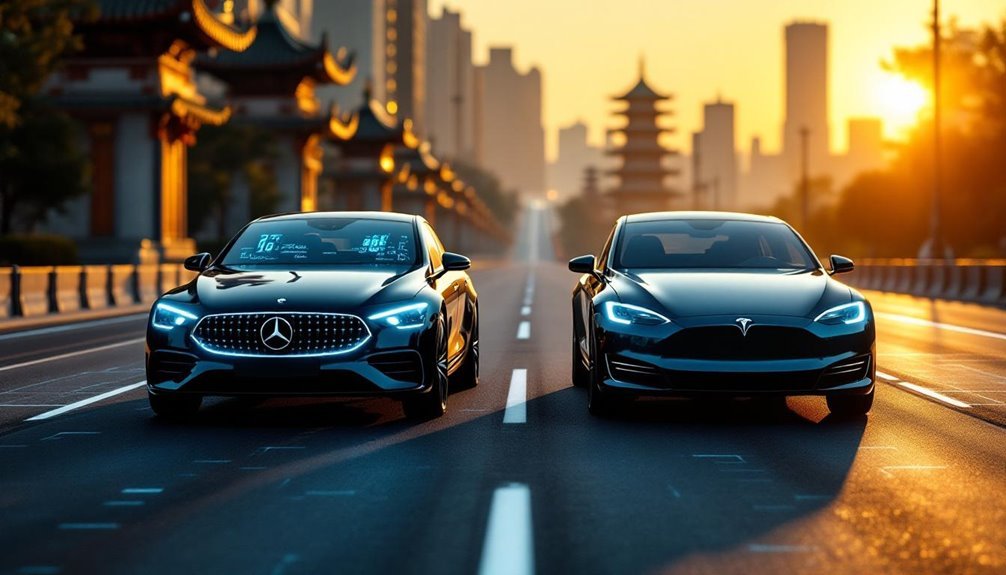

In a significant regulatory milestone, Tesla, Mercedes-Benz, and Volvo‘ve become the first foreign automakers approved to roll out AI chatbots in China. The three companies received approval in November 2024 to deploy their in-vehicle AI assistants to Chinese customers. This breakthrough marks an important moment for foreign technology companies seeking to enter China’s heavily regulated AI market.
Tesla, Mercedes-Benz, and Volvo become the first foreign automakers approved to deploy AI chatbots in China’s heavily regulated market.
The Cyberspace Administration of Beijing registered Mercedes-Benz’s virtual assistant as a generative AI service. On the same day, Shanghai authorities approved both Tesla Shanghai’s xBot service and Volvo’s local chatbot called Xiao Wo. These AI systems are designed to provide interactive assistance to vehicle occupants, helping drivers and passengers with various tasks while on the road.
China implemented a registration-based system for generative AI services in April 2024. This system requires all generative AI services to complete registration and pass examination before companies can offer them to consumers. The framework applies equally to both domestic and foreign companies operating in the country. The process verifies that services comply with China’s data security and AI regulations. Cross-jurisdictional regulatory coordination between Beijing and Shanghai demonstrates China’s unified approach to managing AI deployment across major cities. The xBot service was specifically designed to deliver intelligent Q&A support for Tesla owners and prospective customers across pre-sale, in-sale, and after-sale consultations. Mercedes-Benz’s AI service adopts ByteDance’s large language model for its voice interaction capabilities. Tesla’s in-vehicle AI also leverages DeepSeek and ByteDance models for enhanced speech recognition and navigation features. Tesla vehicles operating in China utilize Baidu Maps instead of Google Maps for their navigation systems.
The approval represents a shift in China’s regulatory approach toward foreign AI technologies. As of November 1, 2024, 611 generative AI services had been registered nationwide. Beijing had registered 183 services, while Shanghai had registered 115. The registration-based system acts as a de facto examination and approval process for all AI services seeking consumer rollout. However, other foreign AI products still await approval. Apple Intelligence remains unapproved for mainland China iPhones, and Tesla continues waiting for approval of its Full Self-Driving software.
The three automakers’ success suggests that China’s regulatory procedures may be accelerating. Previously, domestic brands held a competitive advantage because they’d already registered AI services. Foreign companies faced longer wait times and stricter scrutiny. This approval demonstrates that the process can work for international technology firms willing to meet China’s requirements.
AI technology is increasingly becoming embedded in vehicles and other hardware products. The registration approval opens doors for wider adoption of in-vehicle AI assistants across the automotive industry. This development reflects China’s strategic approach to balancing AI innovation with regulatory control. The milestone shows how foreign companies can successfully steer through China’s complex technology regulations.