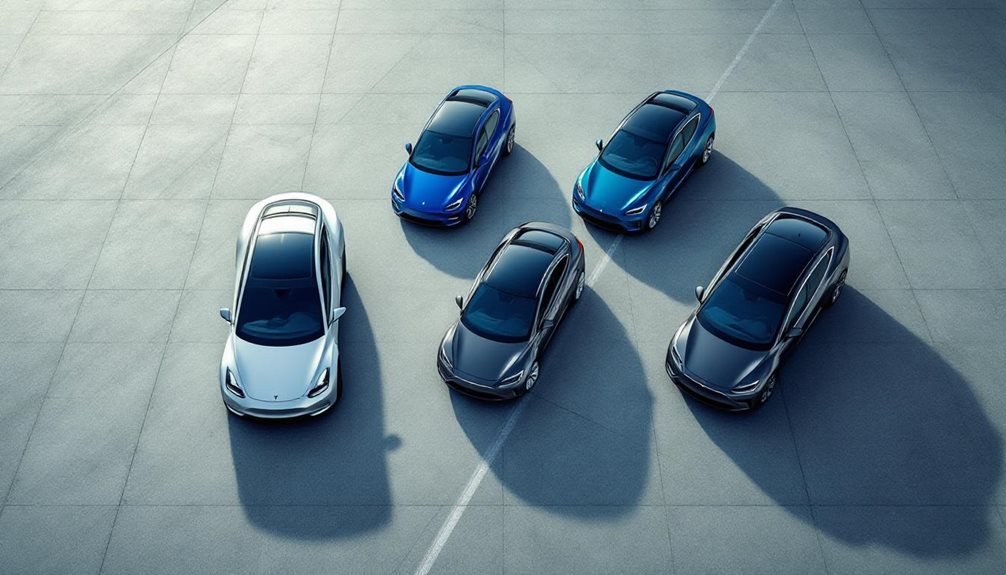
As Tesla prepares to expand its lineup in China, the company’s filing with the Ministry of Industry and Information Technology reveals two new electric vehicles designed for different buyers. The Model Y L and Model 3+ represent Tesla’s latest attempts to capture more of China’s growing electric vehicle market.
Tesla’s regulatory filing unveils two new EVs tailored for Chinese consumers: the stretched Model Y L and efficiency-focused Model 3+.
The Model Y L is a stretched version of Tesla’s popular SUV. It’s 4,976 millimeters long with a 3,040-millimeter wheelbase, making it 255 millimeters longer than the Model 3+. This extra length allows for six seats instead of the standard five. The vehicle weighs 2,088 kilograms and uses an 82 kWh battery pack from LG Energy Solution. Despite being the largest battery ever put in a Model Y, it only delivers 751 kilometers of range using China’s CLTC testing standard.
The Model 3+ takes a different approach. It’s smaller and lighter at 1,760 kilograms, with a 78.4 kWh battery that provides up to 830 kilometers of range. That’s 79 kilometers more than the larger Model Y L, even though its battery is smaller. The Model 3+ uses a single rear motor producing 225 kW of power, while the Model Y L has two motors totaling 340 kW. The Model 3+ will start at 270,000 yuan when it enters the market in September.
These range numbers matter in China’s competitive market. Chinese automakers now offer electric vehicles with ranges exceeding 1,000 kilometers. Tesla’s new models don’t match those numbers, which could affect sales. The Model Y L’s dual-motor setup and heavier weight explain why it gets less range than the Model 3+ despite having a bigger battery. Both batteries achieve similar energy density levels of 175-176 Wh/kg, showing Tesla’s consistent battery technology across models.
Tesla designed these vehicles for specific Chinese buyers. The Model Y L targets families who want more space and seats. Its taller height of 1,668 millimeters and six-seat layout appeal to Chinese SUV preferences. The Model 3+ aims at commuters who prioritize maximum driving range over cargo space.
Both vehicles are scheduled for release in China’s third quarter of 2025. They’ll compete in a market where local brands offer longer ranges at competitive prices. Whether Tesla’s brand reputation and technology can overcome the range disadvantage remains uncertain.