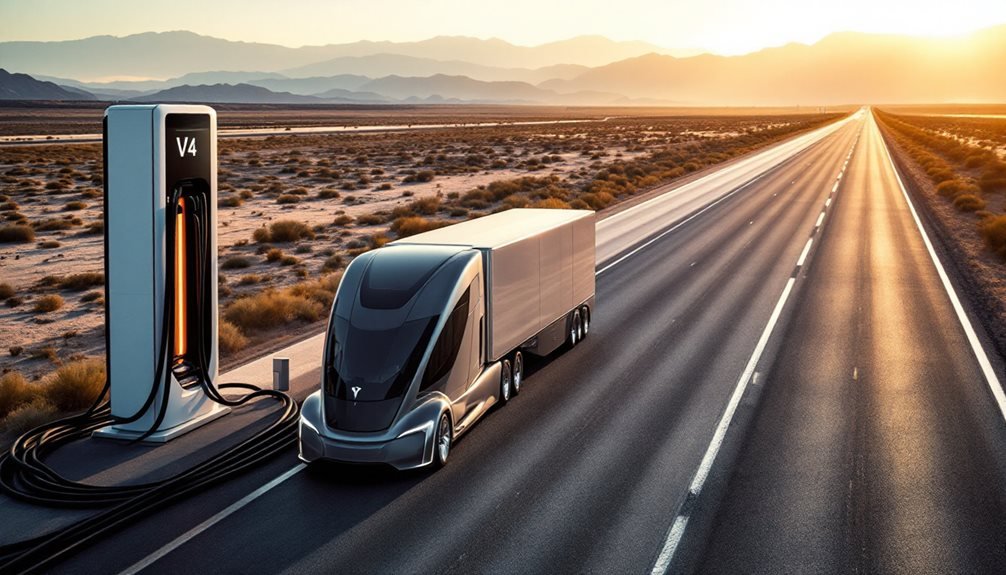

Tesla’s pushing into the long-haul trucking market with powerful new charging technology that can deliver 1.2 megawatts of electricity to its Semi trucks. The company’s new V4 Power Electronics Cabinet supports voltages up to 1,000 volts and can power eight charging stalls at once. This technology marks a major shift in how electric trucks might operate on highways.
The V4 cabinets cost less than $40,000 per stall to install, down from the $40,000 to $45,000 range for older V3 versions. Tesla offers pre-assembled units that speed up installation times. Each cabinet can handle both regular cars and massive commercial trucks, making the stations more versatile.
Tesla’s charging network already spans the globe with 7,500 stations and over 70,000 connectors. About 3,000 stations operate in Asia Pacific, another 3,000 in North America, and 1,500 in Europe. The company added 2,200 new stalls in the first quarter of 2025 alone, growing the network by 17% compared to last year. China represents the second largest market with nearly 2,200 Supercharger sites after the United States.
Tesla operates 7,500 charging stations worldwide with over 70,000 connectors, expanding rapidly across three continents.
The first 500-kilowatt Superchargers will launch in the third quarter of 2025, with Campbell, California among the first locations. Current chargers max out at 325 kilowatts, but the new ones will deliver 500 kilowatts to passenger vehicles. The Semi trucks will get even more power at 1.2 megawatts, enough to charge their huge batteries quickly during mandatory rest breaks. Tesla’s existing Superchargers can reach 80% charge in approximately 15 minutes at 250 kW for passenger vehicles.
Tesla’s network handled 42 million charging sessions in early 2025, up 27% from the previous year. These sessions delivered 1.4 terawatt-hours of energy, replacing about 173 million gallons of gasoline. The company calculates this prevented 1.5 billion kilograms of CO2 from entering the atmosphere.
The charging stations work for both Tesla and non-Tesla vehicles. Major automakers including Ford, GM, BMW, and Mercedes-Benz have committed to adopting Tesla’s NACS standard by 2025, expanding the network’s potential user base. Users pay for the electricity they use, plus idle fees if they leave their vehicle plugged in too long. Some busy locations also charge congestion fees. Commercial fleet operators can integrate these costs into their management systems.
Tesla expects 2025 to be a record year for new station openings. The company’s focusing on major trucking routes where commercial vehicles need reliable charging. This infrastructure could help electric trucks compete with diesel ones on long-distance routes.