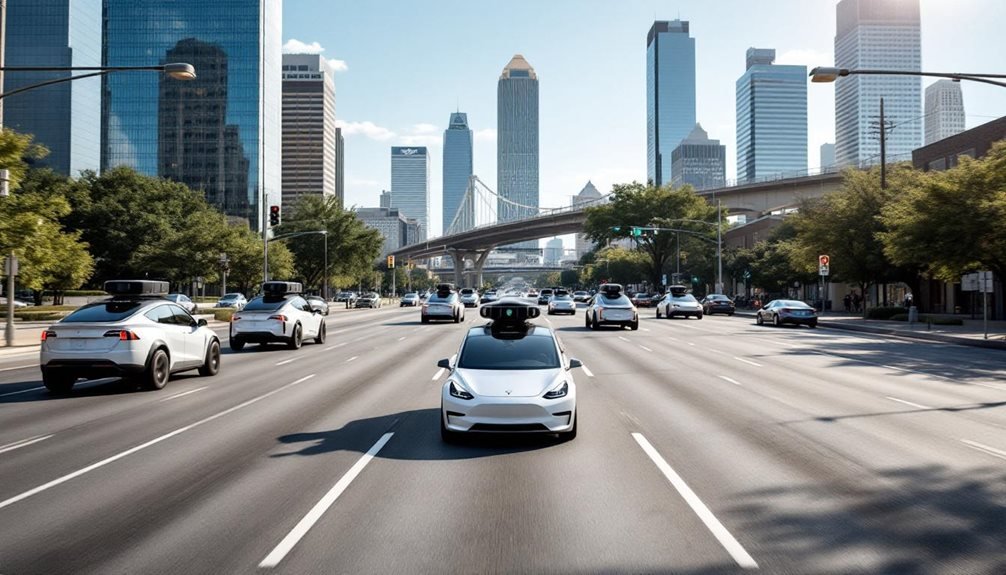

While most automakers test autonomous vehicles with special equipment, Tesla’s taking a different path in Austin. The Texas DMV recognized Tesla as an autonomous vehicle operator, and the company’s started its Robotaxi service around Gigafactory Texas. Instead of building new cars, Tesla’s using regular Model Y vehicles with their existing Full Self-Driving software.
Tesla’s ditching special equipment and betting everything on regular Model Y vehicles with FSD software.
The first public sighting showed an unmodified Model Y operating as a Robotaxi on Austin roads. Tesla’s promotional materials suggest the full service could launch by June 2025. On June 28, Tesla plans to demonstrate driving a vehicle directly from factory to a customer completely autonomously.
The Robotaxi fleet works in a limited area that’s about 30 minutes from the Gigafactory. Users will order rides through the Tesla app, just like other rideshare services.
Tesla’s also using Cybertrucks with special equipment on their roofs to map Austin’s streets. These trucks carry two types of devices – what looks like LiDAR towers and FSD data validation racks. The vehicles drive day and night, collecting information about traffic patterns and road obstacles. Multiple vehicles work together to make sure the data’s accurate.
The Cybertrucks focus on downtown Austin, especially around South Congress Bridge. This area’s challenging for self-driving cars because it’s got complex traffic patterns. The mapping work goes beyond the current service area, preparing for future expansion.
Dozens of validation vehicles are now working to improve the FSD software’s abilities.
Not everyone’s convinced Tesla’s approach will work. Safety concerns exist about vehicles wayfinding Austin without special autonomous hardware. A Seeking Alpha report questioned whether Tesla’s vision for self-driving cars makes sense.
Critics worry the FSD software can’t handle all road conditions reliably. Legal risks also exist when implementing autonomous vehicles this way.
Tesla’s production numbers show they’re ready to scale. They made 362,000 vehicles and delivered 336,000 in the first quarter of 2025. The company also deployed 10.4 GWh of energy storage, which could support charging infrastructure. The expansion of Robotaxi services may drive demand for Tesla’s Wall Connector charging infrastructure as customers transition to electric vehicle ownership. Tesla will announce its Q1 financial results on April 22, 2025, providing more details about the company’s performance and autonomous vehicle investments. Additionally, Tesla’s ongoing commitment to quality and reliability is evident in its efforts surrounding tesla’s fight against dojo defects, which aims to enhance the performance of its AI systems. The successful resolution of these issues is crucial for maintaining customer trust and ensuring the smooth rollout of its autonomous technology. As Tesla continues to innovate, the impact of these advancements will likely be reflected in future production and delivery figures.
Model Y production volumes might allow Tesla to grow the Robotaxi fleet quickly. Whether this strategy succeeds depends on how well the FSD software performs in real-world conditions.