
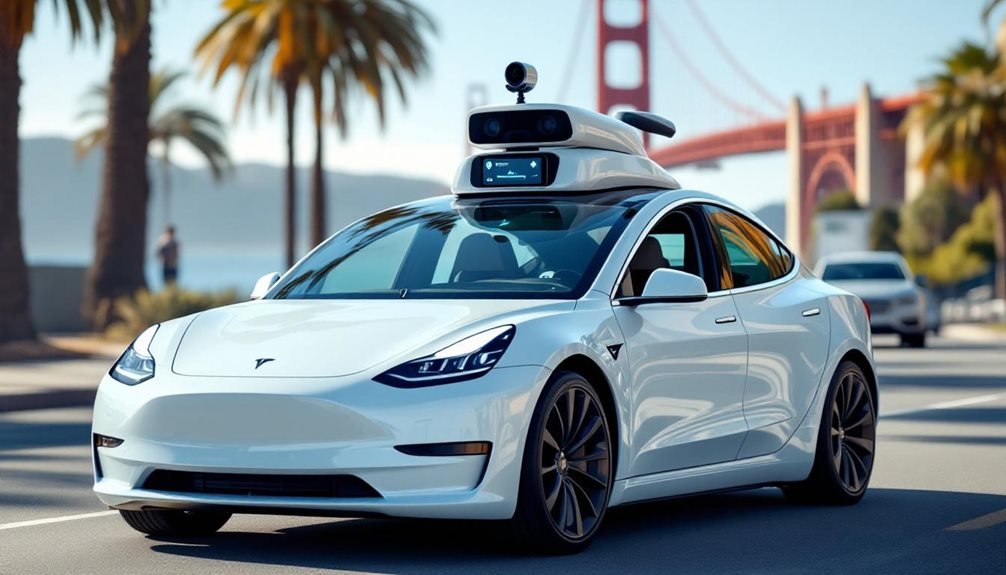
Tesla’s planning to launch its robotaxi service in the San Francisco Bay Area during the weekend of July 25-26, 2025. The company will start with invitation-only access for selected Tesla owners through its Robotaxi app. The service will operate in Marin County, East Bay, San Jose, and San Francisco using modified Model Y vehicles.
Tesla’s approach differs from typical autonomous vehicle services. The company will place monitors in the driver’s seat in California, while in Austin they sit in the passenger seat. These monitors won’t operate the vehicles but will collect data. The Model Ys come equipped with extra telecommunications units from the Austin program. Waymo currently operates 1500 driverless vehicles across five cities without any human monitors present.
Tesla monitors collect data from driver seats in California, passenger seats in Austin – they don’t operate the vehicles.
The launch faces significant regulatory obstacles. Tesla holds a permit from the California Public Utilities Commission for human-driven fleets but lacks authorization for autonomous vehicles. The permit doesn’t allow public passenger rides in self-driving cars. Tesla argues its vehicles need active human supervision, which contradicts the “robotaxi” branding. State Senator Scott Wiener has warned of consequences for deploying autonomous vehicles without proper permits.
California’s Department of Motor Vehicles is investigating Tesla for allegedly misleading customers about its Autopilot and Full Self-Driving features. The DMV wants to suspend Tesla’s manufacturing and sales for 30 days. State regulators worry about public safety and question whether Tesla’s ready for autonomous implementation.
Elon Musk told followers on social media the service would launch in “a week or two.” The timing matches an X Takeover event in San Mateo. A Business Insider memo revealed staff learned about expanded operational zones. Despite calling it a robotaxi service, human monitors will remain in the vehicles.
Industry experts express skepticism. Brad Templeton criticized Musk’s unclear claims about “clean” self-driving capabilities. Competitors like Waymo already operate fully autonomous vehicles without human monitors.
The Bay Area service covers more ground than Austin’s trial program. Tesla obtained its California permit in March 2025 for human-driven services. Both locations use invite-only access for early users. The main difference remains monitor placement and permit restrictions between states.
Tesla’s pushing ahead despite legal challenges and regulatory restrictions. The company frames the DMV lawsuit as an attempt to slow autonomous vehicle adoption.