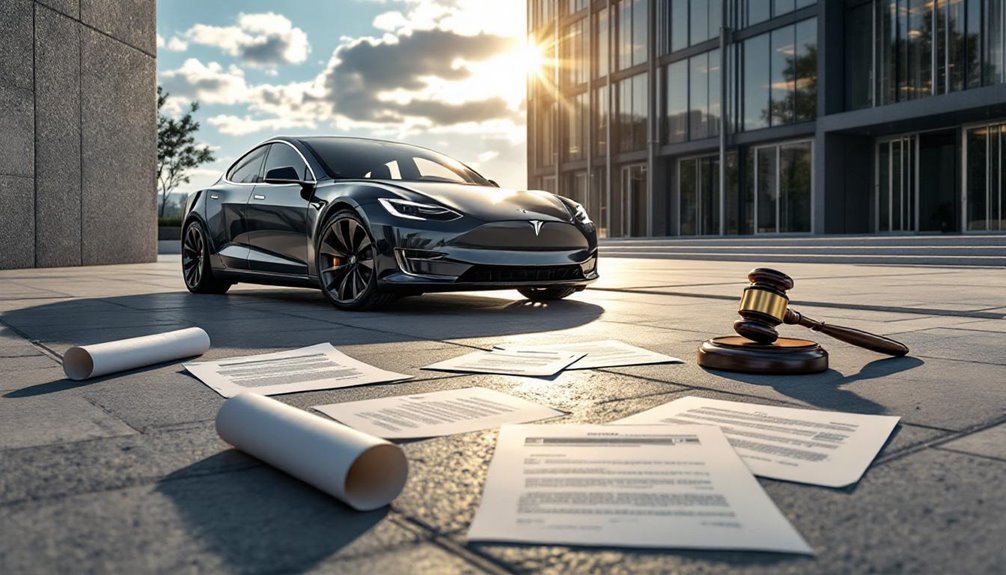
How far did Tesla’s promises go? Seven Chinese Tesla owners filed a lawsuit against the company in Beijing’s Daxing District People’s Court, claiming the company made false promises about its Full Self-Driving (FSD) features. The court accepted the case in August 2025, marking the first collective legal action in China targeting Tesla’s autonomous driving claims.
Seven Chinese Tesla owners filed the first collective lawsuit against the company for allegedly making false promises about its Full Self-Driving features.
The plaintiffs say they paid for FSD capabilities that never worked as promised. One customer paid 56,000 RMB (about $7,800) for the feature back in August 2019. Sales representatives allegedly told customers that FSD would “definitely be achieved and soon available in China.” However, the customers uncovered that their vehicles could only perform automatic lane changes on highways. Other promised features, like summoning cars in open parking lots, reportedly never functioned at all. Industry experts have increasingly questioned whether Tesla’s camera-only approach can achieve the higher levels of autonomous driving the company claims.
The lawsuit claims Tesla concealed a major technical problem from buyers. Vehicles equipped with Hardware 3 chips apparently can’t deliver the promised FSD features. Tesla recently revealed it’d only roll out FSD to newer HW4.0 chip vehicles. Meanwhile, the U.S. is already testing an “Unsupervised” version through robotaxi services, while China’s version remains unachieved. The plaintiffs allege that Tesla knew regulatory approval was not obtained at the time of sale.
The customers’re seeking full refunds plus triple compensation under China’s Consumer Rights Protection Law. Potential damages could reach 256,000 RMB (about $36,000) per customer. Hundreds of other Chinese Tesla owners are reportedly consulting lawyers about joining the lawsuit. Tesla owners can purchase FSD later through the Tesla app or opt for a monthly subscription at $199 per month for those preferring a flexible payment option.
China’s Ministry of Industry and Information Technology banned the term “autonomous driving” in April 2025 due to misleading advertising concerns. Tesla changed FSD’s Chinese name to “Intelligent Assisted Driving” after the regulation. The company launched the trial version in China in 2025, offering a one-month trial period. The software is priced at 64,000 yuan, making it a significant investment for consumers seeking advanced driving capabilities.
This isn’t Tesla’s only FSD problem. The company’s simultaneously facing a similar class action lawsuit in U.S. courts. A federal judge recently denied Tesla’s motion to dismiss that case. The lawsuits highlight growing concerns about whether Tesla’s self-driving promises match reality across multiple countries.