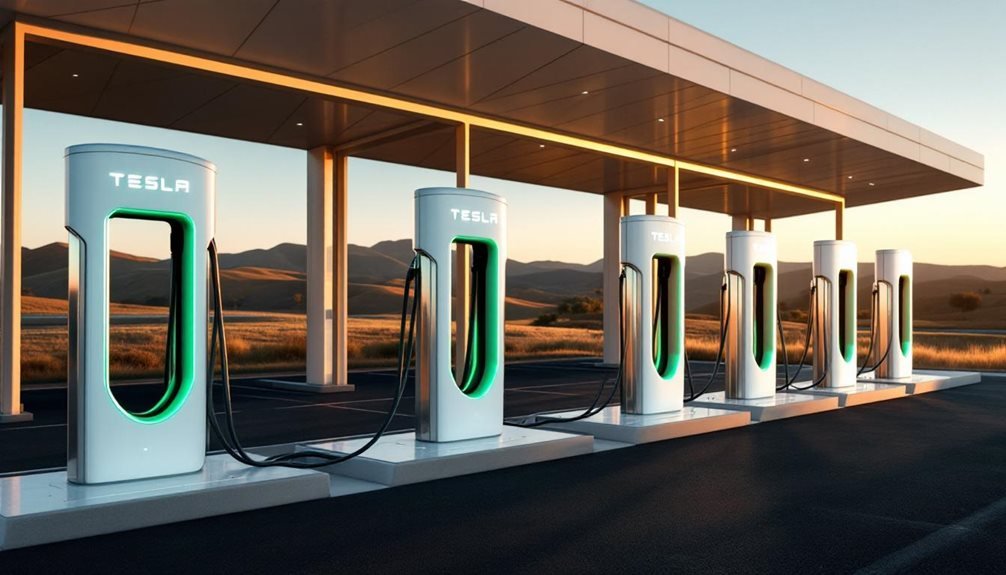
Tesla’s Supercharger network achieved a 99.95% average uptime in 2024, marking a slight improvement from previous years. This means the charging stations were available for use almost all the time, with only about 4 hours of downtime per year at each location.
Tesla’s charging stations were available 99.95% of the time, with only 4 hours of yearly downtime.
The company’s investment in redundant power systems and rapid maintenance protocols has kept the network running smoothly. When hardware problems occur, dedicated service teams fix them within hours. Tesla’s also using software that automatically checks for issues before they cause problems.
Tesla’s expanding its charging network faster than ever. The company added 2,200 new Supercharger stalls worldwide in the first quarter of 2025. That’s a 17% jump from last year. The total number of stalls has now passed 50,000 globally. Tesla’s focusing on busy travel routes where drivers need charging the most. The expansion targets high-traffic areas where potential EV buyers can see the infrastructure firsthand. In addition to expanding the Supercharger network, the company is also invested in upgrading existing stations to provide faster charging times. This effort aligns with Tesla’s 2025.26 update details, which emphasize enhanced charging efficiency and user experience. As the demand for electric vehicles grows, these improvements are essential to support the increasing number of drivers transitioning to EVs. As Tesla continues to expand its charging infrastructure, the company is also facing increasing scrutiny regarding its autonomous vehicle initiatives. Recently, the rollout of Tesla robotaxis under scrutiny has raised questions about safety and regulatory compliance. Despite these challenges, Tesla remains confident in the future of its self-driving technology and the potential for a fully integrated electric vehicle ecosystem.
The network’s providing massive amounts of energy. In Q1 2025, Superchargers provided 1.4 terawatt-hours of electricity through 42 million charging sessions. That’s 26% more energy than the same period last year. Tesla expects to deliver 1.6 terawatt-hours in Q2, with 45 million sessions.
All this electric driving saved the equivalent of 173 million gallons of gasoline. The average charging session now delivers 35.5 kWh, up from 33 kWh earlier in 2025.
The reliable network’s transforming how people use electric cars. Drivers worry less about running out of power on long trips. More non-Tesla EVs are using the stations through CCS adapters. But success brings challenges. About 30% of stations see wait times over 10 minutes during busy periods. Tesla’s app shows real-time availability to help drivers plan better. Tesla’s reliable charging infrastructure complements the company’s commitment to safety, as Tesla vehicles achieve the lowest injury probability in standardized crash tests.
Tesla spent over $500 million in 2024 to expand into cities and rural areas. They’re partnering with hotels, restaurants, and shopping centers. The company’s testing new 350-kilowatt chargers that’ll charge cars even faster. They’re also replacing older V2 chargers with newer V4 models. This expansion is part of a broader strategy to cater to a growing customer base and accommodate the rising demand for electric vehicle infrastructure. By enhancing charging options in various locations, Tesla is addressing convenience and accessibility, which are crucial for potential buyers. This initiative is also a key reason why Tesla is diversifying operations, ensuring the company remains competitive in a rapidly evolving market.
The network uses innovative technology to manage busy times. Dynamic load balancing distributes power between cars when stations get crowded. Remote diagnostics let technicians fix problems without visiting the site. Tesla’s building tools to forecast station usage and help drivers find the best routes.