
Tesla’s 2025 towing lineup spans from the Model 3’s modest 2,200-pound capacity to the Cybertruck’s beastly 11,000-pound limit. The Model Y handles 3,500 pounds with an optional package, while the Model X maxes out at 5,000 pounds—unless you pick those fancy bigger wheels, then it drops to 3,500. Here’s the kicker: towing heavy loads can slash your range by two-thirds. The math gets interesting when you factor in charging stops and real-world conditions.
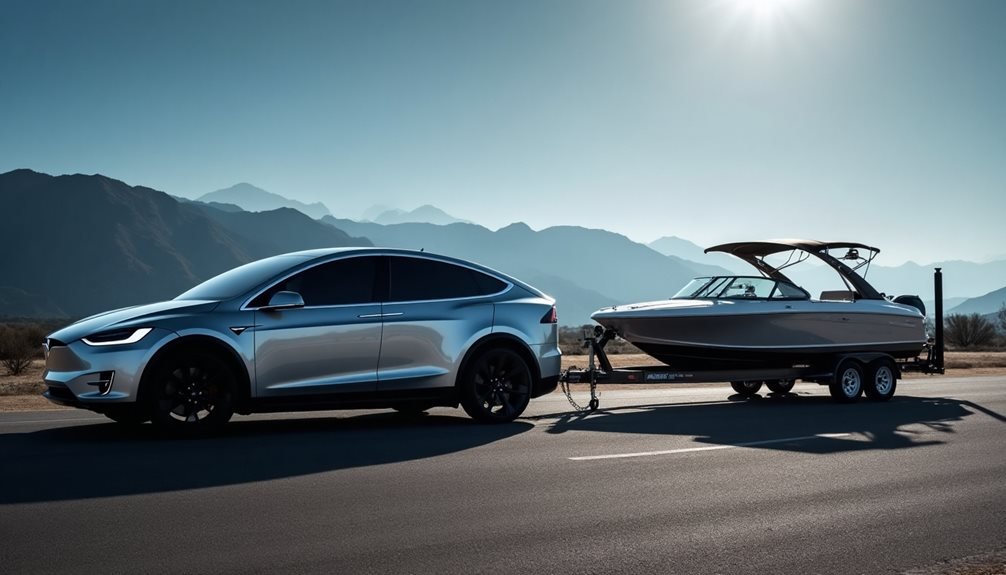
Why would anyone assume electric vehicles can’t haul serious weight? Tesla’s lineup proves that notion dead wrong, offering towing capacities that range from respectable to downright impressive across multiple models.
The Tesla Model X leads the current production pack with a 5,000-pound towing capacity, complete with trailer brake support and standard towing package. That’s serious hauling power.
The Model Y AWD follows with 3,500 pounds when equipped with the optional $1,300 tow package, which includes a steel tow bar, hitch, connector, and Trailer Mode functionality.
Tesla’s newest addition to the towing game is the Model 3 Highland, introduced for 2024 and beyond. Non-Performance variants can pull 2,200 pounds with an optional towing package that includes suspension upgrades. Not bad for a sedan that some folks still think of as just a commuter car. The Model 3’s towing package is not available in all regions, limiting options for some potential buyers.
Then there’s the Cybertruck. The Long Range variant handles 7,500 pounds, while the AWD and Cyberbeast models jump to an eye-watering 11,000 pounds. Rumors suggest potential capacities reaching 10,000 to 14,000 pounds, but those numbers remain unconfirmed.
Here’s the reality check: towing demolishes range. We’re talking up to two-thirds reduction due to increased weight and drag. Trailer Mode provides adjusted range estimates, but actual consumption varies wildly. Heavier loads mean more charging stops. Period. Tesla’s dual-channel system helps manage battery cooling during demanding operations like heavy towing. Braked towing capacity applies when trailers have their own braking systems and typically allows for higher weight limits than unbraked configurations.
The details matter more than you’d think. Model X owners with 22-inch wheels get limited to 3,500 pounds instead of the full 5,000-pound capacity available with smaller wheels. Aerodynamics and weight distribution become critical factors for efficient towing.
Safety features across Tesla’s lineup include trailer-specific stability control adjustments and braking system modifications.
The company prohibits towing at maximum capacity on steep or uneven terrain, and they’re serious about proper weight distribution to prevent instability.
Tesla’s approach to towing proves electric vehicles aren’t just for grocery runs anymore. These machines can handle real work, though the range penalty remains the price of admission.
The Cybertruck’s armored design might offer improved towing safety, but only the future will reveal how it performs in real-world conditions.
Frequently Asked Questions
Does Towing a Trailer Void Tesla’s Warranty Coverage?
Towing a trailer doesn’t automatically void Tesla‘s warranty—if you follow the rules. Use Tesla’s official towing package, stay within weight limits, and you’re fine.
Go rogue with third-party hitches or exceed capacity? Kiss your coverage goodbye. Model 3 owners are out of luck entirely since Tesla doesn’t support towing on that model.
Stick to the guidelines or face the consequences.
Can I Install a Third-Party Hitch on My Tesla?
Installing a third-party hitch on a Tesla is possible but comes with serious tradeoffs.
The EcoHitch works on Model Y (2020-2025) with 3,500 lbs towing capacity and no drilling required.
However, Tesla’s Trailer Mode won’t activate, meaning no cruise control adjustments, braking optimization, or Autopilot integration.
Plus, it voids the warranty.
The Model 3 can’t be retrofitted in North America.
How Does Cold Weather Affect Tesla’s Towing Range?
Cold weather absolutely hammers Tesla’s towing range. Batteries lose 20-30% capacity below freezing, and towing already drains power fast. That’s a brutal combo.
Regenerative braking becomes less effective too, so drivers lose energy recovery on downhills.
Plus, cabin heating eats more battery juice while cold-thickened fluids slow charging rates.
Winter towing basically turns road trips into charging station marathons.
What Happens if I Exceed Tesla’s Maximum Towing Weight Limit?
Exceeding Tesla’s towing weight turns expensive fast. The hitch system buckles, chassis warps, and suspension components strain beyond limits.
Range plummets by two-thirds while dashboard warnings flash frantically. Control becomes sketchy, braking distances stretch dangerously, and maneuverability tanks.
Tesla voids the warranty instantly. Insurance claims get rejected. Legal penalties stack up for violating towing regulations.
Basically, the truck breaks and the owner pays.
Do I Need Special Towing Mirrors When Pulling a Trailer?
Special towing mirrors aren’t automatically required, but they might be necessary depending on trailer width. If the trailer extends beyond the vehicle’s width, blocking rearview visibility, extended mirrors become essential.
Tesla recommends adjusting side mirrors outward when towing.
State laws vary—some jurisdictions mandate auxiliary mirrors regardless of trailer size. Wide boats, RVs, or cargo trailers typically need them.
It’s about maintaining clear sight lines, not meeting arbitrary requirements.