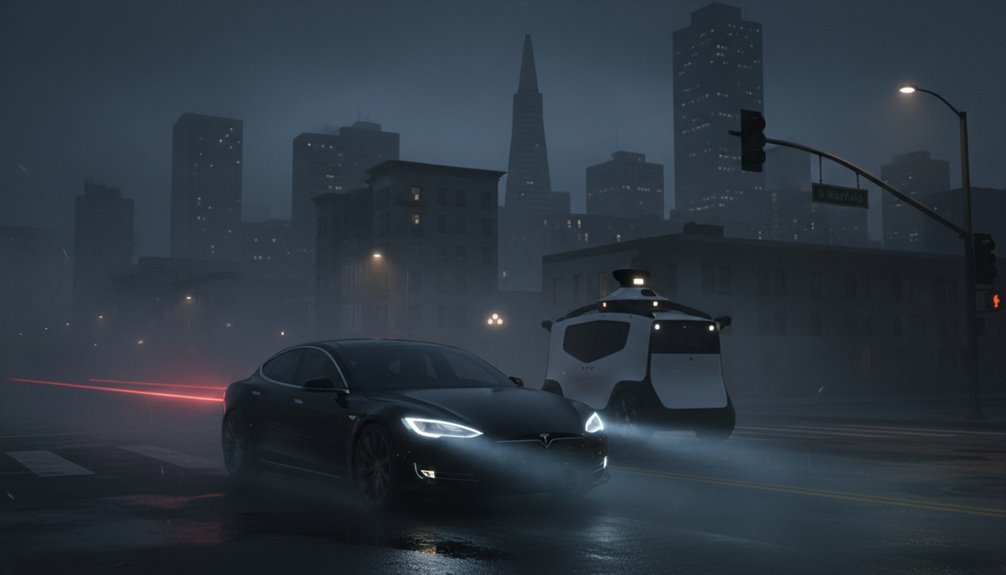
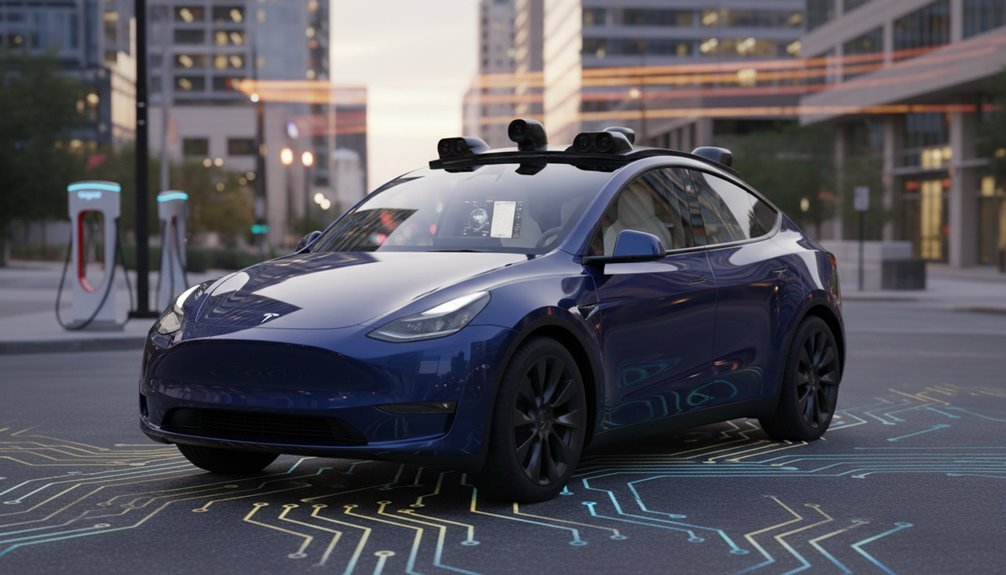
While both Tesla and Waymo are racing to perfect self-driving technology, the two companies take very different approaches. Waymo equips its vehicles with 29 cameras, 6 radars, and 5 lidars. Tesla relies on just 8 cameras for its vision-based system. This difference in sensors shapes how each company operates and performs on city streets. Waymo’s sensor redundancy allows data cross-checking and enhances safety through multiple detection methods.
Waymo’s 40-sensor approach contrasts sharply with Tesla’s minimalist 8-camera vision system, fundamentally shaping each company’s autonomous strategy.
A Business Insider test from Twin Peaks to Chase Center showed both systems in action. Waymo handled an intersection safely and avoided a red light error that Tesla made. However, Tesla executed smooth highway driving, which isn’t available to Waymo customers yet. Waymo displayed assertive maneuvers like lane changes at stop signs. Tesla showed no phantom braking on San Francisco’s winding, hilly roads.
The companies’ safety records tell different stories. Waymo has logged nearly 100 million rider-only autonomous miles. Tesla accumulated about 50,000 driverless miles in its limited Austin rollout. Waymo reports 9,793 miles driven per disengagement in California, meaning a safety driver rarely needs to take control. Tesla’s disengagements happen more frequently, around every 200 miles. Elon Musk anticipates millions of autonomous Teslas by 2026 as part of the company’s aggressive expansion timeline.
Waymo currently provides 250,000 paid rides weekly across multiple cities. The company recently expanded to Uber customers in Atlanta. Tesla launched its robotaxi pilot in Austin with Model Y vehicles. Waymo avoids highways for public rides and focuses on city streets. The company uses HD maps and sensor data to prepare for each city carefully. Waymo’s methodical approach involving years of testing per city demonstrates its commitment to thorough validation before expansion. Tesla’s approach relies on a fifth-generation Waymo Driver architecture that enables rapid scaling without pre-mapping each location.
Tesla takes a different approach. It relies on AI trained on billions of miles rather than mapping. The company aims for rapid scaling to any location once it launches in initial cities. Tesla plans to introduce the Cybercab and have millions of autonomous vehicles by 2026.
Analysts view Waymo as safer short-term due to its sensor redundancy. However, Morningstar predicts Tesla could launch fully by 2028 and overtake Waymo. Waymo lost $1.2 to $1.5 billion last year but expects profitability. Both companies continue pushing toward fully autonomous futures, each betting on their own technology strategy.