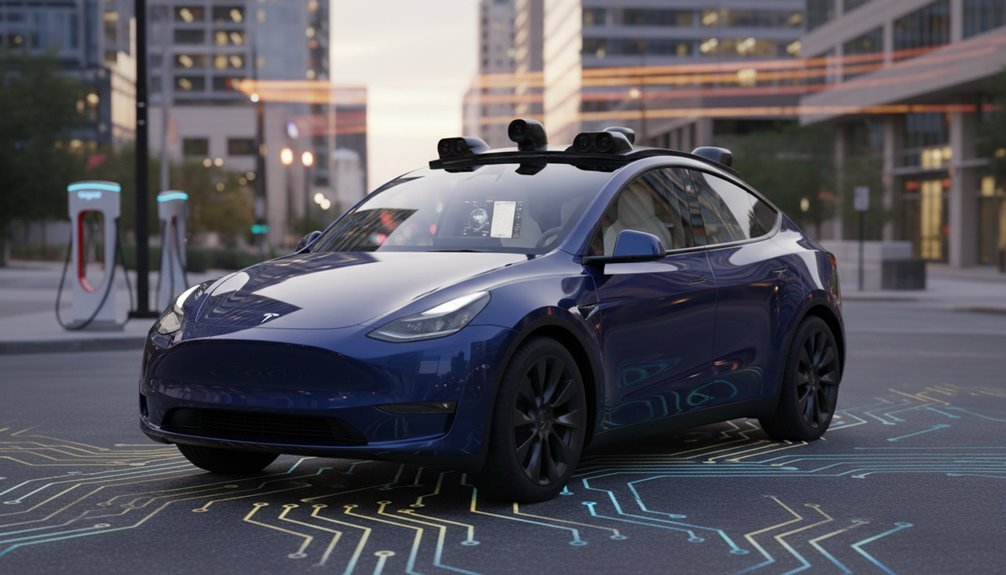
As Tesla moves forward with its autonomous vehicle ambitions, the company’s robotaxi service is expanding across the United States. The company launched its Austin pilot on June 22, 2025, with 10-20 modified Model Y vehicles operating in a geofenced area. Human safety monitors sat in the front passenger seats during this initial phase, ready to take control if needed. Tesla invited Full Self-Driving beta testers, EV influencers, and investors to try the service. The initial launch featured a flat promotional ride rate of $4.20 to attract early adopters during the invite-only phase.
The vehicles used teleoperation-assisted technology, allowing remote operators to help when the cars faced complex driving scenarios. Tesla’s Full Self-Driving software version 13 achieved 1.5 million miles per critical intervention during Q3 2025. The system relies on cameras and artificial intelligence instead of lidar sensors. Neural networks trained on billions of miles of driving data power the autonomous capabilities.
Tesla’s Full Self-Driving v13 achieved 1.5 million miles per critical intervention, powered by camera-based AI and neural networks trained on billions of driving miles.
By the end of 2025, Tesla planned to shift to fully driverless vehicles with no onboard safety operators. In the Bay Area, Tesla registered 1,655 vehicles and 798 drivers with California’s Public Utilities Commission. The company’s fleet was projected to reach approximately 1,500 vehicles by year’s end. Initial rollouts started with 1,000 units in California and Texas, expanding toward 10,000 by Q4. As of December 2025, Tesla maintained roughly 135 robotaxis in active service. Tesla’s safety testing demonstrated a 5.5 star safety score that exceeded human driver performance in internal evaluations. Internal recruitment of factory workers and sales staff as AI operators aims to minimize external hiring costs while capitalizing on employee knowledge.
Tesla identified five new cities for expansion: Las Vegas, Phoenix, Dallas, Houston, and Miami. The company’s rollout map covered 23 major cities, with California leading in rollouts. Plans included expanding to 8-10 metro areas by year’s end, pending regulatory approvals. However, the service faces operational challenges as robotaxis may struggle with severe weather conditions and complex urban intersections.
Looking ahead, Tesla’s Cybercab represents the next step. This purpose-built autonomous vehicle will enter production in 2026. Initial units were expected in Q2 2025 for employee testing at Giga Texas. The company targets a $25,000 price point with inductive charging capabilities.
Tesla aims for $0.20 per mile operating costs for competitive ride-hailing economics. The “unboxed” manufacturing process could enable production of 2 million units annually by 2027.