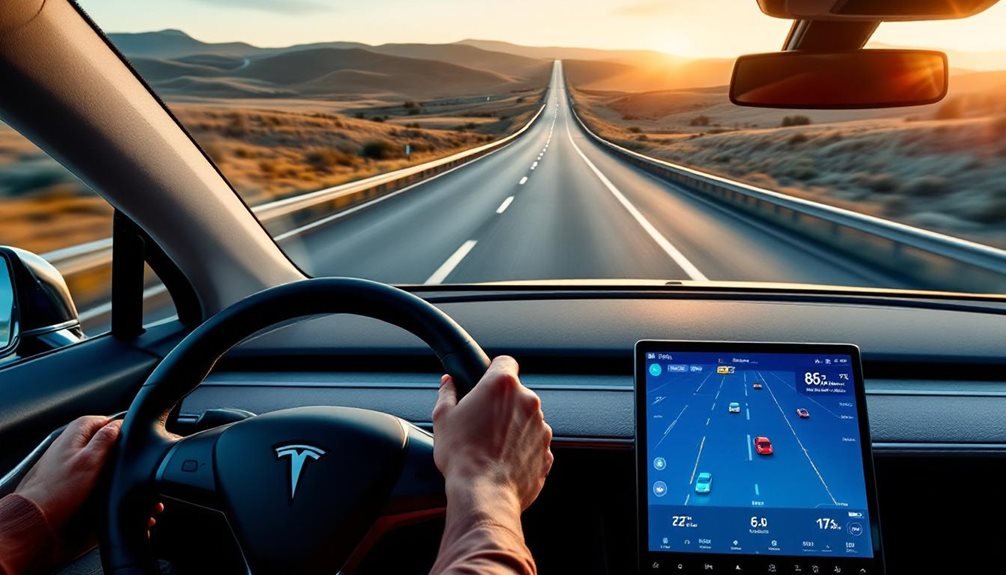

While Tesla’s Autopilot system can steer and control speed on highways, the technology still requires drivers to keep their hands on the wheel at all times. A recent viral video showing a Tesla traveling 360 miles apparently without driver intervention has reignited discussions about the system’s capabilities and safety requirements.
Tesla’s Autopilot includes Traffic-Aware Cruise Control and Autosteer as standard features. The system uses cameras to recognize objects and ultrasonic sensors that provide a 360-degree view, though they’re limited to detecting obstacles within 16 feet. This short range can affect the system’s performance during lane changes and other maneuvers.
Ultrasonic sensors detect obstacles within 16 feet, limiting the system’s reliability during lane changes and complex maneuvers.
The SAE International classifies Tesla’s Autopilot as Level 2 automation. This means drivers must constantly monitor the system and be ready to take control immediately. Even Tesla’s Full Self-Driving package remains at Level 2, despite its advanced-sounding name. The company’s owner’s manual clearly states that Autopilot shouldn’t be used on city streets or roads where traffic conditions constantly change.
Tesla’s hardware has evolved since 2014. The first version used a Mobileye EyeQ3 chip with a single front camera, forward radar, and 12 ultrasonic sensors. However, this early system couldn’t detect pedestrians or cyclists. Two documented cases show Hardware 1 vehicles rear-ending motorcycles, even though the system was supposed to detect these obstacles. Tesla ended its partnership with Mobileye in July 2016, leading the company to develop its own hardware systems.
Later versions added more computing power and features like dashcam and sentry mode. Tesla now offers free hardware upgrades to customers who purchase the Full Self-Driving package. The latest Hardware 4, released in January 2023, is manufactured by Samsung and claims to be three to eight times more powerful than its predecessor. But regardless of the hardware version, all systems maintain the same Level 2 classification.
The debate continues because some drivers post videos of extended hands-free driving, which contradicts Tesla’s official guidelines. The manual explicitly states drivers must “have hands on the wheel and be prepared” at all times. Features like Guide on Autopilot and Traffic and Stop Sign Control remain beta features that need constant driver oversight.
Weather conditions can compromise the camera-based system, and the ultrasonic sensors’ limited range restricts reliable obstacle detection. While the system includes automatic emergency braking, drivers must still verify all system decisions. Phantom braking incidents can cause sudden stops on highways, creating additional safety concerns for drivers relying on the system. These limitations explain why continuous driver supervision remains mandatory for safe operation.