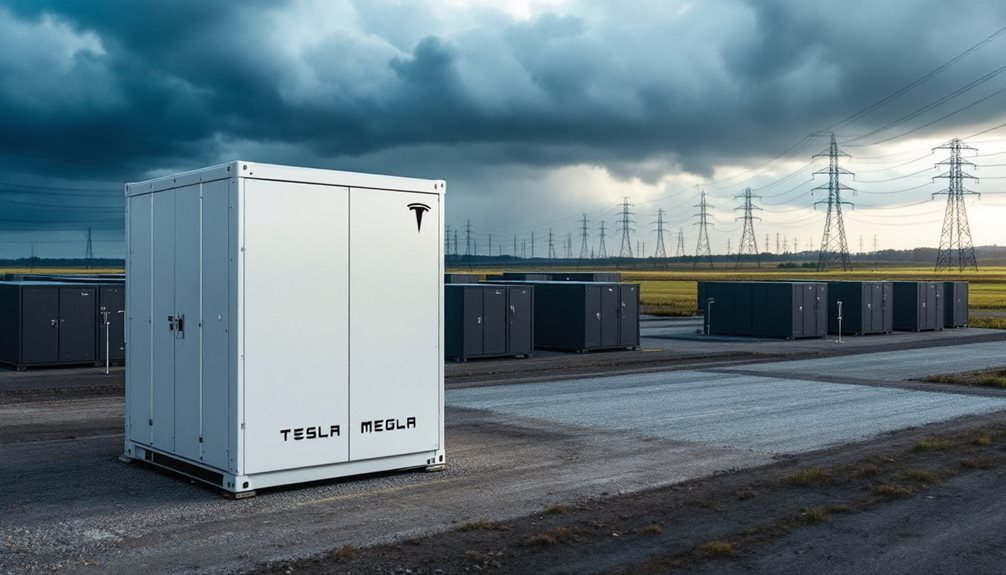
While most people know Tesla for its electric cars, the company’s making a massive push into the energy storage business with its Megapack battery systems. Tesla’s betting big on grid-scale energy storage as competitors like China’s CATL race to grab market share in this growing industry.
Tesla’s Megapack 2XL stores nearly 4 megawatt-hours of energy in a container-sized unit that weighs 84,000 pounds. Each unit costs about $1.47 million and comes with a 15 to 20-year warranty. The company’s achieved a 93.7% round-trip efficiency, meaning very little energy gets lost when charging and discharging the batteries.
The Lathrop facility in California now produces 10,000 Megapacks yearly. It’s become North America’s largest utility-scale battery manufacturing facility. Inside, over 30 welding robots build the core structure while 90 robotic paint atomizers apply protective coating. Each Megapack contains 24 battery modules that Tesla designs and manufactures in-house.
What makes Megapack attractive to utilities is its plug-and-play design. The units arrive pre-assembled and pre-tested from Tesla’s factories. They don’t need DC connections during installation, which cuts project costs by 40% compared to older Powerpack systems. The modular design lets utilities start small and add more units as their energy needs grow.
These giant batteries help electric utilities manage peak demand and provide backup power during grid disruptions. They can discharge power continuously for two to six hours depending on configuration. The systems scale from 1 megawatt-hour to over 1 gigawatt-hour installations, making them flexible for different utility needs. Tesla’s already deployed Megapacks at projects like the Victorian Big Battery in Australia, which became the largest battery storage system in the southern hemisphere at 450MWh capacity.
Tesla’s planning its next move with a “Las Megas” event scheduled for September 8, 2025, in Las Vegas. The company’s expected to reveal its next-generation Megapack at this keynote. Each Megapack unit operates at 480 V AC three-phase power, matching standard industrial electrical systems. Tesla also offers residential energy storage through its Powerwall technology, which integrates with solar panel systems for home energy management. Meanwhile, competitors aren’t sitting still. Chinese battery giant CATL and other rivals are developing their own grid-scale storage systems, threatening Tesla’s position in this market.
As renewable energy grows, utilities need more battery storage to manage intermittent solar and wind power. Tesla’s Energy division is becoming increasingly important to the company’s future. Whether Tesla can maintain its edge against aggressive international competitors will shape the future of grid-scale energy storage.