
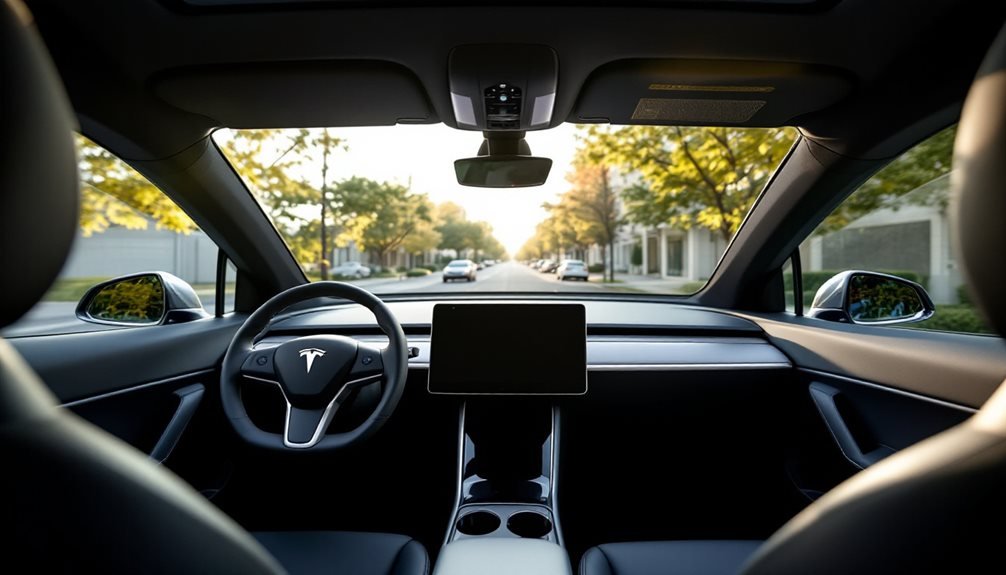
Tesla’s preparing to release its most advanced self-driving software yet with FSD version 14, which uses a neural network that’s 10 times more powerful than the current version. The company’s skipping an interim 4x parameter model and jumping straight to the 10x version for customers. This massive increase in processing power represents a major structural leap that’ll enable the system to handle more intricate information.
Tesla’s bypassing incremental upgrades to deliver a 10x neural network leap that fundamentally transforms how FSD processes complex driving scenarios.
The new software brings several real-world improvements that drivers have been requesting. It can now detect and avoid potholes, maneuver parking lots more effectively, and identify parking spaces with greater accuracy. Features like Smart Summon allow the car to navigate autonomously to the owner’s location while providing real-time camera views during operation.
Tesla’s also implemented major enhancements to video compression, which reduces information loss and helps the car’s cameras process visual details more clearly. These technical upgrades allow the system to make more sophisticated calculations in real-time.
According to recent announcements from Elon Musk on X, an early wide release is scheduled for next week, with a potential public release by the end of September 2025 if testing goes well. The model’s currently in its final testing phases before customer implementation. Version 14.1 is expected approximately two weeks after the initial 14.0 release, with version 14.2 planned as the final iteration of this update cycle.
Tesla describes the driving experience with v14 as much smoother, with some testers saying it feels “sentient” in operation. The improved processing power enables the car to handle difficult driving situations in a more human-like way.
Tesla’s planning to considerably reduce driver attention nags in v14, making the experience less intrusive for users. This represents another step toward Tesla‘s goal of fully unsupervised autonomous driving, where passengers could potentially sleep or use their phones during travel. The system currently operates as a Level 2 system that requires driver supervision and attention monitoring.
However, not all Tesla vehicles perform equally with the new software. The Cybertruck‘s FSD v13 performance is currently inferior to vehicles with AI4 hardware.
Tesla’s AI team is working to address issues specific to the Cybertruck’s large size and wedge-like design, which create different variables for processing. The Model Y Juniper has been identified as the best vehicle for FSD applications, while conventional Tesla models like the S, X, 3, and Y demonstrate better performance than the Cybertruck.
These neural network improvements form the foundation for Tesla’s planned robotaxi implementation, using the same technology that powers consumer FSD systems.