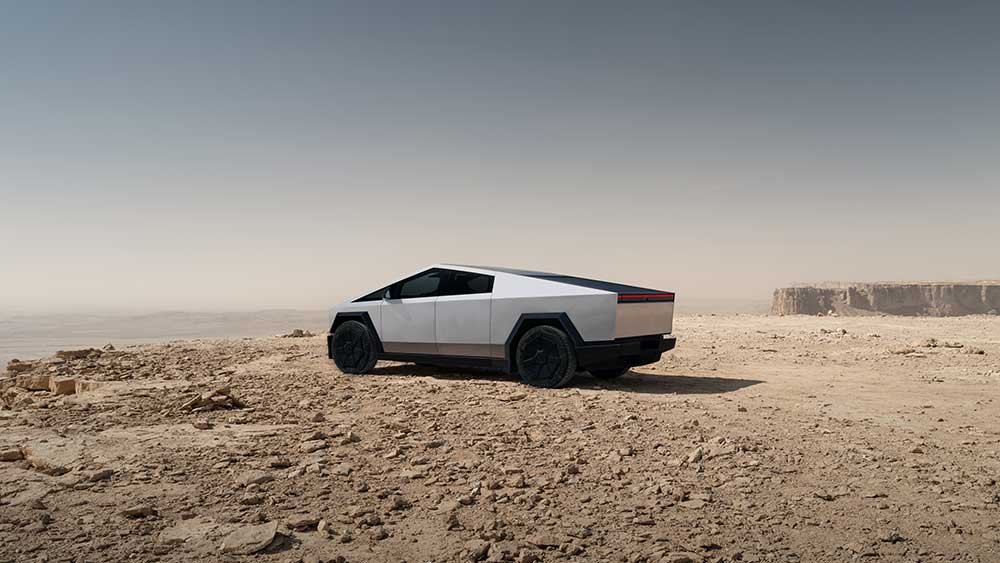

Single-Motor Rear-Wheel Drive Overview
What’s the deal with Tesla’s single-motor Cybertruck? It’s the efficiency play. One rear motor. 235 kW of power. 364 lb-ft of torque.
Honestly, it’s not the fastest—0-60 in 6.2 seconds is respectable, not revolutionary. But here’s the thing: single motor efficiency means 350 miles of EPA-estimated range. That’s the real draw. Rear drive dynamics keep things nimble despite the truck’s size. The Long Range RWD model was introduced mid-2025, expanding Tesla’s lineup with a more efficient option. The 8-year battery warranty is transferable to future owners, adding long-term value.
It’s built for folks who care about going far, not necessarily fast. Lower payload and towing than AWD variants, sure. But maximum range among all Cybertruck options? That’s worth something to efficiency-obsessed buyers. The single-motor RWD variant is exclusively available in the United States and Canada, limiting its global market reach.
Dual-Motor All-Wheel Drive Configuration
The dual-motor setup cranks out 593-600 horsepower and 525-743.5 lb-ft of torque, which translates to a 0-60 time of 3.8-4.1 seconds—pretty quick for a truck that weighs 6,603 pounds.
That 340-mile EPA range keeps the Cybertruck competitive with gas haulers on long hauls, though the 250 kW DC fast charging speed means you’re not exactly stuck waiting around. With adaptive air suspension providing 12 inches of travel, the dual-motor Cybertruck maintains composure across diverse terrain while preserving that extended range capability. The all-wheel drive system maintains stability on challenging surfaces like icy roads, ensuring consistent traction in extreme conditions.
With 11,000 pounds of towing capacity and a 2,500-pound payload, the dual-motor configuration proves it’s actually serious about being a truck, not just another electric novelty. In Sport mode, the Cybertruck delivers more focused handling and a lower ride height that maximizes acceleration performance during dynamic driving.
Performance and Acceleration
Brace yourself—the dual-motor Cybertruck accelerates hard, though Tesla’s official numbers and real-world testing don’t quite line up in the way you might expect. The company claims 4.1 seconds to 60 mph. Independent testers? They’ve consistently beaten that. MotorTrend nailed 3.8 seconds. Car and Driver hit 3.9. Launch control and battery heat management enable this brutality. With 600 horsepower and 743.5 lb-ft of torque distributed across two motors, the physics checks out. The 6,660-pound curb weight shouldn’t allow this speed. Yet it happens. The steer-by-wire system and adjustable air suspension work together to maintain traction during aggressive acceleration launches. This instant torque delivery creates a fundamentally different driving feel compared to traditional internal combustion engines.
| Source | 0-60 Time |
|---|---|
| Tesla Official | 4.1 sec |
| MotorTrend | 3.8 sec |
| Car and Driver | 3.9 sec |
| T Sportline | 3.9 sec |
| Real World | Varies |
Range and Battery Capacity
Most dual-motor Cybertruck owners will see 318 miles of EPA-rated range—on paper, anyway.
Real-world highway driving? Expect 224-254 miles instead. The 123 kWh battery pack delivers impressive specs, but cold weather, terrain, and driving style wreck efficiency fast.
Highway cruising at 70 mph burns 0.488 kWh per mile. Uphill stretches double that consumption.
All-terrain tires slash range by 22%. Battery degradation and charging etiquette matter for longevity. During the first 15 minutes of Supercharging from low battery, the Cybertruck adds 94 miles of range, outperforcing competing electric trucks in that critical initial interval.
The structural battery design adds rigidity, though peak DC fast-charging hits 250 kW. Real-time tow limit detection alerts warn you when vehicle load exceeds rated capacity to prevent damage and dangerous driving conditions. Bottom line: that EPA estimate assumes perfect conditions. Reality bites harder.
Towing and Cargo Capability
Dual-motor Cybertrucks flex serious hauling muscle—11,000 pounds of towing capacity, to be exact. That’s no joke.
The payload tops out at 2,500 pounds, with a six-foot composite bed handling payload distribution effectively. Hitch ergonomics work smoothly thanks to that high-resolution rear camera system.
Four-wheel steering makes maneuvering with trailers genuinely manageable. The air suspension automatically adjusts to tongue weight—around 800-900 pounds typically. With a curb weight under 6,700 lbs, the dual-motor Foundation Series remains impressively nimble despite its towing prowess. The reinforced steel construction provides structural durability for demanding hauling operations.
Regenerative braking recovers energy while decelerating with a trailer attached. Integrated trailer brake gain keeps everything coordinated.
Bottom line: this dual-motor setup outperforms the single-motor version markedly, handling 33-foot travel trailers like they’re nothing.
Tri-Motor Cyberbeast Specifications
The Tri-Motor Cyberbeast doesn’t mess around. This beast pumps out 834-845 horsepower and a jaw-dropping 10,296 lb-ft of torque. Yeah, you read that right. The acceleration? 0-60 in 2.6 seconds. Quarter-mile in 11.0 seconds at 119 mph. Electronically limited to 130-131 mph top speed because, apparently, sanity exists.
| Specification | Details |
|---|---|
| Horsepower | 834-845 hp |
| Torque | 10,296 lb-ft |
| 0-60 Time | 2.6 seconds |
The tri-motor longevity depends heavily on maintenance strategies. Thermal management keeps everything running smooth. With a 200 kWh battery capacity, this vehicle delivers impressive range and efficiency for extended driving sessions. The adaptive air suspension ensures optimal performance across varied driving conditions and terrain. Class IV towing equipment comes standard, enabling the Cyberbeast to handle heavy loads with up to 11,000 pounds of towing capacity.
Quad-Motor Design Considerations
Tesla initially ditched the quad-motor setup because, frankly, they thought it was overkill—then Rivian showed up with their R1T quad doing sub-2.5 second 0-60 times, and suddenly four wheels with independent torque control looked pretty good.
The trade-off’s real though: more motors mean complexity, cost, and production headaches that delayed the whole thing past Musk’s December 2021 announcement. CEO Elon Musk cited independent torque control of each wheel as a primary reason for reversing the earlier engineering decision. When quad-motor specs finally emerge, they’re expected to feature individual-wheel motors for superior traction and torque vectoring capabilities that justify the engineering investment. However, the vehicle’s rigid design structure has raised significant safety concerns among European regulators, who argue that the angular construction fails to properly absorb accident forces.
Why Quad-Motor Was Eliminated
Stacking four motors into a single vehicle sounds impressive on paper—until you realize Tesla was already drowning in reliability issues with fewer powertrains.
The tri-motor setup already caused permanent magnet motor failures and frying inverters.
Adding a fourth motor? That’s asking for thermal management nightmares and software integration chaos Tesla couldn’t handle.
The company had enough on its plate fixing “limp mode” breakdowns and brake issues. The prototype’s air suspension system was described as wallowy and problematic during development testing, adding another layer of instability to the vehicle’s dynamics. The dual rear motors that made the final production version nimble and agile would have complicated weight distribution even further with an additional powerplant.
Engineering resources were stretched thin stabilizing existing configurations. Early production models already demanded frequent part replacements that consumed service capacity and engineering attention.
A quad-motor Cybertruck wasn’t eliminated because it wouldn’t work—it was eliminated because Tesla needed to actually deliver functioning trucks first.
Performance Trade-offs Analysis
Before Tesla abandoned the quad-motor dream, engineers faced a brutal reality: more motors meant more power, sure, but also more problems. Quad-motor configurations promised 1,000-1,200 horsepower and sub-2.5-second 0-60 times. Sounds incredible.
But thermal tradeoffs? Brutal. Four motors generate serious heat. The cooling system would need major expansion just to manage temperatures during repeated hard acceleration.
Then there’s torque distribution across individual wheels—incredible for handling and traction, but demanding. Battery drain accelerated noticeably. Range dropped below 320 miles. More power meant more energy consumption. The math didn’t work. Performance gains weren’t worth the efficiency penalties.
These engineering challenges contributed to Tesla’s decision to refocus resources on Model Y production as the company grappled with Cybertruck’s underperformance in the market.
Production Feasibility Challenges
The gap between what was promised in December 2021 and what actually rolled off the Texas production line in late 2023 tells you everything about the quad-motor dream‘s collision with reality. Manufacturing bottlenecks killed it. Adding a fourth motor means extra wiring looms, expanded electrical systems, and production line reconfiguration. Tesla’s supply chain couldn’t hack it—developing cost-effective quad-motor tech takes time.
Rivian needed expensive Bosch motors. Tesla’s vertical integration strategy demanded homegrown solutions. Meanwhile, the Texas gigafactory was built around tri-motor specs. Adding complexity? Not happening. Not yet. Elon Musk’s statement that ramping production will be the challenge underscores why Tesla deprioritized the quad-motor variant despite insider leaks suggesting sub-2-second 0–60 times. Tesla chose volume over ambition, prioritizing simpler configurations first. The three powertrain options Tesla ultimately settled on—single-motor RWD, dual-motor AWD, and tri-motor configurations—reflect the engineering constraints that forced the automaker to abandon its most ambitious power delivery plans. The Austin Gigafactory’s focus on FSD mapping and validation with Cybertrucks equipped with specialized equipment demonstrates how Tesla reallocated resources toward autonomous capabilities rather than expanding powertrain complexity.
Acceleration Performance Metrics
Regarding raw speed, the Cybertruck doesn’t mess around.
The Dual Motor variant hits 0-60 in 3.8 seconds—beating Tesla’s own 4.1-second claim . That’s 593 horsepower and 525 lb-ft of torque doing the heavy lifting. The Cyberbeast? It obliterates that, crushing 0-60 in 2.5 seconds flat. The electric torque application is instantaneous, no transmission lag nonsense. Launch control keeps all that power planted. Advanced launch-control features like Ludicrous, Ludicrous+, and Warp Mode work in tandem with cheetah stance to lower the front suspension and adjust damping for improved traction during acceleration.
Quarter-mile times? 12.4 seconds at 110 mph for Dual Motor. Tri Motor runs 11.0 seconds. In comparison, the 2023 Lucid Air Sapphire achieves a 0-100 km/h time of 1.89 seconds, making it one of the fastest production vehicles available. The performance gap between variants is massive—1.3 seconds faster isn’t subtle. Meanwhile, Tesla’s upcoming Performance variant of the Model Y achieves 0-60 mph in 3.6 seconds with enhanced suspension tuning for track-focused capability.
Top Speed Capabilities by Trim
Regarding top speed, Tesla split the Cybertruck lineup into two distinct camps. RWD and AWD models cap out at 112 mph, while Cybertrust pushes 130 mph. Sounds straightforward? Not quite.
Software governors initially limited production vehicles to 115 mph regardless of specs. Real-world testing exposed weird anomalies—MotorTrend hit 113.7 mph, Car and Driver squeezed 119 mph at quarter mile. The launch control system enabled consistent, minimal wheelspin launches across test runs, demonstrating the sophisticated engineering behind these acceleration figures.
The truck weighs nearly 7,000 pounds, which complicates things. Similar to how Tesla achieves performance improvements through advanced powertrain management, the Cybertruck’s capabilities are engineered for optimal efficiency and control. Tesla’s firmware-based limitations suggest future software updates could enable higher speeds. Basically, your Cybertruck’s top speed depends on which variant you bought and what Tesla decides to enable later.
Horsepower and Torque Comparison
Power output on Cybertrucks gets messy fast. The Dual Motor Foundation Series delivers 593 hp and 525 lb-ft torque—verified by MotorTrend testing, not Tesla’s optimistic initial claims.
The Beast tri-motor? A straight 845 hp with 864 lb-ft torque. Different motor configurations explain the gap: Dual Motor uses induction (front) and permanent-magnet (rear) setup, while Beast flips it with one permanent-magnet front motor and dual induction rear motors.
That rear dual-motor arrangement enables wheel torque vectoring capabilities. Despite specs dancing around, performance numbers don’t lie—the Beast hits 0-60 in 2.5 seconds. The electric drivetrain delivers. Raw numbers aside, Tesla’s commitment to reliability extends beyond vehicle performance to their AI training infrastructure, where silent data corruption prevention ensures computational integrity during neural network development.
Towing Capacity Analysis
The Cybertruck’s towing game changes dramatically depending on which motor setup buyers choose—the single-motor RWD maxes out at a modest 7,500 lbs, while dual-motor and Cyberbeast versions jump to a respectable 11,000 lbs.
Real-world towing tells a different story than the spec sheet, though; owners actually see solid performance hovering around 75% of that maximum rating, especially once weather gets cranky and range anxiety creeps in. The Cyberbeast’s tri-motor configuration may reduce usable payload due to greater drivetrain weight, which further impacts what you can actually haul alongside your trailer.
The air suspension and trailer brake integration sound fancy, sure, but they can’t magically overcome the tongue weight math that eats into payload capacity, which means buyers need to do the actual calculation or risk running into their vehicle’s gross combined weight limit.
Single-Motor Towing Limitations
How much can a single-motor Cybertruck actually tow? Not as much as you’d hope. The rear axle heating becomes a real problem during sustained pulling, and payload distribution gets tricky with just 2,006 lb capacity.
Here’s what limits this beast:
- 7,500 lb towing max—3,500 lb less than dual-motor variants
- Single 315 hp motor can’t distribute power efficiently
- Range drops significantly when hauling anything substantial
- Thermal management systems work overtime during extended towing
The single-motor configuration simply lacks the muscle. One motor. One chance. And frankly, it’s not enough for heavy lifting operations. Tesla’s strategy of using existing technology and manufacturing processes across multiple vehicle variants means the single-motor Cybertruck shares fundamental limitations with other stripped-down models designed to reach price-sensitive buyers.
Dual-Motor and Cyberbeast Capacity
Dual-motor and Cyberbeast models both max out at 11,000 lbs of towing capacity—a full 3,500 lbs more than the single-motor version. The Cyberbeast’s 845 horsepower absolutely dominates the dual-motor‘s 600, yet both share identical towing limits. Weird, right?
The tongue weight caps at 1,100 lbs for either configuration. Payload distribution matters enormously here—load your truck heavy, and you’re eating into that tongue weight allowance fast. Proper weight management prevents trailer sway, keeps handling stable, and stops your brakes from getting angry. The air suspension automatically adjusts to tongue weight, which is genuinely smart engineering.
Real-World Towing Considerations
Knowing those towing numbers is one thing. Reality? Markedly different. Here’s what actually happens:
- Cold weather decimates range. Freezing temps reduce efficiency dramatically when hauling trailers
- Steer-by-wire demands modification. Maneuvering with a trailer requires an adjustment period—it’s not intuitive initially
- Range impact is brutal. Towing near maximum capacity obliterates real-world distance calculations
- Weight distribution matters. Combined payload and tongue weight must stay within limits or you’re breaking the truck
The numbers Tesla advertises assume perfect conditions. They don’t.
Factor in weather impacts, regenerative braking variations, and electronic stability control adjustments. Trailering modification takes time. Your actual towing experience will demand respect and planning.
Overall Vehicle Length Dimensions
The Cybertruck stretches 223.7 inches long—that’s 18.64 feet of stainless steel wedge.
Tesla’s official specs nail this dimension across all trim levels. Real-world measurements sometimes vary though. One on-site check clocked 230 inches. Differences stem from measurement techniques and manufacturing tolerances—where you start and stop measuring matters.
Tesla’s official specs hold across all trims, though real-world measurements sometimes vary due to manufacturing tolerances and measurement techniques.
Wikipedia aligns with Tesla at 223.74 inches. Dimensions.com? They claim 231.7 inches, which honestly seems like an outlier.
For perspective, it matches the Ford F-150 Raptor’s length, confirming it’s a legit full-size pickup despite looking like a geometric fever dream. The vehicle’s industrial design complements Tesla’s broader strategy of integrating Supercharger stations with dining and entertainment experiences to enhance the EV ownership experience.
Wheelbase Measurements
The Cybertruck’s 143.1-inch wheelbase isn’t just some random number—it’s engineered to handle serious business, contributing to that impressive 0.75 g lateral acceleration and the truck’s ability to stop from 70 mph in 176 feet without breaking a sweat.
This wheelbase stretches across 64% of the vehicle’s overall length, which means the cargo bed gets a legitimate amount of space while maintaining the structural foundation needed for that angular exoskeleton design and its up-to-11,000-pound towing capacity.
Whether it’s the single-motor or triple-motor Cyberbeast variant, that wheelbase length keeps the thing planted and stable even when it’s pushing 131 mph or hauling 2,500 pounds of payload.
Wheelbase Impact on Handling
At 143.1 inches—that’s roughly the length of a small boat—the Cybertruck’s wheelbase is legitimately long.
Turns out, this isn’t a handling nightmare. Four-wheel steering and steer-by-wire tech make it surprisingly nimble with a 43.5-foot turning circle.
Highway stability? Exceptional. The extended wheelbase reduces pitching, minimizes oscillations, and crushes crosswind effects. The ultra-hard stainless steel exoskeleton contributes to overall structural rigidity and impact resistance on long highway drives.
What makes it work:
- Near 50/50 weight distribution from the low-mounted battery pack
- Responsive gain steering adjusts responsiveness by speed
- Four Corner Flexible Air Suspension maximizes terrain advantages
- Superior turning feedback despite the length
Ride comfort stays solid because the framework actually compensates for those long dimensions. Similar to how rural EV adoption depends on local service centers to address maintenance concerns, the Cybertruck’s advanced suspension system ensures driver confidence across diverse driving conditions.
Cargo Bed Length Relationship
Cybertruck’s bed measures 72.92 inches—basically 6 feet of cargo space that technically isn’t quite 6 feet.
Here’s the thing: that’s shorter than standard full-size pickups by about 6 inches.
The sloping bulkhead creates a design quirk—usable length actually shrinks as cargo gets taller.
Zero-inch items? Full 73 inches.
Thirty-inch tall cargo? Down to 4 feet 11 inches.
The vault-like construction trades traditional wheel well intrusions for a wider floor, but it comes with geometric trade-offs. The 100 cubic feet of total storage volume compensates for some of these dimensional constraints. This non-rectangular bed shape represents a departure from conventional truck design focused on rectangular cargo areas.
Width exceeds conventional trucks by 2-3 inches though, so there’s that compensation.
Stability and Performance Metrics
While the Cybertruck’s cargo bed plays tricks with space through geometry and angles, the chassis itself plays it straight—143.11 inches of wheelbase, to be exact.
That’s 11 feet 11.11 inches of pure stability engineering. The wheelbase dynamics here aren’t flashy, but they’re brutally effective. Consider these performance anchors:
- Four-corner responsive air suspension with Extract Mode raising clearance to 17.44 inches
- 39.9-degree approach angle and 27.6-degree departure angle for terrain conquest
- 43.5-foot turning circle despite the massive footprint
- Suspension tuning manages 6,603 pounds curb weight across the extended chassis
The geometry works. Physics confirms it. Tesla’s focus on modularity and engineering efficiency extends beyond wheelbase design, as seen in the modular design approach that allows for easier component replacements as technology evolves.
Width Without Mirrors
Regarding fitting the Cybertruck through your garage door without taking out the frame, here’s the good news: the thing is officially 79.98 inches wide without its mirrors. That’s roughly 80 inches of pure angular steel. This narrower stance? It crushes competing vehicles like the Rivian R1T at 81.8 inches. Urban parking and garage compatibility suddenly become less nightmarish. The dimension keeps it between mid-size and full-size trucks—strategically positioned for actual maneuverability. Narrower than most full-size pickups, this width contributes to that 43.5-foot turning circle. Your driveway won’t need remodeling.
| Vehicle | Width | Category | Advantage |
|---|---|---|---|
| Cybertruck | 79.98″ | Mid-Full Size | Most Nimble |
| Rivian R1T | 81.8″ | Full Size | Wider Cabin |
| F-150 | 80.9″ | Full Size | Standard |
| Ram 1500 | 80.8″ | Full Size | Conventional |
Width Including Mirrors
With the mirrors extended, things get decidedly less nimble.
The Cybertruck stretches to 95.0 inches wide—a measurement documented consistently across Edmunds, Tesla’s Owner’s Manual, and official websites.
That’s legitimately wide. Mirror aerodynamics and garage clearance become real concerns here.
Consider these implications:
- Extended mirrors add roughly 8.4 inches compared to folded configurations
- Standard US garage doors typically max out at 96 inches
- Width exceeds most full-size truck dimensions
- Vehicle demands careful maneuvering in tight residential spaces
Basically, you’re piloting something comparable to a Ford Raptor.
The Cybertruck isn’t winning any nimbleness awards when those mirrors are deployed.
Vehicle Height Specifications
The Cybertruck stands 70.6 inches tall—or 6’3” if you prefer the gas station measurement—though honestly, sources vary slightly depending on whether Tesla measured with air suspension at medium or some other random configuration.
Ground clearance checks in at a respectable 7.9 inches, which actually stacks up decently against competitors, though the truck’s towering profile makes it look like it should clear way more.
Stack it next to a Ford F-150 or Ram 1500, and the Cybertruck‘s angular proportions and height-to-wheelbase ratio give it a distinctly alien presence—part futuristic slab, part legitimate off-road machine.
Standard Height Measurements
Regarding figuring out exactly how tall this thing actually is, well, brace yourself—because Tesla’s got a range. The Cybertruck’s ride height isn’t fixed. Thanks to its adjustable air suspension system, height varies depending on suspension settings.
Here’s what you’re working with:
- Minimum height: 68.5 inches without load
- Maximum height: 76.6 inches fully extended
- Standard setting: 70.6 inches (official Tesla spec)
- Medium clearance: 70.5 inches documented baseline
Ground Clearance Details
Ground clearance on the Cybertruck isn’t some fixed number you can memorize and move on with—it’s a dial that Tesla lets owners spin depending on what they’re doing.
| Mode | Ground Clearance | Use Case |
|---|---|---|
| Extract | 16 inches | Extreme obstacles |
| Medium | 10.12 inches | Daily driving |
| Entry/Exit | 7.95 inches | Easy access |
The ride height adjustment range spans roughly eight inches total. Extract Mode delivers maximum clearance at 406 millimeters. Medium air setting drops to 257 millimeters. Entry/Exit mode—the lowest perch—sits at 202 millimeters. The system adjusts automatically based on speed and terrain, or owners can manually dial it in. That’s flexibility. Real flexibility. In Extract mode, the air suspension system raises to its maximum height while also linking the air springs for enhanced articulation on technical terrain.
Comparison to Competitors
When stacked against other full-size electric pickups, Cybertruck’s height specs get a little murky—and that’s putting it charitably. Tesla claims 70.6 inches officially.
Real-world measurements? Try 75 inches. That’s a frustrating 4.4-inch gap that matters when considering garage clearance against competitors like the F-150 Lightning.
Here’s what you need to know:
- Official specs list 70.6 inches at medium suspension
- Real-world measurements reach 6 feet 3 inches
- Competitor pricing remains vital for budget-conscious buyers
- Brand reliability and consistency affect measurement credibility
The discrepancy raises eyebrows. Whether it’s methodology or suspension positioning, potential owners deserve clarity before dropping serious cash.
Ground Clearance Details
With its responsive air suspension doing the heavy lifting, the Cybertruck pulls off a pretty wild trick: it can literally change its height depending on what the driver needs.
Standard curb height sits at 7.9 inches. Low setting drops to 8.54 inches for easy entry. Medium bumps it to 10.12 inches.
But here’s where it gets ridiculous: Extract Mode cranks ground clearance to 16 inches—sometimes claiming 17.44 inches depending on the source.
The four-corner adaptive air suspension system enables serious off-road articulation. Basically, this truck’s suspension dynamics morph it from commuter to mountain-conquering beast. Wild stuff.
Stainless Steel Exoskeleton Construction
The Cybertruck’s exoskeleton isn’t some marketing gimmick—it’s legitimately wild. Tesla engineered this thing using ultra-hard stainless steel derived from SpaceX’s Starship program. The construction method? Cold forming techniques using air-bending instead of traditional stamping. Here’s why that matters:
Tesla’s Cybertruck exoskeleton uses ultra-hard stainless steel from SpaceX’s Starship program, engineered through cold-forming air-bending instead of traditional stamping.
- 3mm thick exterior panels (way thicker than normal trucks)
- Laser-cut flat panels avoid conventional presses entirely
- Dual-layer design: hardened outer shell plus annealed inner steel
- Bullet-resistant rating against 9mm rounds
The angular design isn’t just aesthetic posturing. That flat geometry enables simplified manufacturing while providing exceptional torsional rigidity. The high chromium content in the 30X stainless steel forms a passive oxide layer that provides long-term durability without requiring protective coatings.
However, Tesla has confirmed that the stainless steel exoskeleton will not be used in any future vehicle models. Exoskeleton maintenance remains straightforward thanks to corrosion resistance eliminating paint requirements.
Cargo Bed Length
The Cybertruck’s bed stretches 72.92 inches at floor level—basically 6 feet 1 inch of metal—which honestly seems impressive until you realize traditional trucks laugh at it with their 6.5 or 8-foot options.
That sloped rear bulkhead is the real kicker: throw a 12-inch-tall item back there and suddenly you’re down to 5 feet 6 inches of actual usable space, making the bed’s practical capacity wildly dependent on what height cargo you’re actually hauling.
Still, the 51-inch width between wheel wells compensates somewhat, and at 120.9 cubic feet total when combined with the frunk, the Cybertruck matches up reasonably against competitors like the Ford Maverick—just don’t expect to stack lumber like you’re building an ark. The combined cargo space exceeds some conventional full-size pickup cargo volumes, giving owners genuine hauling versatility for typical use cases.
Bed Dimensions and Specifications
Cargo bed length matters more than most people think—especially when you’re trying to fit actual stuff in your truck.
Tesla’s Cybertruck delivers approximately 72.9 inches of bed space. Sounds great. Until you load something taller than six inches. Then reality hits different.
Here’s what you’re actually working with:
- 0″-6″ cargo: 73 inches maximum length
- 6″-15″ cargo: 70 inches usable (shrinks fast)
- 30″+ cargo: Only 59 inches available
- Rear bulkhead: Substantially impacts bed ergonomics and tailgate durability
The angular geometry creates a sloped floor that narrows toward the rear bumper.
It’s longer than the Rivian R1T but shorter than traditional truck beds.
Practical Storage and Capacity
Beyond the impressive 72.9-inch headline number lies a more complicated reality. That rear bulkhead? It’s basically a cargo killer. The sloping design cuts usable length dramatically depending on what you’re hauling. Tall items get obliterated. A 30-inch box? You’re looking at just 4’11” of practical space. Meanwhile, flat cargo like lumber maximizes the bed at 72.75 inches. The box measurement? A mere 66 inches. The tonneau security cover helps, though. Here’s what actually fits:
| Cargo Height | Usable Length |
|---|---|
| 0 inches | 6’1″ |
| 12 inches | 5’6.5″ |
| 25 inches | 5’5.5″ |
| 30 inches | 4’11” |
Comparison to Competitors
When stacked against traditional full-size pickups, the Cybertruck’s bed situation gets weird fast.
The bed geometry doesn’t play nice with conventional cargo loading. Here’s the reality check:
- Ford F-150 and Chevy Silverado offer 69.9 inches consistently; Cybertruck maxes at 73 inches but loses length as cargo stacks higher
- At 30 inches cargo height, usable length drops to 59 inches—shorter than many compact trucks
- Ford Maverick squeezes 67.5 inches into a materially smaller vehicle
- Traditional competitor beds maintain uniform height; Cybertruck’s slope demands diagonal sheet placement
The unconventional bed geometry sacrifices practicality for aerodynamics.
Competitor beds win on straightforward utility.
Total Cargo Volume Capacity
The Cybertruck’s storage capability is legitimately impressive—120.9 cubic feet of total cargo volume, or 3,425 liters for the metrically inclined. That’s 43.5 cubic feet more than Ford’s F-150 8-foot bed. Multiple distributed compartments handle cargo distribution across the vehicle. Security features? Lockable access everywhere. Everything’s locked down tight. However, the gear locker becomes inaccessible once items are placed in the bed and the tailgate is used, which limits flexibility for accessing stored items during trips.
| Storage Area | Volume | Max Weight |
|---|---|---|
| Cargo Bed | 56.2-58.1 cu ft | 1,310 lbs |
| Front Trunk | 7.1 cu ft | 441 lbs |
| Underbed | 3 cu ft | 220 lbs |
That composite bed resists scratches and dents. L-track rails, LED lighting, four tie-down anchors. Cabin storage hits 54.4 cubic feet with rear seats folded. The retractable bed cover seals everything. With up to 17 inches of ground clearance, the adjustable air suspension allows easier loading and unloading of cargo. Seriously practical.
Under-Bed Storage Solutions
Hidden storage compartments aren’t anything new in trucks, but Tesla went ahead and wedged 16 cubic feet of under-bed real estate into the Cybertruck’s stainless steel skeleton anyway. It’s genuinely clever.
Access requires lowering the bed floor—not exactly a one-handed operation. The 220-pound weight limit keeps things real though. That’s the trade-off for lockable compartments built into the exoskeleton itself.
What fits:
- Tire repair kits and tools
- Small gear and accessories
- Flat tire equipment (not full-size spares)
- Modular organizers for better space management
Theft-resistant storage beats traditional truck beds. Simple as that. The tonneau and tailgate controls are accessible through exterior switches, the Tesla mobile app, and the in-car touchscreen, making it easy to access your cargo bed whenever you need to retrieve items from storage.
Single-Motor Range Estimates
The EPA slaps a neat 350-mile range estimate on the single-motor Cybertruck, but real-world testing tells a different story—Green Cars Compare clocks it at 332 miles, while Car and Driver’s highway sprint hit just 250 miles at 75 mph.
That 10-30% gap between EPA figures and actual driving isn’t unique to Tesla, though it does sting when you’re planning a road trip. DC fast charging makes the pain slightly less brutal, providing roughly 200 miles of range in 15-20 minutes, versus the leisurely 11.5 kW home charger that’ll take considerably longer to top things off. The 800V architecture enables faster charging speeds compared to traditional EV platforms, helping minimize downtime during longer journeys.
Real-World Performance Data
Beyond the marketing hype, Tesla’s single-motor Cybertruck actually delivers real numbers that don’t completely fall apart in the real world. Green Cars Compare clocked a verified 332 miles—a solid 30-mile dip from EPA’s 362-mile claim. Highway degradation hits hard; 75 mph cruising tanks range noticeably. Weather impacts amplify the gap further.
Real-world breakdown:
- EPA estimate: 354-362 miles
- Verified real-world: 332 miles
- Consistent 70-mile shortfall versus official specs
- Highway driving substantially reduces achievable range
The truck proves competent despite the gap. Not earth-shattering, but respectable for a vehicle this size. Ordering the tonneau cover option at $750 can help recover some of the lost range through improved aerodynamics.
Charging Time Comparisons
Home charging times vary wildly depending on your setup.
Standard 120-volt outlets? Forget about it—you’ll be waiting forever.
A proper 240-volt home charger makes actual sense.
The single-motor‘s smaller battery means faster charging than beefier models, but battery degradation remains a concern over time.
Real-world charging speeds depend on ambient temperature, charger type, and how aggressively you drain that battery.
Cold weather? Charging slows down.
It’s annoying but unavoidable physics.
Tesla’s documentation outlines specific timelines, though actual results differ from promotional claims.
The Long Range model achieves a claimed peak rate of 325 kW, allowing up to 147 miles of range added in just 15 minutes under optimal conditions.
Preconditioning your vehicle prior to charging in cold conditions can help optimize charging efficiency and speed.
Smart charging helps preserve long-term battery health.
Dual-Motor Range Estimates
With Dual-Motor range estimates, Tesla tells potential buyers one thing, and real-world testing says something entirely different. The automaker claims 318-325 miles.
Highway reality? Drastically different. Real-world efficiency analysis reveals a consistent 22-25% gap between official specs and actual consumption patterns.
- MotorTrend’s constant 70 mph test: 224 miles (94 miles short)
- Cybertruck Owners Club achieved 254 miles at 70 mph
- Car and Driver measured 250 miles at 75 mph
- Actual efficiency sits around 2.05 miles per kWh
The stainless steel construction and 6,901-pound curb weight hammer efficiency. Highway driving exposes the gap between marketing promises and pavement reality.
Cyberbeast Range Estimates
The Cyberbeast variant claims an even rosier portrayal than its Dual-Motor sibling. Tesla advertises 320 miles of range, though the EPA estimates a more conservative 301 miles. Tire impact matters here—those all-terrain tires? They’ll cost you 19 miles, a sneaky 5.9% penalty.
Real world testing tells a different story. Edmunds hit just 250 miles at highway speeds, falling 70 miles short of Tesla’s promise. Throw in heavy towing or cold weather, and that range plummets. The gap between marketing and reality remains frustratingly wide. The Cyberbeast’s tri-motor design delivers up to 845 horsepower, which contributes to the higher energy consumption that affects real-world range performance.
Battery Capacity and Technology
The Cybertruck packs a 122.4 kWh lithium-ion battery—smaller than competitors’ electric pickups, yet Tesla claims it’s “one of the most sophisticated battery systems in the world,” which is bold considering the pack has visible empty space inside. Teardown analysis revealed the battery pack is approximately half empty, with rigid cross members and notable gaps between cells contributing to the unused internal volume.
Those 4680 cells can gobble up 325kW at a Supercharger, theoretically adding 136 miles in 15 minutes, though real-world conditions often tell a different story. The battery capacity was confirmed through EPA documents submitted by Tesla during the certification process for the 2024 models.
The liquid cooling system keeps things running hot (literally), but don’t expect peak charging rates to last forever—repeated DC fast charging sessions gradually dial them back.
Liquid-Cooled Lithium-Ion Technology
At the heart of Cybertruck’s impressive range sits a battery pack that’s genuinely impressive—or at least, genuinely complicated. Tesla engineered this 122.4 kWh beast with serious thermal management demands.
Keeping 1,344 cells happy requires sophisticated engineering:
- Battery thermal management systems prevent overheating during brutal off-road sessions
- Coolant loop circulation maintains ideal cell temperatures across the entire pack
- Pack temperature control enables consistent performance in extreme conditions
- Immersion cooling techniques maximize energy density while minimizing degradation
The 800-volt framework generates significant heat. These 4680 Gen 2 cells deliver approximately 268 Wh/kg gravimetric energy density, enabling greater power output and thermal challenges. That’s where liquid cooling steps in, protecting your investment and ensuring the pack doesn’t become an expensive paperweight. The serpentine cooling pipe design weaves between cell rows to balance thermal performance with manufacturing efficiency.
Tesla basically built a temperature-controlled spa for lithium-ion cells.
Fast-Charging Performance Capabilities
Now that Tesla’s engineered a literal spa for those 1,344 cells, the real question becomes: how fast can you actually fill this thing up?
The AWD hits 136 miles in 15 minutes at a Supercharger. Cyberbeast? 128 miles. Peak charging reaches 325 kW thanks to that 800-volt framework.
But here’s the catch: thermal management keeps things real. Charge too aggressively, and rapid degradation looms.
Real-world testing showed 50 minutes from 10% to 50%. Cold weather tanks it. Nearly full? Slows down. Battery ages? Slower still. It’s not magic. It’s physics.
Supercharger Network Performance
Boasting 7,700 Supercharger stations and over 73,000 connectors spread across the globe as of September 2025, Tesla’s charging network has grown into something genuinely impressive—assuming you’re not trying to road trip through rural Queensland.
Tesla’s global Supercharger network spans 7,700 stations with 73,000+ connectors, though rural coverage remains spotty.
The infrastructure delivers charger reliability where it counts, with peak throughput hitting 325 kW currently. Real-world performance varies based on battery size, temperature, and grid conditions.
Key network highlights:
- Asia Pacific and North America each host 3,000 stations
- 150km coverage radius enables dependable long-distance travel
- V3 and V4 Supercharger compatibility maximizes charging speeds
- Route gaps exist between Gympie and Gladstone requiring alternative chargers
Home Charging Time Requirements
Home charging converts from a luxury into a practical necessity for Cybertruck owners—and the timeline depends entirely on what’s plugged into the garage wall.
A 48 amp Wall Connector delivers roughly 44 miles per hour. That’s 10-12 hours for a full charge.
Standard 11 kW AC? Try 21.5 hours.
The catch? Most homes max out at 48 amps anyway. Want faster? Electrical upgrades exist, sure. But 80 amp systems? Rare as unicorns in residential areas.
Reality check: overnight charging works fine for daily driving. Most owners don’t drain to zero anyway.
DC Fast-Charging Rates
The Cybertruck’s peak charging power is legitimately impressive—325 kW theoretically, though real-world conditions often tell a different story, especially on older V3 Superchargers that max out around 250 kW.
On the Supercharger network, the thing actually delivers: users report adding roughly 120-136 miles in just 15 minutes under ideal conditions, which translates to about 9-12 miles per minute when the battery’s in its happy zone.
Battery temperature, charger generation, and state of charge all throw wrenches into the equation, so that theoretical maximum rarely shows up uninvited.
Peak Charging Power Output
Cybertruck’s DC fast-charging capability hits different when you grasp what’s actually happening under the hood. The truck officially maxes out at 325 kW with V4 Superchargers, though independent testing hit 405 kW. Here’s the reality:
- Peak power only sticks around during initial low-state-of-charge phases
- Battery preconditioning via Trip Planner optimizes thermal conditions
- Ambient limitations heavily influence sustained output
- Average sessions to 80% take roughly 35 minutes despite peak rates
The 800-volt design enables this beast. But honestly? That peak power disappears fast. Expect 9-12 miles of range per minute early on, then watch it taper dramatically.
Supercharger Network Performance
How fast does the Cybertruck actually charge at Tesla’s network? Pretty fast, honestly. The truck hits 325 kW at V4 Superchargers—but only nineteen locations have this capability. Strategic corridor placement prioritizes major travel routes.
Here’s the catch: maximum speeds demand battery preconditioning before arrival. Skip that? Charging slows considerably.
The 800-volt design crushes other Tesla models, which cap at 250 kW regardless. Real talk: most charging happens at lower power rates anyway. That 325 kW peak? It’s basically a brief fireworks show during the lowest 10-20% of charge. After that, efficiency tanks fast.
Real-World Range Addition
During actual DC fast-charging sessions, the Cybertruck delivers the goods in ways that matter—real-world range addition, not theoretical maximums. The charging behavior here is genuinely impressive, though not magic. Here’s what actually happens:
- Gains 9-12 miles per minute during peak charging
- Restores 135-137 miles in just 15 minutes
- Completes 10% to 80% in 23-30 minutes
- Hits 249 kW within the first minute
Battery preconditioning matters. The truck sustains peak power for roughly five minutes before power delivery drops markedly after 50% state of charge. Real talk: these numbers assume ideal conditions. Highway reality? Expect 55 minutes for a 148-mile leg with reserve.
Onboard AC Charger Specifications
The onboard AC charging apparatus sits at the heart of Cybertruck’s daily usability.
An 11.5 kW charger handles the conversion work, converting household AC into DC battery power. The AC inverter manages this conversion seamlessly across all trim levels.
What’s the catch? Charge throttling limits output to 48 amps maximum at 240V, even when connected to beefier circuits. That’s still respectable—roughly 22 miles of range per hour.
Compared to Model 3’s wimpy 7.7 kW setup, Cybertruck flexes harder.
European markets get capped at 11 kW on 400V 3-phase systems, naturally.
Center Touchscreen Display
While that onboard charger handles the juice flowing into Cybertruck’s battery, the 18.5-inch touchscreen is what actually lets occupants do anything useful with all that stored power. This massive display—Tesla’s largest—replaces basically every physical button in the cabin. An ergonomic layout keeps climate, media, and route guidance accessible. The “Infinity Touchscreen” handles everything: cabin temperature, headlights, entertainment, route guidance, and battery status.
Key features include:
- Digital speedometer displayed full-time on the central screen
- Voice commands for hands-free control
- Drive mode indicators accessible via swiping
- Driver profile customization options
It’s minimalist design meets total control. Privacy concerns aside, it’s undeniably powerful.
Rear Passenger Display Features
Rear passengers get their own 9-inch touchscreen embedded in the second-row center console—basically a digital command center for the back seat. This display stays powered throughout your drive, handling all rear controls for climate and seat adjustments. The interface manages ventilation, fan speeds, and even lets the right rear passenger move the front seat forward for extra legroom. No manual knobs here. Just digital everything. Heated seats included. The touchscreen lacks a manual power-off option, though, which means it’ll keep generating heat during longer trips. Passenger comfort meets modern Tesla minimalism.
| Feature | Details | Control |
|---|---|---|
| Display Size | 9-inch touchscreen | Center console |
| Climate Control | AC & ventilation | Digital interface |
| Fan Speeds | Low, medium, high | Rear controls |
| Seat Adjustment | Front passenger position | Remote capability |
| Heated Seats | Yes | Touchscreen access |
Full Self-Driving Capability
Beyond the rear seat’s digital comfort zone lies something bigger—Tesla’s Full Self-Driving system. It’s not magic. It requires constant driver supervision and vision limitations mean you’re always watching.
The system handles curves, traffic lights, stop signs, and intersections. It steers highways, executes turns, and adjusts speed based on traffic. Version 12.5.5 brings smoother lane changes and better urban performance.
But here’s the catch:
- Driver remains legally responsible for vehicle control
- System doesn’t replace human judgment
- enhanced attention monitoring keeps tabs on you
- Insurance costs spike roughly $1,000 annually
Bottom line: impressive tech, but you’re still driving.
Advanced Driver Assistance Systems
The Cybertruck’s Advanced Driver Assistance Systems represent Tesla’s current sweet spot—powerful enough to genuinely help, honest enough to admit they’re not actually driving the thing for you.
Lane Assist keeps you centered, Collision Avoidance works to prevent impacts, and Speed Assist nags you about limits, all automatically kicking in without you asking.
The data doesn’t lie: Autopilot engagement correlates with a 9.5x lower crash rate than the national average, though that massive gap comes with a catch—you still have to actually pay attention.
Full Self-Driving Capability
How close is Tesla’s Cybertruck actually getting to driving itself? Not that close, honestly. Full Self-Driving (Supervised) launched in late 2023, but it’s still firmly a Level 2 system requiring constant driver supervision. Here’s what it actually does:
- Guides intersections, stop signs, and roundabouts autonomously
- Executes lane changes and highway merges without intervention
- Handles parking lot maneuvering with improved precision
- Delivers more natural acceleration and braking patterns
The catch? You’re legally responsible. Vision-only cameras power the neural network processing, while software audits continue revealing quirks. Driver supervision remains mandatory. It’s not self-driving. It’s fancy assistance.
Adaptive Safety Features
While Full Self-Driving Supervised demands constant vigilance from the driver, the Cybertruck actually comes loaded with legitimate safety tech that doesn’t require you to keep both hands glued to the wheel.
Adaptive cruise control maintains speed and distance automatically. Lane-keeping assist actively centers the vehicle within lane markings. Speed assist matches posted limits using route guidance data. The system includes pedestrian detection through multiple exterior cameras and radar operating in all visibility conditions. Driver monitoring via cabin radar tracks occupant presence. Lane departure warnings alert when drifting. Blind-spot monitoring detects adjacent vehicles.
Honestly? It’s competent automation that actually works.
Autonomous Navigation Systems
Full Self-Driving Supervised doesn’t just handle highway cruising—it tackles the genuinely hard stuff.
The system processes millions of video clips through a single end-to-end neural network, relying on vision redundancy instead of expensive LiDAR sensors.
Sensor fusion combines real-time environmental data with traffic detection, displaying everything on the touchscreen.
Here’s what actually works:
- Red light compliance that stops smoothly, not like your grandmother’s panic brake
- Lane merging with cooperative driving behavior in dense urban chaos
- Reversing and parking capabilities previously missing from Cybertruck
- HOLD state activation during standstill situations
The driver must stay attentive. Always.
Power-Retractable Tonneau Cover
Tesla’s tonneau cover isn’t your average roll-up bed blanket. This motorized system uses 29 individual extruded slats—way more complex than Rivian’s three-cell approach. The retractable mechanism stores neatly in the front bed compartment, powered by a motor that handles both extension and retraction.
Material durability comes from Polyoxymethylene plastic in critical bearing components, chosen for its lubricity and chemical resistance. The engineering payoff? Real-world range jumps from 225 to 250 miles at 75 mph when closed. It also doubles as a lockable “Vault,” converting the bed into a secure storage fortress. Obstacle detection adds safety, though Tesla warns against relying solely on it.
Four-Wheel Independent Suspension
The Cybertruck’s suspension setup is basically the opposite of a pickup truck from your grandfather’s era. This thing rocks four-wheel independent suspension with double wishbone designs front and rear. The AWD and Cyberbeast trims? They get adjustable air suspension. Meanwhile, the Long Range settles for coil springs—practical, sure, but less flashy.
Four-wheel independent suspension with double wishbones—the Cybertruck’s setup is worlds apart from grandpa’s pickup truck.
Here’s what makes it genuinely impressive:
- Up to 12 inches of active suspension travel for serious wheel articulation
- 17.4 inches of ground clearance that actually means something off-road
- responsive damping with independent compression and rebound control
- Self-leveling capability that keeps things stable on uneven terrain
Translation: smooth ride comfort even when things get rough. The engineering prioritizes both everyday comfort and gnarly terrain capability.
Adaptive Air Suspension Capabilities
While that independent suspension setup handles everyday bumps with grace, the real party starts when air springs enter the chat.
The Cybertruck’s adaptive air suspension automatically adjusts damping to road conditions—no manual tweaking required. The system ditches traditional sway bars for corner-isolated damping technology instead.
Here’s the clever bit: ride leveling compensates for variable loads, keeping the truck level regardless of cargo weight. The reservoir placement above the rear gigacasting protects it during off-road adventures.
Air pump and reservoir work together seamlessly. Only AWD and Cyberbeast trims get this tech; Long Range RWD gets stuck with basic coil springs.
Stabilizer Bar Systems
The Cybertruck’s stabilizer bar system works alongside its adaptive air suspension to manage body roll, though the factory setup reveals some design quirks—rubber isolators and band clamps keep things in place, but the rear assembly looks like it was squeezed into a space it barely fits.
OEM sway bars are genuinely stiff: the 29mm front bar clocks in at 650 lbs/in stiffness, which stabilizes that nearly 7,000-pound beast on highways but murders wheel articulation on rocky terrain.
For owners wanting flexibility between street handling and off-road capability, aftermarket options with quick-disconnect systems and adjustable rates offer a real alternative to being locked into one tuning philosophy.
Adaptive Air Suspension Technology
Cybertruck’s air-suspension setup takes a pleasantly straightforward approach: it prioritizes practical utility over racetrack heroics. The responsive ride system uses load sensing to maintain consistent height regardless of cargo weight. It’s not flashy. It works.
Key features include:
- Auto Lower: Vehicle automatically adjusts to entry height when shifted into Park
- Self-Leveling: Maintains ride height under varying load conditions without driver intervention
- Adjustable Heights: Multiple modes for highway cruising, off-roading, and towing scenarios
- Strategic Placement: Air pump and reservoir positioned above rear gigacasting for rock protection
The suspension defaults to stiffest settings during failures—a safety-first design philosophy that beats the alternative.
Front and Rear Stabilization
Stabilizer bars keep a nearly 7,000-pound truck from rolling onto its side like a capsized boat.
Tesla’s standard setup uses a 29mm front bar and 16mm rear bar for roll control on highways. The engineering is straightforward: stiffer bars mean less body lean during corners, but they sacrifice articulation limits for off-road crawling.
Aftermarket options like UPP’s quick-disconnect end links let owners disconnect stabilizers entirely for rock crawling. T Sportline goes the adjustable route—three settings for street, performance, and towing. It’s honest engineering: maximum highway stability comes at the expense of terrain flexibility.
Independent Wheel Motion Control
Forget mechanical linkages—Tesla ditched the old-school steering column connection entirely. The Cybertruck’s steer-by-wire system replaces traditional mechanical steering with pure electronics. No cables. No hydraulics. Just signals.
Here’s what makes it radical:
- Four-wheel steering operates independently without mechanical connections
- Dynamic steering ratios automatically adjust based on speed and conditions
- Crabwalk capability lets all wheels turn the same direction for diagonal movement
- Real-time torque vectoring distributes power to individual wheels within milliseconds
The quad-motor setup enables suspension articulation that keeps tires vertical through full travel. Software algorithms orchestrate everything—handling, traction, stability. Future updates could reveal even wilder capabilities. Traditional trucks suddenly feel prehistoric.
Front Trunk Storage
The front trunk—yes, Tesla went there—delivers a solid 7.1 cubic feet of storage space right up front. That’s legit storage for groceries, luggage, whatever.
Tesla’s front trunk delivers a solid 7.1 cubic feet of storage space for groceries, luggage, and whatever else you need to haul.
But here’s the catch: max out at 440 pounds. Exceed that? You’re risking frame damage. Tesla’s serious about weight distribution and frunk organization—ignore it at your own peril.
The compartment locks, seals against weather, and keeps your stuff protected from thieves and the elements. It’s weather-sealed climate-controlled storage that actually works.
Not revolutionary, but genuinely useful for everyday hauling without sacrificing the truck’s structural integrity.
Under-Bed Trunk Compartment
While the frunk handles your upfront hauling needs, Tesla’s engineers weren’t done playing storage tetris.
Buried beneath your cargo bed floor sits a sealed compartment—basically a hidden cooler meets waterproof vault. This thing holds 220 pounds, features an actual drain plug (twist counter-clockwise, folks), and exists solely on All-Wheel Drive and Cyberbeast models. Perfect for ice, water, or sensitive cargo when the main bed’s maxed out.
- 220 lbs weight capacity
- Counter-clockwise drain plug for water management
- AWD and Cyberbeast exclusive feature
- Secondary secure storage beneath cargo floor
It’s impressively weird. Genuinely useful.
Cyberbeast Base Pricing
So here’s where things get real: buyers looking at a 2025 Cyberbeast need to clear $102,235 off the table before even thinking about optional gear. That’s $1,995 destination fee baked in. The Cyberbeast sits atop Tesla’s lineup—a tri-motor beast packing 845 horsepower, 740 lb-ft torque, and 340-mile range.
| Competitor | Base Price |
|---|---|
| Cyberbeast | $102,235 |
| GMC Hummer EV | $99,045 |
| Chevy Silverado EV | $97,895 |
Pricing transparency matters here. It’s $18,000 higher than 2024. Optional packages push costs toward $122,000. For resale projections? Premium EVs holding value remains uncertain.
Fully Loaded Configuration Costs
Once buyers start loading up a Cybertruck with options, they’re easily crossing the $120,000 threshold—sometimes more after fees and taxes hit.
The ownership costs pile up fast.
Here’s what fully loaded actually means:
- 20-inch Cyber wheels with 35-inch tires: $3,500
- Standard $1,995 destination fee applies
- Foundation Series includes Full Self-Driving
- Regional taxes push final price higher
Upgrade priorities matter.
Skip the tonneau cover if you’re budget-conscious.
Flexible air suspension? Not on base trims anyway.
The Cyberbeast configuration starts at $99,990 before you even sneeze near optional upgrades.
By the time you’re done customizing, expect $120,000 minimum.
Possibly markedly more.
Foundation Series Package Details
The Foundation Series bumps up the price by $20,000—a hefty chunk of change that converts a standard Cybertruck into something decidedly more capable. You’re getting Full Self-Driving software, lifetime premium connectivity (no subscription fees), and Powershare technology that turns your truck into a mobile power station. White accents distinguish the exterior alongside 20-inch Cyber wheels and 35-inch Goodyear tires. The integrated offroad lighting system? Perfect for nighttime excursions. Here’s what you’re actually getting:
| Feature | Benefit | Impact |
|---|---|---|
| Full Self-Driving | Autonomous capabilities | Game-changing tech |
| Powershare System | Vehicle-to-home power | Emergency backup |
| Lifetime Connectivity | No recurring fees | Saves thousands |
Premium Accessories Included
Beyond that $20,000 price bump sits a collection of practical additions designed to make Cybertruck ownership less of a headache.
These premium amenities alter the truck from functional to genuinely livable. Here’s what you’re actually getting:
- All-weather interior liners (valued at $295, already standard)
- 3D MAXpider floor mats with deeper channels for dirt trapping
- Cargo management solutions including specialized nets and L-Track cleats
- Interior conveniences like cup holder liners and glass roof sun shade
The catch? Access limitations hit hard.
You can’t grab these after purchase without jumping through hoops. Order during Foundation Series or buy aftermarket later—your call.
Insurance Cost Considerations
Before breaking the bank on a Cybertruck, owners need to brace themselves for insurance sticker shock. The Cybertruck’s stainless steel exoskeleton demands specialized repairs. Limited service networks spike costs. Expect to pay roughly double the national average—somewhere between $3,392 and $4,864 annually. Ironically, it costs 30% less than the Model 3 to insure. When handling claims disputes and developing deductible strategies, owners should know that Tesla Insurance uses real-time driving behavior tracking. Traditional insurers? They require special underwriting approval. EV repair complexity continues climbing, suggesting rates will rise further.
| Vehicle | Annual Cost | MSRP | Savings vs. Cybertruck |
|---|---|---|---|
| Cybertruck | $3,900 | $82,235 | — |
| Model 3 | $4,347 | $38,990 | -$447 |
| F-150 Lightning | $2,778 | $55,974 | $1,122 |
| Hummer EV | $4,132 | $99,095 | -$232 |
| Silverado EV | $3,397 | $35,000 | $503 |
Insurance Provider Terminations
Facing a policy cancellation letter from GEICO or Hanover Insurance? You’re not alone. Major insurers are dropping Cybertruck owners outright, citing coverage denials and insurer responses rooted in repair nightmares.
Here’s what’s happening:
- Minor fender benders cost $13,000-$20,000 to fix
- Stainless steel panels require full replacement, not repairs
- Specialized Tesla technicians inflate labor costs dramatically
- System failures leave vehicles completely immobilized
GEICO, the second-largest U.S. auto insurer, terminated existing policies without warning. Hanover followed suit. Even owners with spotless driving records got axed during renewals.
The culprit? Cybertrucks damage other vehicles disproportionately. Their 6,800-pound weight and exoskeleton design create collision chaos. Insurers simply can’t stomach the financial exposure anymore.
2024 Model Year Launch
While insurers were busy dropping Cybertruck owners left and right, Tesla was actually getting vehicles into customers’ hands—finally. December 2023 marked the real launch timeline when initial deliveries kicked off to select individuals. The tri-motor Cyberbeast and dual-motor AWD configs arrived first. Buyer reactions? Mixed. Premium buyers got their rigs, but everyone else? They waited. The single-motor version didn’t show up until 2025, completing Tesla’s promised three-tier structure from 2019. That’s right—six years to deliver what was promised.
| Model Year | Configuration | Horsepower | Price | Status |
|---|---|---|---|---|
| 2024 | Dual-Motor AWD | 600hp | $79,990 | Available |
| 2024 | Tri-Motor Cyberbeast | 834-845hp | $99,990 | Available |
| 2025 | Single-Motor RWD | TBD | $60,990 | Delayed |
| 2025 | Dual-Motor | 600hp | Standard | Available |
| 2025 | Full Lineup | Various | $60,990-$114,990 | Complete |
Initial Delivery Timeline
After nearly four years of delays, Tesla finally got Cybertrucks into actual customer hands in November 2023. The prototype reveal happened way back in 2019 with that distinctive angular stainless steel design. Production started at Gigafactory Texas, where initial deliveries went exclusively to Foundation Series buyers near the facility.
Tesla delivered its first Cybertrucks in November 2023, nearly four years after the 2019 prototype reveal, exclusively to Foundation Series buyers in Texas.
The delivery logistics? Surprisingly straightforward:
- Tesla app handles registration and delivery location details
- SMS notifications confirm specific pickup dates and times
- Customers choose between center pickup or home delivery
- Tesla Advisors manage the handoff and vehicle orientation
Early variants featured the tri-motor Cyberbeast configuration. Yeah, the wait was brutal, but they finally shipped.
Production Volume Impact on Market Availability
The Cybertruck‘s production story is basically a tutorial in miscalculation. Tesla built capacity for 125,000-250,000 units annually but churned out just 17,161 across all models in Q1 2025. Oops. Around 3,000 unsold Cybertrucks sat gathering dust as inventory utilization tanked.
Then came March 2025’s recall affecting all 46,096 previously built units—recall effects proved brutal, halting production and torching consumer confidence. Q2 sales plummeted 50% year-over-year to 4,306 units. The truck lost its best-selling electric pickup crown to Ford. Massive manufacturing capacity meant absolutely nothing when demand evaporated and quality issues piled up.