

When a Tesla’s battery dies, the car doesn’t trap you inside like some dystopian nightmare. The vehicle provides multiple warnings through reduced acceleration and range alerts before complete depletion. Doors still work, hazard lights keep flashing, and essential systems remain functional thanks to reserved power. However, you’re stuck until professional help arrives—mobile charging or roadside assistance becomes necessary since self-recovery isn’t possible. Comprehending the full scope of battery management reveals surprising details about Tesla’s safety protocols.
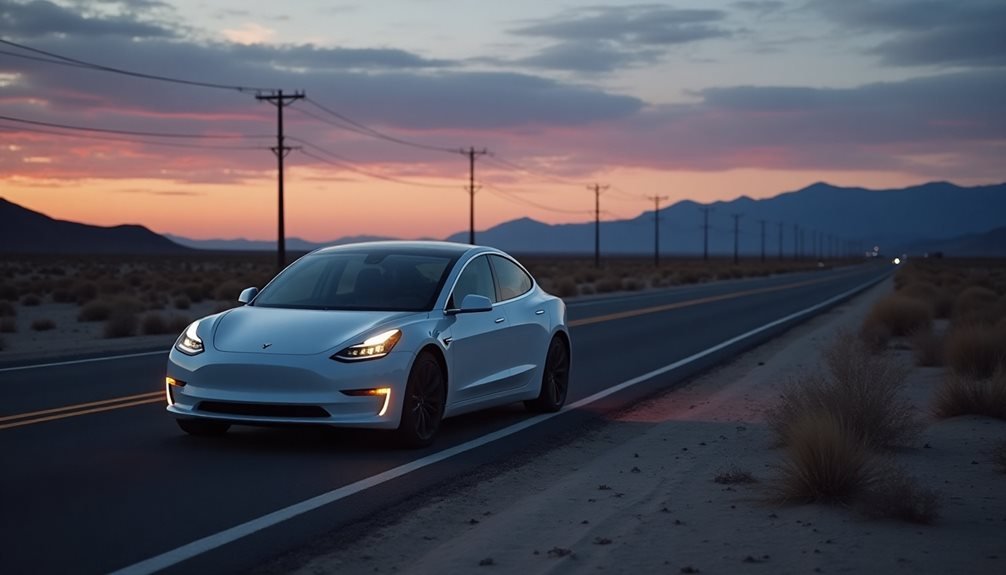
Tesla batteries don’t die dramatically like smartphones that suddenly shut off at 20%. Instead, they give you plenty of warning before leaving you stranded on the highway like a confused tourist.
The car starts throwing warning messages at you well before complete depletion. Reduced acceleration kicks in first. Then ranging alerts appear on your screen, basically telling you to find a charger immediately or prepare for an embarrassing phone call. The vehicle systematically limits power output as the battery drains, giving you time to pull over somewhere safe.
When the battery finally gives up, you won’t be trapped inside like some dystopian nightmare. The doors still work. Hazard lights keep flashing. Essential systems remain functional for a while thanks to reserved power that prevents the car from completely bricking itself. Smart engineering, really.
Once you’re officially dead on the road, pull to safety and engage those hazard lights. Avoid sudden movements unless you enjoy the thrill of manual steering.
Contact Tesla roadside assistance or call a tow truck, because self-recovery isn’t happening. Your two-ton paperweight needs professional help. Mobile charging services can provide enough power to reach the nearest charging station if mobile EV charging is available in your area. In some cases, if you manage to get your vehicle to a charging station, you may still encounter issues getting it to charge. This is where troubleshooting tesla charging issues becomes essential to ensure you can safely recharge your vehicle. Be sure to check all connections and potential error messages displayed on the dashboard for guidance.
Charging from completely empty takes patience you probably don’t have. Full recharge via Level 2 charging requires 12 to 24 hours. Partial charging might restore limited mobility within one to two hours, assuming you can find a charger and don’t mind sitting around feeling foolish.
The good news? Tesla batteries retain about 80% capacity after 200,000 miles on average. European drivers reach this milestone sooner at around 150,000 miles despite typically driving fewer annual miles than their American counterparts. A 2022 Model 3 LFP achieved only 5% degradation at 110,000 miles. These batteries are surprisingly resilient when treated properly.
Capacity loss accelerates beyond 100,000 miles but typically stays under 20% for most drivers. Tesla’s 8-year warranty guarantees 70% capacity retention, so complete battery failure within warranty periods is rare. Performing battery calibration annually can help maintain accurate range readings and optimize overall performance.
Owners report high satisfaction with battery performance during covered years.
The reality is that running completely out of battery requires serious negligence or terrible planning. The car gives you multiple warnings, and charging infrastructure keeps expanding. Most people never experience complete depletion unless they’re deliberately testing limits or ignoring obvious warning signs.
Frequently Asked Questions
How Much Does It Cost to Tow a Dead Tesla?
Towing a dead Tesla varies wildly depending on warranty status and distance. Basic warranty covers the first 50 miles, then owners pay around $6 per mile after that.
A 200-mile tow? That’s $1,200 out of pocket. Extended warranty holders get up to 500 miles free, which is actually decent.
No warranty means paying full freight for everything, and flatbed service isn’t cheap.
Can You Push a Tesla if the Battery Dies?
Pushing a dead Tesla is technically possible but requires activating tow mode first.
The owner needs to access the dimmed touchscreen and manually enable tow mode, which releases the parking brake and shifts to neutral.
However, these cars weigh around 3,800 pounds. That’s a lot of metal to move.
Multiple people would be needed, and it’s frankly unsafe on busy roads.
Short distances only.
Will Tesla Insurance Cover Running Out of Battery?
Nope, Tesla insurance won’t cover running out of battery. The company clearly states that battery depletion isn’t a covered event under their policies.
Insurance only kicks in for accident, fire, or theft-related battery damage. Running out of juice? That’s on the driver.
They’ll need to call Tesla service or roadside assistance and pay out of pocket for recovery services.
How Long Does Emergency Roadside Assistance Take for Teslas?
Tesla roadside assistance typically takes 29-39 minutes in areas like Fairfax, Virginia. But that’s just one location. Response times vary wildly depending on where someone’s stranded, weather conditions, and how many tow trucks are actually available.
Emergency situations get priority, obviously. There’s no universal guarantee across all regions. Rural areas? Good luck.
Urban centers usually fare better, but traffic can still mess things up.
Can a Dead Tesla Battery Damage the Car’s Electronics?
A dead Tesla battery rarely damages the car’s electronics permanently. The battery management system actually shuts things down before reaching true zero to protect itself.
Sure, you’ll need Tesla’s proprietary tools and likely a tow to get diagnosed and recharged. But single deep discharges don’t typically fry the lithium-ion cells or cause lasting electronic damage.
It’s more inconvenient than catastrophic.