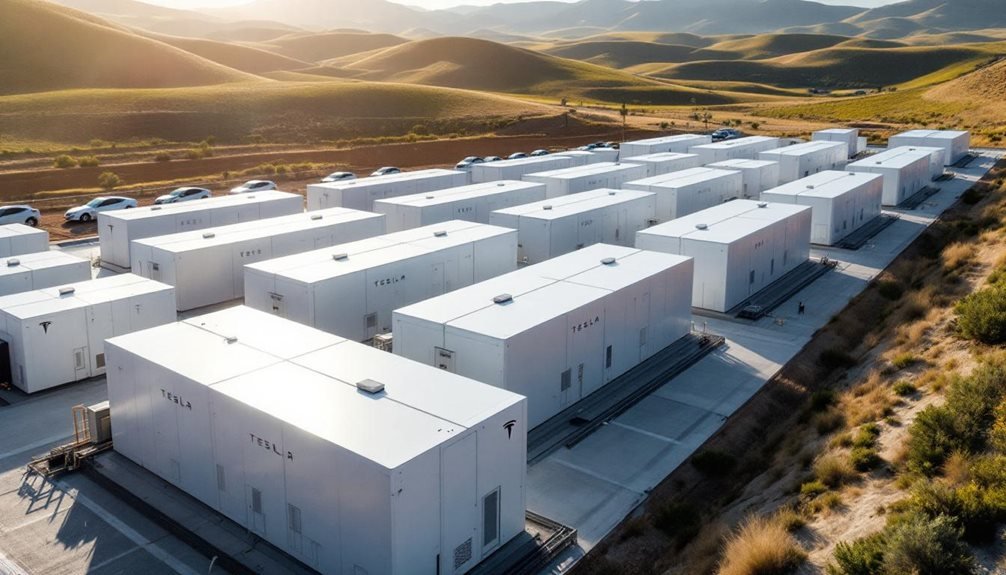

While Tesla’s car sales have been struggling, the company’s battery business is providing a bright spot. The energy storage division brought in $2.73 billion during the first quarter of 2025, jumping 67% from the previous year. This growth came from strong demand for Tesla’s Megapack grid-scale batteries and Powerwall home systems.
Tesla’s energy storage division surged 67% to $2.73 billion, offsetting declining car sales with booming Megapack and Powerwall demand.
The timing couldn’t be better for Tesla. Car revenue dropped 16% in the same period, and the company’s overall profits fell 71% in the first quarter. Without the battery business, Tesla’s financial landscape would’ve looked much worse. The energy segment helped offset these losses, along with Tesla’s services division, which grew 17% to reach $3.05 billion.
Tesla’s Megapack system has become a major revenue driver. The company utilized 10.4 gigawatt-hours of these grid-scale batteries in the first quarter alone. Utilities and commercial customers worldwide are buying these systems to store renewable energy. Meanwhile, homeowners are purchasing Powerwall units to protect against power outages and store solar energy. The Powerwall systems are proving particularly attractive as homes with solar plus battery installations can see resale values increase by approximately $125,000.
The success hasn’t been without challenges. Revenue from energy storage fell 7% year-over-year in the second quarter, though it stayed steady compared to the first quarter. More concerning are new U.S. tariffs on Chinese batteries, which jumped to 145%. These tariffs could create supply problems and push prices higher, since Tesla relies on imported battery components.
Tesla’s trying to reduce its dependence on outside suppliers. The company’s building lithium refining and cathode plants that should start production in 2025. These facilities will help Tesla control more of its battery supply chain and potentially lower costs. The company plans to produce its first in-house LFP cells in 2025 specifically for stationary storage systems.
Competition in the energy storage market is heating up, with other companies fighting for grid contracts. This pressure could squeeze Tesla’s pricing power. The company also faces ongoing struggles in its car business, with automotive revenue dropping 9% in the first quarter and total revenue falling 12% in the second quarter. Meanwhile, Tesla’s brand has suffered from public backlash and vandalism incidents targeting vehicles and dealerships due to Musk’s controversial political involvement.
Despite these headwinds, clean energy adoption and growing demand for grid storage continue to drive customer interest. Tesla’s battery business has become essential to the company’s financial health, proving that diversification beyond cars was a smart move.